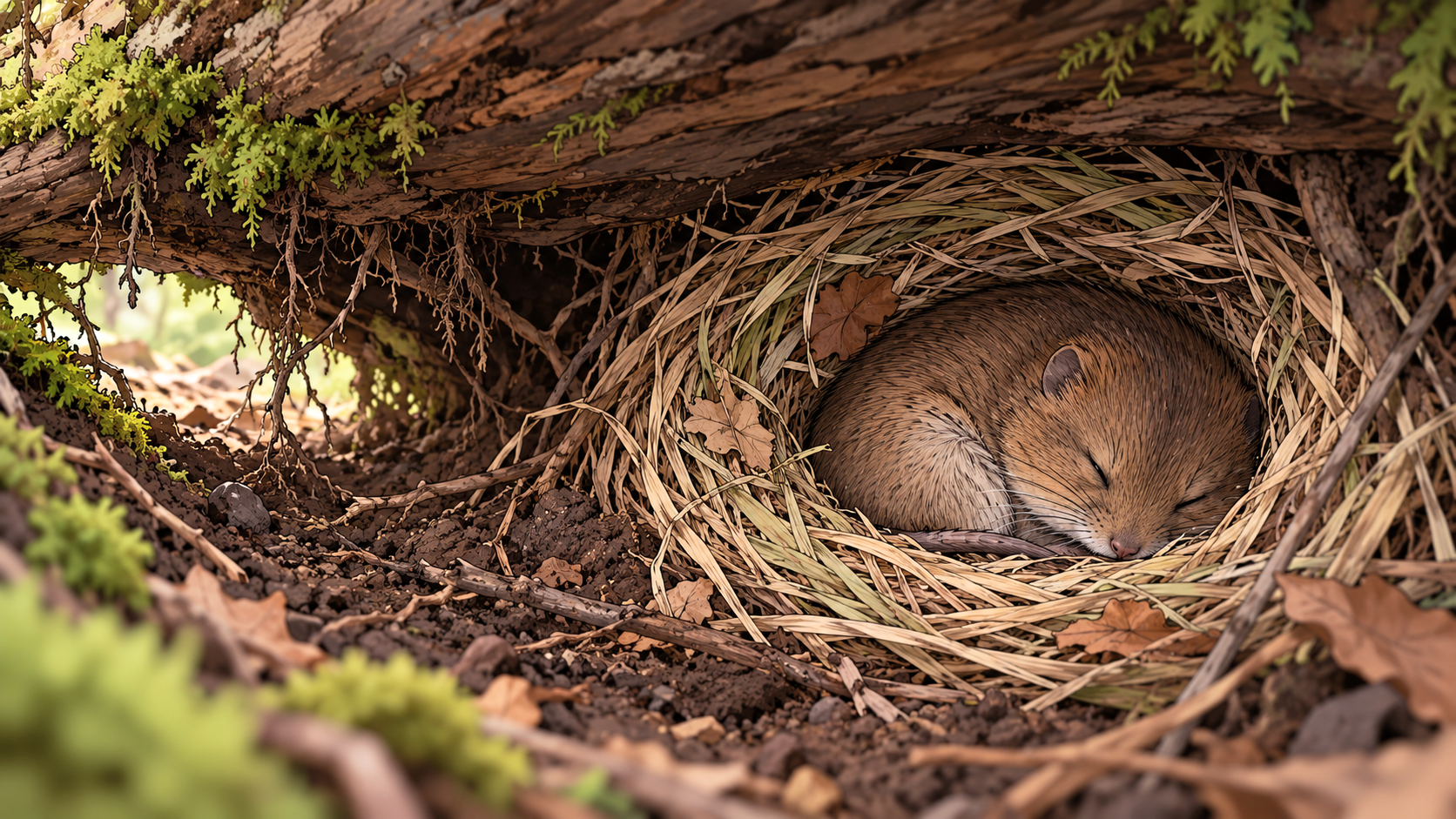
A vole nest is a rounded, tightly arranged bundle of dried grass, stems, leaves, and other soft vegetation, usually hidden underground or beneath dense ground cover. Depending on the species, it may resemble a small ball of woven grass or a compact cup of shredded plant fibers inside a shallow chamber. Voles use these sheltered spaces for resting, protection from weather, and raising their young.
Unlike a bird’s nest, a vole nest rarely sits somewhere easily visible. It may be concealed beneath a log, inside a clump of grass, or within a burrow. The animal’s nesting habits also vary considerably between meadow voles, which frequently use surface-level shelter, and woodland voles, which spend more time underground.
What Does the Inside of a Vole Nest Look Like?
A typical vole nest has a rounded outer structure made from dry vegetation, with a softer interior where the animal rests. Grass blades, shredded stems, leaf fragments, and fine plant fibers are arranged into a sheltered cavity rather than left as a random pile.
Meadow voles construct roughly globe-shaped nests of dried plant material, often measuring approximately 6–8 inches across. Other descriptions place meadow vole nests at about 3–5 inches in diameter. These differences reflect variation in the nests examined and the conditions in which they were built.
The interior is generally compact and insulated. The surrounding vegetation helps retain warmth while keeping the occupant concealed from predators. Some nests have recognizable openings connecting the resting cavity with nearby passages, although these may not be obvious until the surrounding material is disturbed.
Woodland voles construct similarly rounded nests, but their nesting material commonly includes dead grasses, leaves, and fine root fibers. An underground nest may look less like a freestanding ball because the surrounding soil already provides structural support.
The presence of a rounded grass bundle is not sufficient for identifying a vole nest. Other small mammals also arrange plant fibers into sheltered resting places. Nearby animal evidence and the nest’s location provide additional context.
Where Are Vole Nests Usually Hidden?
A vole’s preferred nesting location depends partly on whether it belongs to a species that commonly travels along the surface or spends more time tunneling underground.
Meadow voles may construct nests in grassy clumps, shallow underground chambers, or protected spaces beneath logs, boards, rocks, and other ground-level objects. Their nesting sites frequently occur beneath existing shelter, where the surrounding vegetation or material conceals the structure.
Woodland voles rely more heavily on underground chambers. Their nests are commonly associated with shallow subterranean passages, although some occur beneath logs or among tree roots. In Canadian woodland vole populations, underground nests have been associated with tree bases and coarse woody debris.
The following locations are consistent with documented vole nesting behavior:
| Location | Nesting significance |
|---|---|
| Dense grass clumps | Conceals surface-level nests |
| Shallow underground chambers | Provides protected resting space |
| Beneath logs or fallen wood | Supplies overhead shelter |
| Under old boards or similar objects | Offers cover close to the ground |
| Among tree roots | Provides protected underground spaces |
| Beneath winter snow | Can shelter temporary surface nests |
These are potential nesting locations, not proof that a vole occupies every sheltered space. The types of habitat used by voles are broader than the specific locations selected for resting or reproduction.
Meadow Vole Nests vs. Woodland Vole Nests
The clearest difference between these two commonly encountered voles is where their nests are usually situated, rather than a dramatic difference in nesting materials.
Meadow voles construct grass nests in shallow chambers or sheltered places near the surface. Their nesting areas can connect with the narrow runways visible through dense vegetation, although the nest itself may remain concealed.
Woodland voles more commonly construct nests within underground passage systems. Their nests are typically rounded structures approximately 5–8 inches across, lined with dry grasses and fine roots.
Prairie voles provide another example of variation. In a historical field investigation, fifteen prairie vole nests were discovered 6–18 inches underground. The cavities were roughly rounded, with dried grass forming much of the nesting material. The documented prairie vole nest chambers measured approximately 150–200 millimeters horizontally and 80–100 millimeters vertically.
These differences help explain why finding a small grass nest just below the surface does not establish which vole species built it. Nest depth and appearance vary, and the identification of vole holes and burrows involves separate evidence from the nest itself.
Do Voles Sleep Underground or Above Ground?
Voles sleep and rest in protected nesting spaces, which may be underground or at ground level depending on the species and available shelter. They do not need to remain inside a single permanent sleeping chamber throughout their lives.
The nest provides a more protected environment than an exposed runway. Meadow voles use woven grass nests for resting, protection from weather, and raising young. Woodland voles commonly rest within their underground systems, where surrounding soil and plant material provide additional concealment.
A sleeping vole is therefore unlikely to be visible on an open lawn. Even when the animal uses a nest at the surface, vegetation or another object usually hides the resting space.
Finding an empty nest does not necessarily mean the animal has abandoned the property. A vole may use different sheltered locations, and an exposed nest can represent an earlier resting or breeding site rather than current activity.
Do Voles Build Special Nests for Their Babies?
Females use sheltered nests to give birth and care for their young. The woven structure provides insulation and a protected place for newborns that are initially hairless, blind, and unable to regulate their surroundings as effectively as older animals.
Woodland vole females construct rounded nests lined with shredded vegetation for their offspring. Meadow vole nests similarly function as nurseries during the period when pups remain dependent on their mothers.
The appearance of newborn and juvenile voles changes rapidly after birth, but the earliest developmental stages are closely associated with the nesting chamber.
A nest containing young should not automatically be considered abandoned simply because the mother is absent when discovered. The adult may be away temporarily or avoiding the disturbance.
If a nest is accidentally exposed during gardening, avoid unnecessary handling and keep people and pets away. The appropriate response to an exposed or injured baby vole depends on whether the young are injured, dependent, and capable of being reunited with their mother.
Do Voles Make Nests Under Snow?
In regions with persistent winter snow, meadow voles can construct temporary nests at ground level beneath the snowpack. The snow provides overhead insulation and concealment, allowing the animals to occupy locations that would otherwise be exposed.
These nests are not necessarily permanent. Aboveground winter nests may be abandoned as the snow melts, leaving behind flattened vegetation or nesting material.
An exposed grass bundle discovered during spring cleanup may therefore be the remains of a winter nest rather than evidence of current occupation. The conditions affecting voles beneath winter snow can make their activity difficult to observe until the snow retreats.
The nest’s location is also important when interpreting discoveries after snowmelt. Material resting directly on the soil may once have been enclosed by snow even though it appears completely exposed when found.
How Can You Recognize a Vole Nest Without Disturbing It?
A convincing identification combines the nest’s shape, materials, sheltered location, and surrounding animal evidence. A compact ball of dried grass beneath dense vegetation is consistent with vole nesting, but the same materials may be used by other small mammals.
The strongest supporting evidence comes from a clearly identified vole seen entering or leaving the site. Nearby pellets or worn vegetation may support the assessment, but neither feature alone proves that the structure is an active nest. The appearance of vole droppings is particularly easy to confuse with waste from other small rodents.
Avoid pulling apart suspected nests simply to confirm their contents. Doing so may expose dependent young, disturb a resting animal, or bring you into contact with contaminated vegetation.
If the nest is already visible, photograph it in place, including the surrounding shelter and a nearby object for scale. A rounded structure of dry grasses beneath a log or within a shallow chamber is consistent with vole nesting, but reliable species identification may require additional evidence.