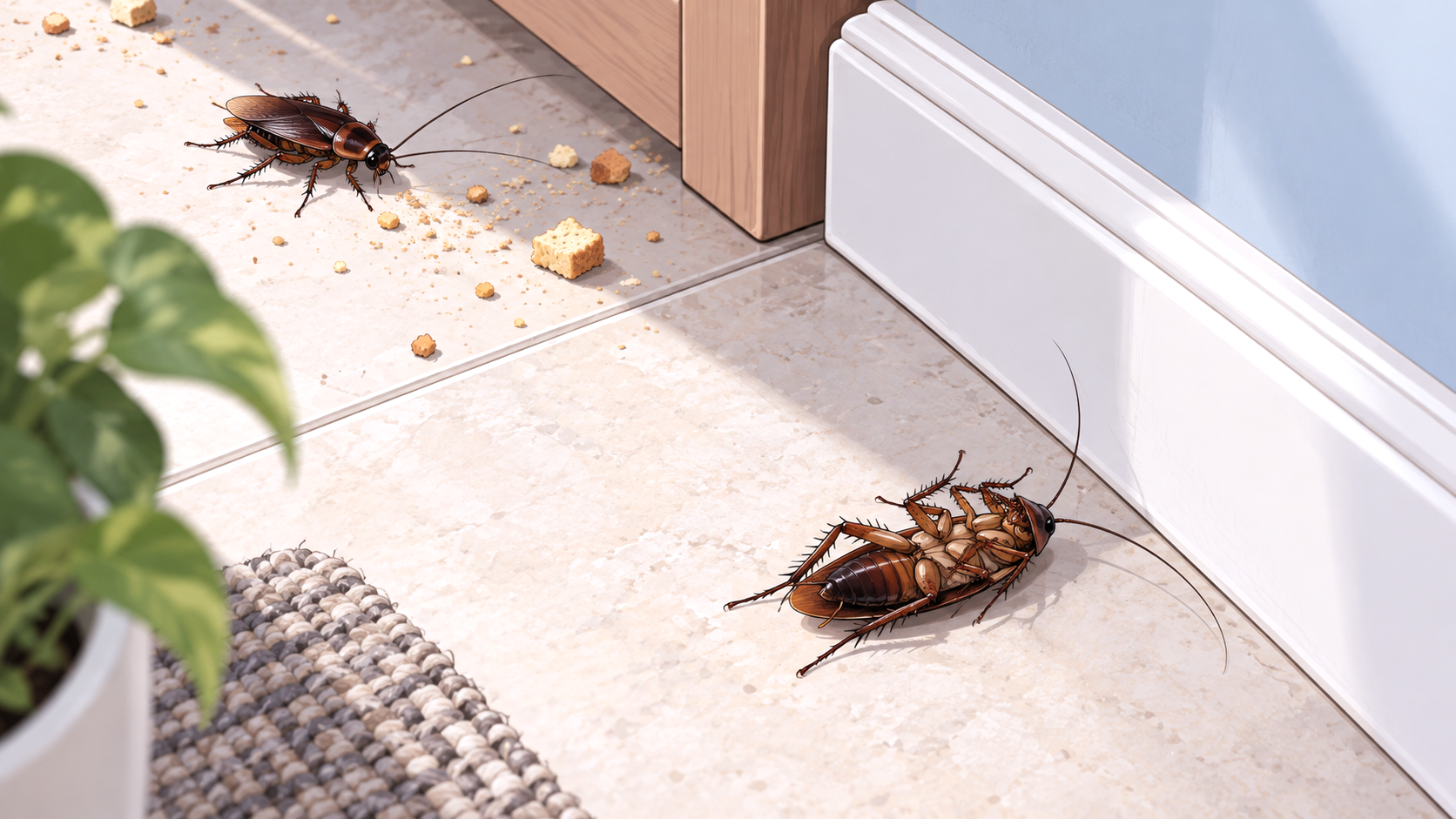
Killing a cockroach does not automatically attract more cockroaches. In fact, some cockroaches avoid chemicals associated with dead members of their species, particularly compounds released from damaged or decomposing bodies. However, cockroaches may also investigate carcasses as potential food, and certain chemical residues around a dead insect can influence their behavior. The outcome depends on the species, the condition of the carcass, and its surroundings. There is no good evidence that crushing a household cockroach releases a universal alarm or attraction signal that summons other cockroaches into the room.
Dead Cockroaches Can Release Chemicals That Repel Others
American cockroaches (Periplaneta americana) provide particularly strong evidence against the belief that dead cockroaches invariably attract more.
In a study published in Environmental Entomology, researchers found that chemical extracts from American cockroach bodies repelled other cockroaches from resting shelters. The effect occurred in both sexes and different developmental stages, and the extracts also repelled several other cockroach species.
The researchers observed avoidance of intact and ruptured carcasses. Their investigation of chemical signals associated with dead American cockroaches found no evidence that living cockroaches released the same repellent as an alarm pheromone.
The compounds were associated with unsaturated fatty acids, which can become exposed or released when an insect dies. Researchers have proposed that recognizing such substances helps surviving insects avoid locations where another individual may have encountered danger.
A broader scientific review of corpse recognition in insects identifies oleic acid as one chemical associated with avoidance of dead American cockroaches.
These experiments demonstrate a repellent response under specific conditions. They do not establish that every cockroach species avoids all dead individuals, or that leaving carcasses around a house will prevent infestation.
Why Other Cockroaches Might Still Approach a Dead One
The presence of a carcass does not always result in avoidance. German cockroaches (Blattella germanica), for example, respond to multiple signals associated with other cockroaches, including physical contact, chemical residues, and familiar shelter conditions.
A 2019 study published in Environmental Entomology tested whether young German cockroaches preferred shelters containing a dead adult female. The nymphs showed a preference for shelters containing the dead female even after certain surface hydrocarbons had been removed.
However, adding purified cuticular hydrocarbons did not increase the attraction. The findings indicate that the response involved something beyond the particular surface chemicals being investigated.
This experiment does not prove that a freshly killed cockroach releases an airborne substance that attracts insects from elsewhere. The nymphs were choosing between nearby experimental shelters, and the researchers were examining shelter preferences rather than long-distance attraction to a newly crushed insect.
Similarly, the chemical cues involved in cockroach grouping include substances deposited while insects are alive. Finding several cockroaches near a carcass does not establish that death brought the others there.
A dead insect inside an established resting area may simply be surrounded by cockroaches that already occupied the location.
Do Cockroaches Eat Dead Cockroaches?
Cockroaches are capable of scavenging dead members of their own species, a behavior called necrophagy. Nevertheless, carcasses are not necessarily preferred food, and scavenging should not be confused with attraction caused by killing an insect.
A laboratory study published in Medical Entomology and Zoology offered German cockroaches ordinary mouse food, dried cockroach carcasses, and dried feces. The insects generally preferred mouse food, followed by the carcasses, while showing little interest in eating the feces. The research on cockroach necrophagy demonstrates that dead insects can be consumed without establishing that cockroaches actively seek freshly killed individuals.
Food availability and environmental conditions influence scavenging. During a field investigation of Turkestan cockroaches, researchers observed trapped insects being dismembered and consumed by other cockroaches. The University of California’s field report described this behavior while examining population control using insecticidal baits.
Laboratory research has also documented contact with and consumption of dead German cockroaches following insecticide exposure. A 2023 study published in the Journal of Economic Entomology investigated how insecticides could move between cockroaches through several possible pathways, including contact with remains and consumption of contaminated material.
These observations establish that carcasses can become part of the insects’ feeding environment. They do not demonstrate that crushing one cockroach increases the number entering a building.
Does Crushing a Cockroach Release an Attraction Pheromone?
The claim that crushing a cockroach releases a special pheromone that summons other cockroaches is not supported by convincing evidence.
Cockroaches produce different chemical signals for different biological purposes. Some compounds influence shelter selection, others participate in reproduction, and certain substances associated with dead bodies can cause avoidance. These signals should not be treated as interchangeable.
For instance, German cockroach feces contain aggregation-related compounds that can encourage other individuals to settle nearby. Researchers identified numerous volatile carboxylic acids associated with bacteria in the insects’ digestive systems. Their study of gut bacteria and cockroach aggregation signals established that fecal chemical mixtures influence grouping behavior.
Crushing an insect could release gut contents along with other body fluids, but the presence of potentially attractive substances does not prove that the resulting mixture attracts cockroaches. It may also contain chemicals associated with injury or death that produce a different response.
There is no established evidence that the smell produced by crushing a cockroach functions as a reliable recruitment signal. The odor associated with cockroach secretions and accumulated waste should not be confused with a proven attraction pheromone released upon death.
Why You Might See More Cockroaches After Killing One
Several cockroaches appearing in the same location over a short period can create the impression that killing the first one attracted the others.
A more straightforward explanation is that the insects were already occupying or visiting the surrounding area. A kitchen with accessible resources and sheltered spaces may support repeated activity whether or not one cockroach is killed.
The distances cockroaches travel during ordinary activity can bring different individuals through the same opening or along the same surface. Seeing another insect after removing the first does not establish a chemical connection between those events.
Some cockroaches may investigate a dead insect or its remains, particularly when scavenging opportunities are available. Others may avoid the carcass. Without observing their behavior before and after the insect’s death under controlled conditions, their presence alone cannot identify the cause.
The distinction is important when interpreting a household sighting. Finding another cockroach near a recently killed one provides evidence that cockroaches are active in that location, not proof that the killing attracted them.
Should You Leave a Dead Cockroach Where It Is?
No. Even though some dead-cockroach chemicals can repel other cockroaches, leaving carcasses around the house is not a dependable control strategy.
Dead insects can become scavenging material, accumulate alongside existing contamination, and contribute to insect-related allergens. Their potential repellent effect under experimental conditions does not make them useful household deterrents.
The U.S. Environmental Protection Agency recommends vacuuming cockroaches, egg cases, and droppings as part of integrated pest management. It specifically recommends HEPA-filtered equipment to reduce airborne allergens during cleaning.
For an individual dead cockroach, a practical disposal method is to pick it up with a paper towel or gloves, place it in a sealed bag, and discard it in a covered trash container. Wipe the affected surface with an appropriate household cleaner, particularly if visible material remains.
Avoid handling the insect with bare hands, and wash your hands afterward. If remains are close to food-preparation surfaces, remove any contamination before using those surfaces again.
The CDC’s guidance on reducing cockroach-related asthma triggers also recommends regularly cleaning areas where cockroaches may be present and keeping household waste contained.
Disposing of one carcass does not require an extensive cleaning operation. The purpose is to remove the insect, any visible residue, and the unnecessary source of contamination.
Can Dead Cockroaches Be Used to Repel Live Ones?
Despite the experimental evidence of avoidance, placing dead cockroaches around a room is not an effective or recommended repellent method.
The American cockroach experiments used controlled concentrations of body extracts and particular shelter arrangements. The results cannot be translated into a predictable household effect simply by leaving a dead insect beneath a cabinet.
Chemical changes after death, differences among species, and the presence of other materials can alter the response. A carcass may also be encountered as potential food rather than avoided.
The most useful implication of the research is biological: cockroaches can detect substances associated with death, and those substances may affect their behavior. It does not establish a practical method for preventing other cockroaches from entering a room.
If more cockroaches appear after one has been killed, the University of California’s cockroach monitoring recommendations favor identifying ongoing activity with strategically placed monitors rather than relying on carcasses as chemical deterrents.