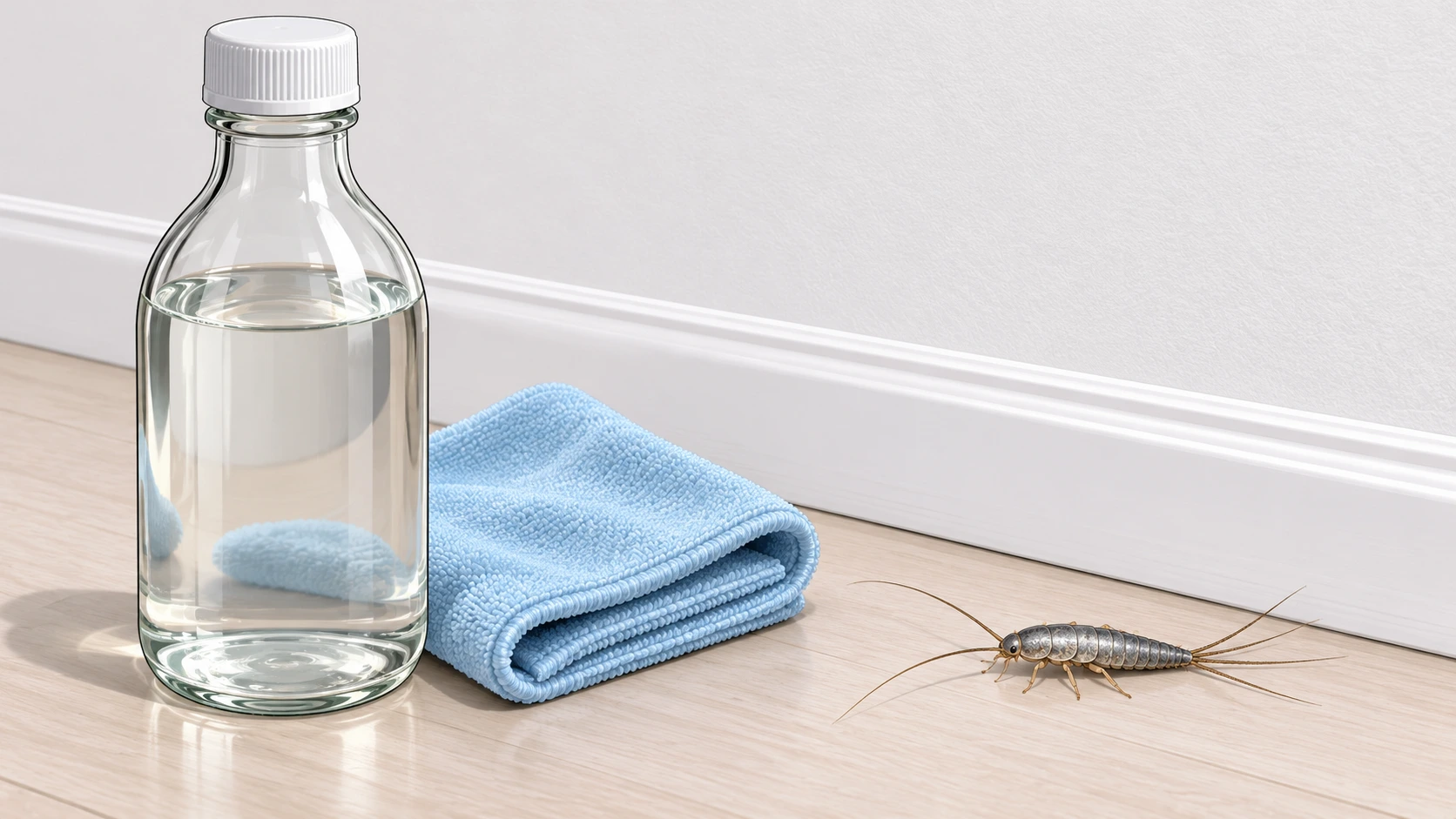
Household vinegar is not a reliable way to kill silverfish or eliminate an infestation. Its acetic acid can affect organisms under sufficient exposure, but ordinary kitchen vinegar has no established silverfish treatment concentration, application method, or contact time. Spraying it around a room may clean some surfaces, but it does not provide dependable control of insects hiding behind baseboards, inside cabinets, or within wall cavities.
Vinegar is frequently recommended as a natural household pest remedy because it is inexpensive and already available in many kitchens. Its cleaning properties are also familiar, which makes it tempting to use against insects discovered around sinks, bathrooms, and storage areas.
The difficulty is that cleaning a surface and killing the insects living around it are different outcomes. A silverfish that escapes before receiving direct exposure is unaffected by the cleaning, while others concealed nearby may never encounter the liquid. We would not recommend buying vinegar specifically for silverfish control or relying on repeated vinegar applications to solve an infestation.
What Happens When Vinegar Comes Into Contact With a Silverfish?
Vinegar contains acetic acid, a chemical responsible for its characteristic sour smell and acidic properties. Ordinary white household vinegar is commonly around 5% acetic acid, although commercial formulations vary.
Acetic acid can damage biological tissues at sufficiently high concentrations. However, its effects depend on the concentration, exposure, and organism involved.
Silverfish have a protective external skeleton called an exoskeleton. Their outer covering helps protect the insect and limits moisture loss. Applying a household vinegar solution to that surface does not establish that the insect will receive a lethal dose or that the liquid will penetrate sufficiently to cause death.
A direct spray may wet or disturb an exposed silverfish. It may also affect an insect through chemical exposure under particular conditions. Neither observation establishes an effective silverfish insecticide.
There is no established household-vinegar application protocol that specifies a proven concentration and contact time for reliably killing silverfish.
The chemical and safety information on acetic acid explains its presence in vinegar and other household products, including cleaners and sanitizers. Its familiar use in food and cleaning should not be interpreted as proof of insecticidal effectiveness.
Does White Vinegar Kill Silverfish Better Than Apple Cider Vinegar?
There is no established evidence that white vinegar or apple cider vinegar provides dependable silverfish control simply because of its color, smell, or source.
White vinegar is generally a relatively straightforward aqueous acetic acid solution. Apple cider vinegar contains additional substances associated with fermented apple products, but that does not establish a silverfish-killing advantage.
The actual acetic acid concentration matters more than the name on the bottle when considering its chemical strength.
| Vinegar type | General characteristics | Silverfish-control verdict |
|---|---|---|
| White distilled vinegar | Common household cleaning and cooking vinegar | Not a verified silverfish treatment |
| Apple cider vinegar | Fermented apple-based vinegar | No established advantage against silverfish |
| Cleaning vinegar | May contain a higher acetic acid concentration than ordinary kitchen vinegar | Greater concentration does not establish silverfish efficacy |
| Concentrated acetic acid | Stronger chemical formulations used for specialized purposes | Not an appropriate homemade silverfish treatment |
A product with a higher acid concentration also requires greater caution. Stronger acetic acid can cause skin burns and serious eye injury.
The National Pesticide Information Center’s acetic acid safety guidance explains how increasing acid concentration changes exposure risks. Some concentrated products are corrosive, making them particularly unsuitable for casual household experimentation.
We would not substitute cleaning vinegar or concentrated acetic acid for an ordinary insecticide.
Does Vinegar Repel Silverfish?
Vinegar has a strong smell, but there is no reliable basis for treating that smell as a dependable silverfish repellent.
An exposed insect may move away when disturbed by liquid or a newly introduced odor. That response does not establish that silverfish consistently avoid vinegar-treated surfaces or that applying vinegar creates a lasting protective barrier.
There is also a practical problem with relying on odor. Vinegar evaporates, and its smell diminishes after application. Even a temporary behavioral response would not establish control of insects sheltering in protected spaces.
Silverfish can continue using suitable hiding places and food sources without crossing the particular surface where vinegar was applied.
This is different from a demonstrated repellent product with an established formulation, target pest, and application directions.
For homeowners considering household scents, the evidence and limitations of natural silverfish repellents deserve separate consideration. A strong household odor should not be mistaken for proof that insects have left the building.
Can Vinegar Kill Silverfish Eggs?
Vinegar should not be relied upon to destroy silverfish eggs.
Silverfish eggs can occur in protected cracks and other concealed locations. A liquid sprayed across an exposed floor or shelf is unlikely to reach every egg deposited elsewhere in the building.
There is no established vinegar concentration or application procedure that guarantees egg destruction. Claims that ordinary household vinegar kills all silverfish eggs should therefore be treated cautiously.
Liquid cleaning products also introduce moisture into places where paper, wood, cardboard, and stored belongings may already be vulnerable.
An empty-looking surface after cleaning does not establish that the insects’ reproductive stages have been eliminated. For accurate identification of the reproductive stage, silverfish egg characteristics are more useful than assuming every small pale object is an egg.
Can You Use Vinegar to Clean Areas Where Silverfish Appear?
Vinegar can have a legitimate cleaning role on compatible household surfaces, but cleaning should not be presented as a complete silverfish treatment.
For example, a suitable vinegar-based cleaning product may remove certain surface residues. Cleaning an accessible shelf or hard surface can also make it easier to inspect for debris and insect activity.
However, vinegar is not appropriate for every material. Its acidity can damage natural stone and certain finishes, while repeated exposure may affect sensitive metals, coatings, and other surfaces.
Before using a vinegar cleaner, check the surface manufacturer’s care instructions. Avoid applying it to materials that may react with acids.
Never mix vinegar with bleach or chlorine-containing cleaners. The combination can release toxic chlorine gas. Do not combine vinegar with other cleaning chemicals in an attempt to increase its pest-control effectiveness.
The EPA’s explanation of pesticide labeling and product claims also makes clear that a substance marketed or distributed for killing or repelling pests can fall under pesticide requirements, depending on its intended use and applicable exemptions.
Cleaning vinegar and a product authorized for insect control are not interchangeable.
Is Spraying Vinegar Around Baseboards a Good Silverfish Treatment?
Spraying vinegar along baseboards is not a dependable way to control silverfish.
Baseboards can conceal narrow gaps that insects use for shelter. A liquid applied to the exposed front of the trim may not reach insects inside those openings.
Repeated spraying also introduces moisture near materials that may already have moisture problems. Wood trim, painted surfaces, flooring edges, and stored belongings can suffer from inappropriate liquid exposure.
The approach can also create a misleading impression of progress. The room may smell strongly of vinegar after application, but that does not demonstrate that silverfish numbers have declined.
If insects repeatedly appear along a baseboard, investigate the accessible opening and the conditions around it. A suitable monitoring trap can provide better information about continuing activity than the smell of a cleaning solution.
Our silverfish removal starting guide explains how to distinguish occasional sightings from activity that warrants more extensive control.
Does Vinegar Have Any Advantages for Silverfish Control?
Vinegar is inexpensive, readily available, and useful for certain household cleaning purposes. Those advantages do not make it an effective silverfish pesticide.
Its actual value depends on the job being performed. Cleaning a suitable surface can remove some accessible residues, but the liquid does not provide dependable insect mortality, residual protection, or egg control.
Household vinegar also creates no established application schedule for silverfish. Reapplying it every few days would simply repeat an unverified treatment while leaving concealed insects untouched.
The distinction between an ordinary cleaner and a pesticide intended to kill or repel insects matters under US pesticide law. The EPA identifies vinegar with a maximum of 8% acetic acid as an eligible inert ingredient in certain minimum-risk pesticide formulations, not as an eligible active ingredient under that federal exemption. A product making pesticidal claims must meet applicable registration requirements or qualify for an exemption on its own terms.
For a homeowner, the practical conclusion is to use vinegar for appropriate cleaning purposes rather than improvising an insecticide application.
What Works Better Than Vinegar Against Silverfish?
When silverfish are appearing repeatedly, the response should focus on confirmed insect activity and the conditions supporting it.
Start by checking accessible hiding places and removing individual insects through physical control. Vacuuming can collect exposed insects and debris around baseboards, shelving, and other accessible edges.
Moisture problems also deserve attention. Repair leaks, address persistent condensation, and improve appropriate ventilation. Excessive moisture can make certain household locations more favorable to silverfish.
For monitoring, suitable crawling-insect traps can help establish where insects remain active. Use products according to their instructions and keep exposed adhesive away from children and pets.
Where a larger infestation requires chemical treatment, select an insecticide whose current label specifically permits silverfish control in the intended location.
Several substances discussed in household silverfish remedies have different evidence and exposure limitations:
- Boric acid: Certain registered formulations are labeled for silverfish, but bait and dust products do not necessarily perform alike. See our examination of boric acid against silverfish.
- Diatomaceous earth: Suitable labeled formulations can work through desiccant action, but contact and dry conditions matter. Its effectiveness against silverfish has different limitations from liquid household cleaners.
- Bleach: Its disinfecting properties do not establish reliable silverfish control. The difference is examined in whether bleach kills silverfish.
Each product needs to be judged by its actual formulation and permitted use, rather than by a general claim that a household substance kills insects.
The Verdict on Using Vinegar Against Silverfish
Vinegar is useful for certain household cleaning tasks, but it is not a dependable way to kill silverfish or repel an infestation. Ordinary white and apple cider vinegar have no established household silverfish-control procedure, and their strong smell does not provide reliable protection against insects returning to treated areas.
There is also no verified vinegar treatment for eliminating silverfish eggs. Spraying baseboards, shelves, or floors can leave concealed insects unaffected while introducing moisture or damaging incompatible surfaces.
We would keep vinegar in its intended cleaning role. When silverfish are present, physical monitoring, correction of moisture problems, and appropriately labeled pest-control products provide a more defensible response than repeatedly spraying a household acid.