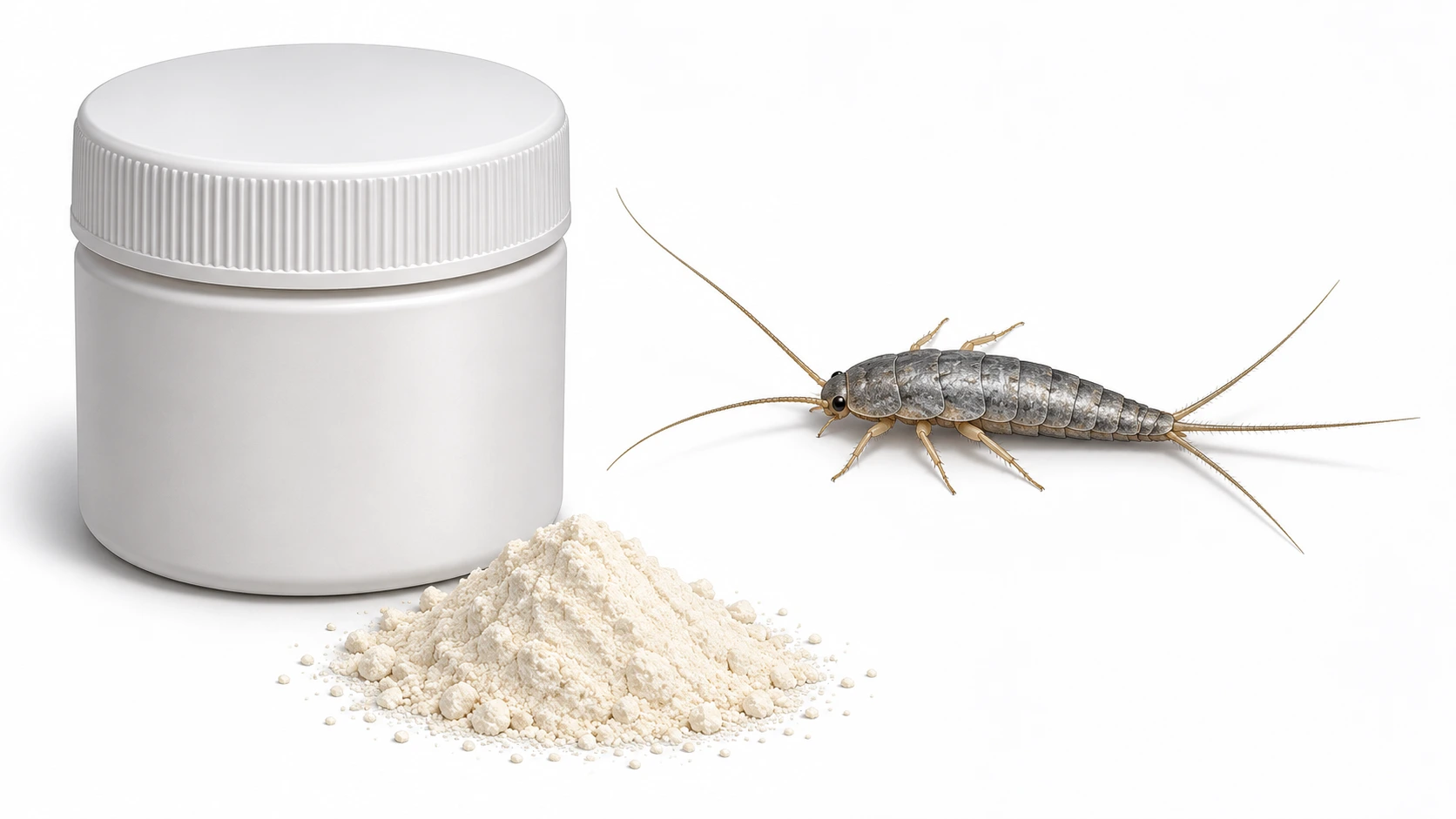
Diatomaceous earth can kill silverfish by damaging the protective outer layer of their bodies and causing them to lose moisture. Its effectiveness depends on direct contact, suitable formulation, and sufficiently dry conditions. Silverfish that remain inside untreated hiding places may never encounter the powder, while moisture can cause deposits to cake and become less effective.
Diatomaceous earth is popular among homeowners looking for a pesticide that works differently from conventional insecticides. It is made from the fossilized remains of microscopic aquatic organisms called diatoms and contains silica.
The powder does not need to poison an insect through ingestion to work. Its desiccant action makes insects vulnerable to dehydration, provided they encounter the material.
There are important limitations, particularly in damp rooms and occupied living spaces. The type of diatomaceous earth also matters because food-grade material has not necessarily undergone the evaluation required of a registered pest-control product.
How Does Diatomaceous Earth Kill Silverfish?
Diatomaceous earth works through physical and moisture-related effects on an insect’s outer covering.
Silverfish have an external skeleton called an exoskeleton. Its outer cuticle contains a protective layer of lipids that helps limit water loss from the insect’s body.
When a silverfish crawls through suitable diatomaceous earth, particles can attach to its body, absorb protective lipids, and abrade the cuticle. The increased permeability allows more moisture to escape, eventually causing dehydration and death.
This process is called desiccation.
The National Pesticide Information Center’s explanation of diatomaceous earth describes how the material absorbs oils and fats from insect cuticles, while its abrasive properties can contribute to damage. The dust does not need to act as a conventional chemical poison to affect an insect.
A 2024 scientific study examining diatomaceous earth against red flour beetles provided additional physiological evidence for this mechanism. Researchers measured increased water loss and changes in the permeability of treated insects’ cuticles. The study was conducted on beetles, so its experimental results should not be presented as a silverfish-specific mortality trial. Nevertheless, it supports the underlying desiccant mechanism.
Does Diatomaceous Earth Work on Silverfish Specifically?
Diatomaceous earth is an established control option for silverfish when an appropriate formulation is used and insects encounter the treated material.
Health Canada’s household pest guidance describes diatomaceous earth as a physical control for silverfish and firebrats. It explains that the abrasive powder damages the insect’s outer protective covering, leading to moisture loss and death. The guidance also identifies locations around baseboards and beneath or behind appliances as possible treatment areas, subject to appropriate product instructions.
The Canadian silverfish and firebrat control guidance supports the use of diatomaceous earth for crawling-insect control, while emphasizing the need to avoid breathing the dust.
There is also a useful distinction between general evidence about diatomaceous earth and an individual product’s authorization. For example, an EPA-accepted 2021 label for Harris Diatomaceous Earth Crawling Insect Killer lists silverfish among its target pests. Its active ingredient is diatomaceous earth containing silicon dioxide. The EPA-accepted product label also includes precautionary statements and application restrictions.
That example demonstrates that appropriately formulated diatomaceous earth products can be labeled for silverfish. It does not mean every bag of diatomaceous earth has the same authorization or performance.
Why Silverfish Must Come Into Contact With the Powder
Diatomaceous earth does not travel through a house looking for insects. It can only affect silverfish that encounter the treated material.
This limits its usefulness when insects are concealed behind baseboards, inside wall cavities, or beneath inaccessible building materials.
A silverfish moving between its hiding place and a feeding area may encounter a suitable treated location. Another insect occupying an entirely separate void may never come into contact with it.
The amount of contact also matters. An insect that briefly crosses a location with little accessible powder may receive a different exposure from one that travels through a suitable treated area.
This is why the location and condition of a pesticide deposit matter more than simply having the powder somewhere in the room.
An exposed pile of powder on an open floor does not establish that the insects have encountered an effective treatment. It may also create unnecessary opportunities for people and pets to disturb and inhale dust.
Why Moisture Makes Diatomaceous Earth Less Effective
Moisture is one of the main limitations of diatomaceous earth.
The material works best when it remains dry and capable of interacting with the insect’s protective surface. When a deposit becomes wet, its particles can cake together as the material dries.
Caked powder becomes more difficult for crawling insects to pick up. That reduces the opportunity for contact and can interfere with the intended desiccant action.
The University of California’s silverfish and firebrat management recommendations specifically explain that diatomaceous earth can remain effective in dry locations, while deposits that become wet and subsequently dry may cake and become difficult for insects to pick up.
The room’s moisture conditions therefore matter when evaluating a treatment.
Bathrooms with recurring condensation, leaking plumbing areas, and damp basements can be poor environments for maintaining an undisturbed dust deposit. Correcting the water source is more useful than repeatedly adding powder to an area where it keeps getting wet.
The relationship between humidity and silverfish activity also matters. The effect of dehumidifiers on silverfish explains why reducing excessive moisture can support broader household control, although humidity reduction alone does not guarantee elimination.
Does Food-Grade Diatomaceous Earth Kill Silverfish?
Food-grade diatomaceous earth may have physical properties capable of affecting insects, but its food-grade designation does not establish that it is an appropriate or safe household pesticide.
Food-grade products and registered pest-control formulations are not necessarily evaluated in the same way. They may differ in composition, specifications, labeling, and intended use.
The National Pesticide Information Center explicitly cautions against assuming that food-grade diatomaceous earth is suitable for pest control. Some food-grade products have not been evaluated for pest-control effectiveness or exposure risks, and their packaging may not provide the application instructions and precautions needed for household use.
Its food-grade diatomaceous earth safety explanation, updated October 26, 2026, emphasizes choosing a product with a pesticide label rather than assuming that a food-related designation establishes safety.
This matters because spreading dust throughout a home can create substantial opportunities for inhalation.
The term food grade does not mean that airborne particles are harmless to breathe or that unrestricted household application is appropriate.
Can You Use Any Type of Diatomaceous Earth Against Silverfish?
Different diatomaceous earth products are manufactured for different purposes. The material’s processing and composition can affect its suitability.
Pesticide-labeled diatomaceous earth is formulated and labeled for specified pest-control uses. Check that silverfish are included among the target pests and that the intended indoor application site is permitted.
Food-grade diatomaceous earth is manufactured for a food-related purpose. Its designation does not establish that it has been evaluated or authorized for household silverfish control.
Pool-filter diatomaceous earth is intended for filtration applications and may be processed differently from products sold for pest management. Do not substitute pool-filter material for a labeled household insecticide.
The label and product identity should be checked before any use. Products that share the same general ingredient name are not automatically interchangeable.
For household pest control, we would select only a product whose actual label authorizes the intended use.
Is Diatomaceous Earth Safe Around Children and Pets?
Diatomaceous earth should be handled carefully because airborne dust can irritate the respiratory system and eyes.
The main household concern is inhalation during application or disturbance. Sweeping, vacuuming, walking through treated areas, or placing fans near exposed powder can put particles back into the air.
The NPIC diatomaceous earth fact sheet identifies potential exposure through inhalation, ingestion, skin contact, and eye contact. Breathing dust can irritate the nose and nasal passages, while sufficiently heavy inhalation can cause coughing and breathing difficulties.
The form of silica also matters. Most diatomaceous earth consists primarily of amorphous silica, but crystalline silica can occur as a contaminant. Repeated or substantial inhalation of crystalline silica presents more serious respiratory hazards.
NIOSH’s silica safety information distinguishes amorphous silica from crystalline forms and identifies inhalation as an occupational exposure route.
When handling a pesticide-labeled product, follow its specific precautions. Keep children and pets away from treatment locations as required by the label, and prevent access to exposed deposits that can be disturbed.
Avoid applying loose dust to bedding, toys, carpets where occupants regularly play, food-contact surfaces, or other locations where it could be easily dispersed or inhaled unless the exact label expressly permits that use.
Do not assume that a product is safe for unrestricted use simply because it comes from a naturally occurring mineral.
How Long Does Diatomaceous Earth Take to Kill Silverfish?
Diatomaceous earth does not necessarily kill a silverfish immediately after contact.
The insect must encounter an effective amount of suitable material, and the dehydration process takes time. Conditions affecting moisture loss, the insect’s exposure, and the product’s formulation all influence the outcome.
There is no universal number of hours or days that guarantees silverfish death after encountering every diatomaceous earth product.
Some manufacturers advertise specific killing times, but those claims apply to their stated product and test conditions. They should not be generalized to every formulation or household infestation.
The pesticide label is the appropriate starting point for understanding the expected use and any performance claims associated with a particular product.
A dead-insect sighting can indicate exposure, but it cannot establish that every silverfish in the home has encountered the treatment.
Why Diatomaceous Earth May Not Eliminate an Entire Infestation
Diatomaceous earth has a limited contact-based action. It does not reliably reach every silverfish hiding in a building.
Several circumstances can prevent a complete response:
- Insects remain inside untreated wall cavities.
- Powder becomes wet and cakes.
- Silverfish travel through areas without encountering the deposit.
- The product is unsuitable for the intended pest or application site.
- Excess moisture continues supporting favorable hiding conditions.
For these reasons, we would not rely on diatomaceous earth as the sole response to an established infestation.
Monitoring helps reveal whether insects remain active. Suitable silverfish traps can provide information about activity near previously identified hiding places.
When choosing among commercial products, examine their target-pest claims, formulation, and indoor-use restrictions. Our silverfish spray and killer comparisons provide a broader product-selection context.
If repeated sightings continue despite appropriate control measures, a professional inspection may identify inaccessible harborages or moisture problems that have not been addressed. The circumstances that justify calling an exterminator for silverfish include persistent activity and treatment limitations that ordinary household measures cannot resolve.
The Verdict on Diatomaceous Earth for Silverfish
Diatomaceous earth can kill silverfish by damaging their protective outer covering and causing dehydration. Its performance depends on direct contact, a suitable pesticide formulation, and dry conditions.
The powder becomes less useful when moisture causes it to cake or when insects remain concealed in untreated areas. Food-grade material should not automatically be treated as a safe or effective household insecticide, and pool-filter products should not be substituted for pest-control formulations.
We consider labeled diatomaceous earth a possible component of silverfish control, not a guaranteed solution for an entire infestation. The best decision depends on the actual product, its permitted application site, household exposure risks, and whether silverfish can reach the treated material.
One thought on “Does Diatomaceous Earth Kill Silverfish?”