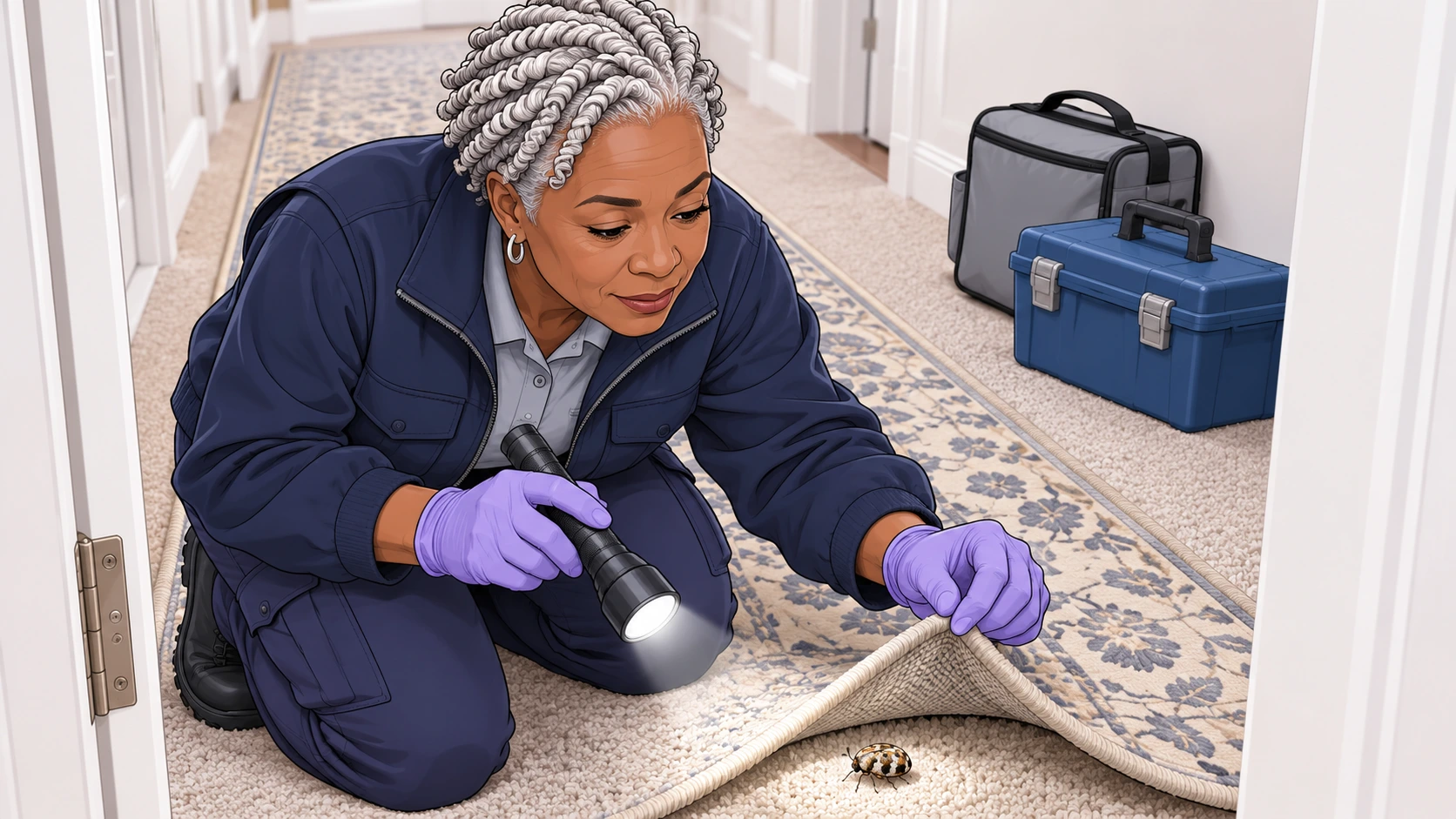
Most carpet beetle infestations do not require fumigation. A few adult beetles near a window, larvae beneath a rug, or damage confined to stored wool clothing can usually be addressed without treating an entire building with pesticide gas. Finding and removing the material supporting larval development is often enough to stop an established infestation.
Professional fumigation can be appropriate in unusual circumstances. Carpet beetles sometimes develop inside densely packed fabrics, valuable upholstered furniture, or collections that cannot be safely cleaned using ordinary methods. A particularly widespread infestation may also involve multiple inaccessible areas, making localized treatment difficult.
Fumigation can reach insects that surface sprays miss, but it brings substantial safety requirements, preparation demands, and expense. It also leaves no protective barrier against future infestations. Before considering it, you need to establish where the beetles are breeding, how much material is affected, and whether treating a specific object would be more appropriate than fumigating the building.
What Does Carpet Beetle Fumigation Actually Mean?
True fumigation involves exposing insects to a fumigant gas inside a controlled, enclosed space. Depending on the treatment, that enclosure might be a professionally operated chamber, vault, container, or sealed building.
The gas can penetrate spaces that liquid insecticides cannot readily reach. That makes fumigation potentially useful when larvae and other developmental stages are concealed within layers of fabric or stuffing.
A professional may recommend treating an individual object in a fumigation chamber rather than fumigating the home where it was found. For example, carpet beetles developing inside antique furniture with animal-hair stuffing may be better addressed through a controlled object treatment, provided the material is compatible with the fumigant.
Whole-structure fumigation is a much larger operation. The building must be properly sealed, secured against unauthorized entry, treated by qualified personnel, and cleared before anyone returns.
In the United States, sulfuryl fluoride is a restricted-use fumigant commonly associated with structural fumigation. Only appropriately certified applicators can use such products, and the treatment must comply with the specific pesticide label and applicable law.
The process is described in structural fumigation safety guidance, including the requirements for sealing, occupant evacuation, aeration, and clearance testing.
The word fumigation is sometimes used casually to describe any indoor insecticide treatment. That can create unnecessary confusion when a company proposes spraying cracks and crevices but a homeowner imagines the house being tented.
Ask exactly what treatment is being proposed. The chemical, formulation, treatment area, and required preparation determine what will happen.
Fumigation, Fogging, and Spraying Are Different Treatments
These methods expose insects in different ways, and their ability to reach concealed carpet beetles varies considerably.
| Treatment | How it reaches insects | Main limitation |
|---|---|---|
| Targeted spray | Liquid contacts insects or leaves residue on permitted surfaces | Cannot reliably penetrate thick fabrics or enclosed stuffing |
| Insecticidal dust | Deposited in labeled cracks, voids, or other permitted locations | Coverage is limited to the treated areas |
| Total-release fogger | Releases airborne pesticide droplets into a room | Droplets have poor access to insects deep inside materials |
| Professional object fumigation | Controlled gas exposure inside an enclosed treatment space | Requires specialized facilities, suitable materials, and professional oversight |
| Professional structural fumigation | Gas treatment of a sealed structure | Significant preparation and safety requirements, with no lasting residual protection |
A room fogger can fill the visible space with aerosol droplets while leaving larvae protected inside a rolled rug or upholstered chair. Professional fumigation uses a gaseous pesticide under controlled exposure conditions, which can provide substantially greater penetration.
That difference is particularly relevant to carpet beetles because their larvae may remain hidden in material that also serves as their food.
Store-bought foggers do not reliably kill fabric pests deep within large infested objects. Mist reaching the outside of a cushion cannot be assumed to reach larvae in its center.
A professional spray treatment is also not automatically fumigation. It may be entirely appropriate for accessible harborages, but its performance should be evaluated on the locations treated rather than described as whole-building gas penetration.
Clarifying the method helps prevent paying for a service whose name sounds more extensive than its actual coverage.
When Is Fumigation Worth Considering?
Fumigation is most defensible when a confirmed infestation cannot be reached adequately by less intensive methods.
A heavily infested heirloom rug is one possible example. The larvae may be concealed deep among layers that could be damaged by unsuitable washing or prolonged moisture exposure. A professional may determine that controlled treatment of the rug offers a better chance of preserving it than repeated applications of liquid insecticide.
Another example is furniture containing natural animal-hair or feather stuffing. These materials can support larval development, but spraying the exterior fabric does not necessarily reach the food source or the insects inside.
For larger infestations, the question becomes more complicated. If carpet beetles are breeding in numerous areas of a building and the sources cannot be accessed or removed, a professional may consider structural fumigation among the available options.
Severe or inaccessible infestations are recognized circumstances in which chemical fumigation may be considered for fabric pests. That does not mean every infestation extending into two rooms warrants the treatment.
The judgment should rest on confirmed breeding activity, the extent of inaccessible material, and whether other control methods can realistically reach it.
We would not regard a few beetles on several windowsills as sufficient evidence for fumigation. Adult carpet beetles can fly indoors from outside, and their presence does not establish widespread larval development.
The extent of actual feeding activity matters much more than the number of occasional adults noticed near windows.
When Fumigation Is Probably Unnecessary
Most household carpet beetle situations are better matched to source removal and localized control.
Consider a closet containing one infested wool coat. If the affected garment can be treated appropriately, there is little justification for fumigating the building. The same reasoning applies to a removable rug or stored blanket when the infestation is confined to that object.
Larvae associated with hair, lint, or dead insects beneath furniture may also be eliminated by thoroughly removing the infested material. Spraying or fumigating an otherwise clean room without addressing that source would add unnecessary complexity.
Routine carpet beetle management emphasizes sanitation, inspection, and removing breeding materials. Insecticides may not be needed when these measures eliminate the source, as outlined in integrated carpet beetle control guidance.
A suspected infestation should also be confirmed before extensive treatment is considered. Finding one shed larval skin does not prove that live insects remain throughout the building.
Likewise, finding a newly emerged adult near a window does not identify where its larval stage developed. It may have come from a localized source, or the adult may have entered from outside.
A careful inspection of carpet beetle activity helps separate an isolated finding from the kind of extensive concealed infestation that could justify specialized treatment.
The absence of a confirmed source is a reason to investigate further, not an automatic reason to fumigate.
Can Fumigation Kill Eggs, Larvae, Pupae, and Adults?
Properly selected and conducted fumigation can control multiple carpet beetle life stages, including insects concealed within materials that ordinary sprays cannot penetrate.
But the outcome depends on the fumigant, target species, exposure conditions, and labeled treatment requirements. It is not safe to assume that every fumigant automatically kills every egg at any concentration.
Some developmental stages can be more tolerant of a particular chemical or exposure than others. Effective control requires the treatment to meet the conditions established for the target pest and intended site.
For valuable fabrics and collections, professionally conducted fumigation can reach pests inside infested articles. That advantage is especially relevant when eggs or larvae are shielded by densely packed fibers.
Even so, fumigation is not a license to overlook infested materials outside the enclosure. Treating one piece of furniture does not control larvae developing in an old bird nest in the attic.
A professional should explain what insects and developmental stages the proposed treatment is intended to control, and what the product label supports.
Claims of complete elimination deserve particular caution if the inspection has not established the infestation’s full extent.
Should You Fumigate One Item or the Entire House?
The scale of treatment should match the location of the infestation.
An infestation confined to a valuable upholstered chair presents a different problem from larvae appearing across numerous storage areas and inaccessible spaces throughout a building.
Object fumigation allows a professional to concentrate treatment on the affected material. Specialized chambers or vaults can be used for suitable furniture, rugs, textiles, and other possessions.
The benefit is that the rest of the building may not need exposure to a fumigant. However, the treatment can still require controlled handling, suitable packaging or transport, and confirmation that the object will not be damaged or contaminated.
Treating an object does not resolve an independent infestation elsewhere. The surrounding room should still be inspected for other sources of animal fibers and accumulated debris.
Whole-structure fumigation may be considered when activity is sufficiently extensive and inaccessible that a localized program cannot reasonably reach all affected areas. It is a major escalation, not the standard response to recurring carpet beetle sightings.
A professional assessing carpet beetles in attics, insulation, and air ducts may also find that removing an old nest or accumulated dead insects addresses the source more directly than a gas treatment.
The choice should follow the evidence. If the infestation can be contained and treated as an individual object problem, a building-wide procedure is difficult to justify.
What Does Professional Carpet Beetle Fumigation Involve?
The exact process depends on whether a structure or individual item is being treated, the fumigant used, and the legal requirements where the service is provided.
For structural fumigation, the professional must assess the building, confirm that the proposed use is permitted, and prepare a treatment plan. The structure may need to be enclosed under a specialized tent or otherwise sealed.
Occupants, pets, and other living things must be protected according to the fumigant’s label. Access to the building is restricted while the treatment is underway.
After exposure, the building is aerated, and the responsible professionals perform the required testing before allowing reentry. You should not enter simply because the tent has been removed or the building appears ventilated.
For sulfuryl fluoride structural fumigation in the United States, licensed and certified application requirements include controlled aeration and testing to confirm that the structure meets the applicable clearance standard.
An object treatment may have a different preparation process. The article may be assessed for compatibility, placed inside an appropriate professional enclosure, treated, and cleared before being returned.
Fumigation should never be improvised using household chemicals, pesticide concentrates, carbon dioxide sources, or improvised sealed spaces. Toxic gases and oxygen displacement can create fatal exposure hazards. The correct concentration, enclosure, monitoring, and clearance procedures belong to trained professionals.
How Much Preparation Would Your Home Require?
Preparation for professional structural fumigation is substantially more demanding than preparation for an ordinary localized insecticide application.
The professional may need access to closets, cupboards, drawers, storage spaces, and concealed parts of the building. Items can require rearrangement so that the fumigant reaches the intended areas.
Occupants must arrange to stay elsewhere until the professional authorizes reentry. Pets and other animals must also be removed when required by the product’s instructions.
Food, medications, plants, and other household contents may need special handling. Some items require removal, while others may be protected using approved procedures or packaging materials specified by the fumigation company.
The requirements depend on the fumigant and its label. Do not assume that plastic bags already present in the home are suitable for protecting food or medication.
Gas appliances, ignition sources, access points, and neighboring areas may also be part of the professional preparation and safety assessment.
These obligations can make whole-structure fumigation impractical for a relatively small carpet beetle problem.
For someone with a single affected wool rug, removing that rug for appropriate off-site treatment may be far less disruptive. The professional must still determine whether fumigation is necessary and whether the object can tolerate it.
Any written proposal should explain what must be moved or removed, who performs the preparation, and what conditions must be met before people and pets return.
Can Fumigation Damage Furniture or Other Belongings?
Fumigation does not necessarily damage every treated object, but material compatibility must be assessed.
Some fumigants, exposure conditions, or preparation procedures may be unsuitable for sensitive collections, finishes, or materials. The treatment can also create contamination concerns depending on the chemical and the object involved.
This matters particularly for valuable rugs, antique furnishings, taxidermy, historic costumes, and museum collections.
A treatment that kills insects but damages the item being preserved may not be an acceptable solution.
Professional collections-care guidance therefore considers fumigation alongside other treatment methods, including controlled heat, freezing, and low-oxygen environments. These alternatives have their own limitations and must be matched to the object.
For a valuable or fragile item, an experienced conservator may need to participate in choosing the method. The ordinary pest-control approach used for a household rug is not necessarily suitable for historic textiles or fragile specimens.
The owner should also identify previous chemical treatments where known. Older museum or taxidermy objects may contain hazardous pesticide residues unrelated to the current infestation.
There is no universal treatment that preserves every material while reliably eliminating all hidden pests. Compatibility should be established before the object is exposed.
Are There Alternatives to Chemical Fumigation?
Several methods can address carpet beetles without chemical fumigation, although they differ in the materials they can treat and the insects they can reach.
For washable textiles, appropriately selected laundering or dry cleaning can kill developmental stages within the item. Controlled freezing or heat may also work for suitable objects when lethal conditions reach the entire infested material.
These methods require proper exposure throughout the item. A large cushion or thick rolled rug can take much longer to reach the necessary temperature in its center than a thin garment.
The effects of washing, drying, and freezing on carpet beetles are especially relevant when choosing a treatment that avoids chemical residues on personal fabrics.
For valuable collections, professional controlled-atmosphere treatment may be possible. Low-oxygen systems can control insects inside a properly designed and monitored enclosure, although treatment may take weeks and requires specialized materials and expertise.
Controlled-atmosphere methods are sometimes described as nonchemical fumigation, but they should not be confused with spraying a household pesticide or creating a makeshift airtight container.
For accessible household sources, removal of infested debris and targeted cleaning are often the simplest options. A labeled insecticide may sometimes supplement that work where larvae remain in permitted treatment locations.
The appropriate choice depends on access and material tolerance. An expensive treatment does not automatically offer a better result when the infestation can be removed directly.
Why Fumigation Does Not Prevent Carpet Beetles From Coming Back
A successful fumigation can kill insects present within the treated space during the required exposure. It does not make the building resistant to future carpet beetle entry.
Many structural fumigants do not leave the kind of insecticidal residue that would kill insects arriving later.
This limitation is explicit in carpet beetle treatment guidance describing severe infestations. Fumigation may eliminate the existing population, but it provides no residual protection against reinfestation.
Adult carpet beetles can enter through doors and windows. Suitable natural-fiber materials, old nests, dead insects, and accumulated animal hair may allow a new population to develop if they remain available.
Fumigation also cannot guarantee that every object outside the treated enclosure is free of insects. A stored wool blanket removed before structural treatment could contain viable larvae or eggs if it is not separately assessed and addressed.
After treatment, the building still needs reasonable cleaning, monitoring, and attention to potential breeding materials.
If live larvae are found again, it is worth establishing whether they developed from material missed during the original treatment or represent a later introduction.
Understanding why carpet beetles return after treatment is important because repeated fumigation without resolving breeding sources can lead to further disruption without reliable long-term prevention.
What Should You Establish Before Agreeing to Fumigation?
A fumigation recommendation should be supported by more than the fact that carpet beetles have been seen indoors.
The proposed service should identify where breeding activity has been confirmed, which materials are affected, and why more localized measures would be insufficient. It should also explain whether the intended treatment is for individual objects or the whole structure.
A homeowner can reasonably ask for the proposed fumigant’s name, the intended treatment site, the target pests, and confirmation that the use is permitted by the relevant product label and local regulations.
The professional should also be able to explain the expected coverage, limits of egg-stage control, required preparation, and the conditions for safe reentry.
For a building-wide operation, a written preparation plan is particularly important. Occupant and pet arrangements, treatment access, protection of belongings, and post-treatment clearance all affect whether the work can proceed safely.
An unusually broad recommendation deserves scrutiny if no effort has been made to identify the source of the infestation. Carpet beetle larvae often develop in localized material that can be removed or treated separately.
A properly documented assessment can distinguish an infestation that requires specialized penetration from one that simply needs better source identification.
The decision is ultimately about matching treatment intensity to the problem. Fumigation should solve an access problem that other realistic methods cannot solve, rather than serve as a substitute for inspection.
How Do You Know Whether Fumigation Was Successful?
A professional fumigation should be evaluated against the infestation that was actually treated.
For an individual object, the immediate question is whether the professional process was completed under the required conditions and whether the article can be returned safely without live insects from the treated population.
For a building, the assessment also involves whether the original breeding sources were included within the treatment and whether independent sources remained elsewhere.
Dead insects found after fumigation are not surprising, and old larval skins may remain in fabrics or hidden spaces. Their presence alone does not mean the treatment failed.
More informative signs include newly active larvae, fresh feeding damage, or continued development in a known source.
Monitoring may be needed because old damage does not disappear when living insects are killed. A hole in a wool rug remains a hole, even after successful pest control.
Repeated inspections and a record of new activity are more useful than expecting every beetle-related trace to vanish immediately. The indicators used to tell whether carpet beetles are gone help distinguish historical evidence from continuing infestation.
A successful treatment also cannot be judged solely by a period without sightings. If susceptible stored materials were not examined, an independent source may still be present.
The Bottom Line: Do Carpet Beetles Require Fumigation?
Carpet beetles rarely require fumigation in an ordinary home. Most infestations can be managed by finding the material supporting larval development, removing or cleaning affected items, and using an appropriate localized treatment when necessary.
Professional fumigation becomes more reasonable when insects are concealed deep inside valuable materials that cannot be treated safely by other methods, or when a severe infestation involves widespread inaccessible sources.
The choice between object fumigation and whole-structure treatment matters. A controlled chamber may address one valuable infested item without exposing the entire home, while structural fumigation involves substantially greater preparation, safety requirements, and disruption.
True fumigation is also not a bug bomb. It is a specialized gas treatment requiring qualified professionals, permitted uses, and verified clearance before reentry.
Even when treatment succeeds, carpet beetles can enter again and establish new breeding sites. The lasting protection comes from addressing the conditions that supported the infestation, not from assuming that one fumigation will permanently keep the building pest-free.