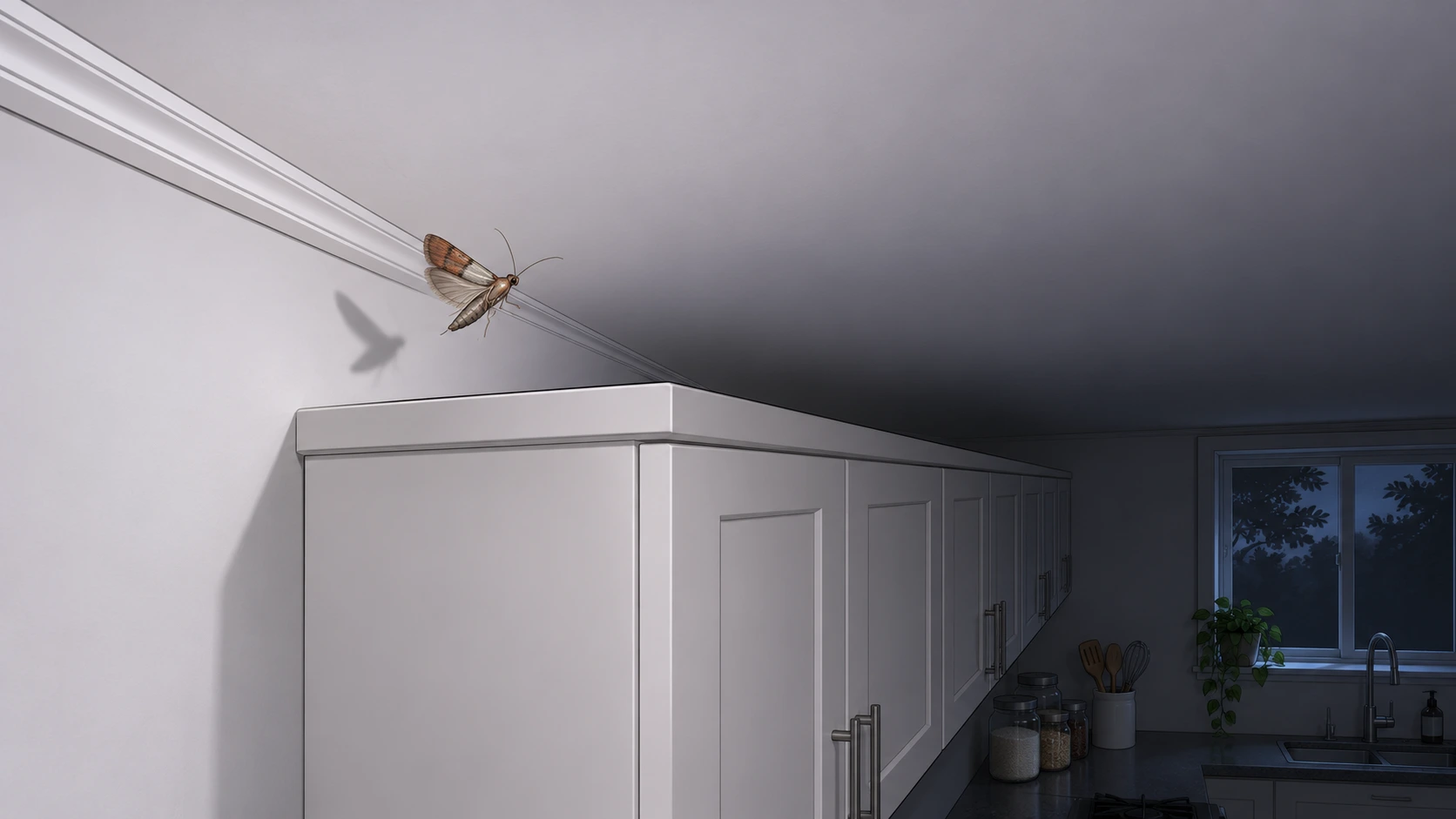
Indian meal moths are primarily nocturnal, with adult activity usually peaking around dusk and during the early part of the night. They often rest quietly on walls, ceilings and cupboards during daylight, but they can still move or fly when disturbed. Seeing one during the day does not mean it is a different species.
The timing is not entirely random. Indian meal moths, Plodia interpunctella, respond to daily changes in light and darkness. Scientific studies have found distinct rhythms in adult movement and reproductive activity, with much of their activity concentrated shortly after the lights go out.
Inside a home, however, artificial lighting and irregular household schedules can make those patterns less obvious. A kitchen that remains brightly lit until midnight is not the same environment as a controlled laboratory with a regular light-dark cycle.
For homeowners, the important distinction is between when adults are most likely to be active and when they are capable of being seen. Indian meal moths favor the dusk-to-night period, but they are not restricted to it.
What Time of Day Are Indian Meal Moths Most Active?
Dusk is one of the best-supported periods of peak adult Indian meal moth activity.
As daylight fades, adults become more likely to move from their resting positions. They may flutter around a pantry, move along walls or become noticeable in other rooms.
The daily activity pattern of Indian meal moths is described in university extension guidance as most active at dusk, with adults often resting motionless during the day.
This pattern is supported by controlled behavioral research rather than household observation alone.
In a 1979 study examining the effects of light-dark cycles, most male and female adult movement occurred within the first three hours after lights-off under a schedule of 16 hours of light and eight hours of darkness.
That result provides a useful explanation for why moths may suddenly become noticeable in the evening after appearing absent for much of the day.
The three-hour finding describes a particular laboratory light schedule at 25°C (77°F). It should not be turned into a rule that every Indian meal moth stops moving exactly three hours after sunset.
Some activity can continue later, and the distribution of activity can change under different lighting conditions.
Is Dusk the Same as Midnight for These Moths?
No. Dusk and the middle of the night are different parts of the daily cycle, and Indian meal moths do not necessarily show the same level of activity throughout both periods.
The strongest activity peak in several studies is associated with the transition from light to darkness or the early dark phase.
That means a moth may be particularly noticeable soon after the room becomes dark rather than waiting until midnight.
In a home, the distinction can be difficult to observe because people use artificial lights. An illuminated kitchen may not experience an abrupt change in light at the same moment that the sun sets outdoors.
We would describe the moth as dusk-active and nocturnal, rather than implying that its activity is evenly distributed across every hour of darkness.
What Does Indian Meal Moth Activity Look Like Across a Day?
A typical daily pattern can be summarized without assuming that every individual follows the same schedule.
| Part of the day | Common adult behavior | How to interpret a sighting |
|---|---|---|
| Morning | Often relatively quiet, with adults resting on surfaces | A resting moth is consistent with normal behavior |
| Afternoon | Many adults remain inactive unless disturbed | Daytime movement does not rule out Indian meal moth |
| Dusk | Adult movement often increases | A well-supported period of peak activity |
| Early night | Substantial movement and reproductive activity may occur | Often a productive time to notice adults |
| Late night | Activity remains possible, although it may be below the early-night peak | An adult sighting is still consistent with nocturnal behavior |
| Dawn | A smaller activity peak has been reported in some references | Not necessarily the main peak under all conditions |
These are general tendencies, not a schedule that every moth follows minute by minute.
One professional stored-product pest reference describes peak flight activity at dusk with a smaller peak at dawn. Experimental studies also show that the daily pattern can change with day length.
For that reason, a specific clock time such as 8 p.m. is not a scientifically reliable universal peak. The timing depends in part on the light-dark conditions the moths experience.
What Do Indian Meal Moths Do During the Day?
Adult Indian meal moths commonly remain still on vertical surfaces during daylight.
They may rest on kitchen walls, cupboard exteriors, ceilings or other accessible surfaces. Their folded wings make them less noticeable when they are not moving.
A person can walk through the same kitchen several times without seeing a resting moth, then notice it once it takes flight.
This does not mean the moth arrived suddenly. It may have been present and relatively inactive for hours.
Adults are also capable of flying when disturbed during the daytime. Moving a cupboard door, approaching a resting moth or disturbing an object may cause the insect to take off.
The observed daytime behavior of Indian meal moths includes resting by day and irregular flight when disturbed.
That makes daytime sightings entirely compatible with the species’ normal behavior.
A moth flying at noon should not be dismissed as a different insect simply because a reference describes Indian meal moths as nocturnal.
Why Do They Sometimes Seem to Disappear During the Day?
A reduction in visible movement can make an infestation seem temporarily inactive.
At night, an adult moth flying across a room draws attention. During the day, the same moth may remain motionless near a ceiling or cabinet edge, where its muted colors blend into the surroundings.
The change in visibility can create the impression that moth numbers increase dramatically every evening.
That impression does not necessarily mean new adults are emerging in a large synchronized group every night. It may partly reflect changes in the activity of adults already present.
Actual numbers can also change as adults emerge, die or move through the building, but movement alone is not a dependable population count.
For this reason, comparisons such as “I saw ten moths last night and none this afternoon” should not be interpreted as evidence that the infestation disappeared during daylight.
Why Are Indian Meal Moths More Active at Dusk?
Indian meal moth behavior is associated with biological rhythms that organize activity across periods of light and darkness.
This is more than a simple reaction in which darkness instantly makes every moth fly. Research has identified daily rhythms in adult movement and reproductive signaling.
A study of circadian regulation in Indian meal moths found that female calling behavior peaked at dusk, while male locomotor activity showed a corresponding peak.
The findings link the timing of movement with reproductive activity, helping explain why adults may become especially active around the beginning of the dark period.
A moth’s internal timing system and the light conditions around it can both contribute to the observed pattern.
That does not mean every movement at dusk is courtship or that every moth seen after dark is searching for a partner. Adults can move for several reasons, and an observer usually cannot determine the purpose of a short flight.
The mating behavior of Indian meal moths is a separate subject. Here, its relevance is that reproductive rhythms help explain why dusk is a prominent activity period.
Do Indian Meal Moths Have an Internal Body Clock?
Research indicates that adult Indian meal moth activity is influenced by circadian timing, although different behaviors do not always respond identically to changes in lighting.
A circadian rhythm is a roughly daily biological pattern that can continue under some constant environmental conditions.
In the 1979 Indian meal moth experiment, adult movement retained a circadian pattern after moths were transferred from a regular light-dark schedule to continuous darkness.
The experimental findings on light-dark cycles and daily moth behavior also showed that the timing of several other developmental behaviors was affected by changing illumination schedules.
A later study found differences between adult movement and female calling responses under constant light and constant darkness. Male locomotor activity maintained rhythmicity under constant darkness, while female calling did not show an equally persistent rhythm under the tested conditions.
This distinction matters because it would be inaccurate to say every Indian meal moth behavior follows one perfectly fixed internal clock.
The evidence supports daily organization of activity, with the response varying according to the behavior measured and the experimental conditions.
For household readers, the practical implication is simple: a moth’s apparent schedule reflects more than whether the room happens to be bright at a particular moment.
Does Artificial Lighting Change When Indian Meal Moths Are Active?
It can influence their observed activity patterns, but the outcome depends on the lighting schedule and the behavior being measured.
A home may contain a bright kitchen, a dark pantry and a hallway that receives light intermittently. Those spaces do not provide the same signals as an outdoor sunset.
Artificial light can alter the timing of the transition to darkness experienced by an insect. A moth may encounter a room that remains illuminated long after outdoor dusk, or a cupboard that becomes dark whenever its door is closed.
Laboratory experiments show that changing the light-dark schedule can change how adult Indian meal moth activity is distributed through the day.
Under one short-day regime, the early-night activity peak was particularly clear. Under longer-day conditions, researchers observed more complicated patterns, including two peaks in some measurements.
It would be an overstatement to conclude that leaving a kitchen light on will reliably prevent Indian meal moth activity or stop reproduction.
The studies establish that lighting conditions influence behavior. They do not establish household lighting as a dependable elimination method.
The separate article on whether Indian meal moths are attracted to light addresses how adults respond to particular light sources and why those observations can be misleading.
Can Indian Meal Moths Be Active in a Dark Pantry During the Day?
Yes, but the fact that a pantry is dark does not mean the moths will automatically behave as though it is dusk.
A cupboard may remain dark for much of the day. Its occupants may also experience light whenever the door opens, while the surrounding kitchen follows a different lighting schedule.
The moth’s behavior may depend on its recent light exposure and daily rhythm, as well as the immediate conditions.
An adult resting inside a dark cupboard at lunchtime is not inconsistent with a nocturnal activity pattern.
Likewise, an adult disturbed when the door opens may fly even though it is daytime.
The important point is that darkness and nocturnality are not interchangeable. Nocturnal describes a general pattern of activity across the day, not an absolute rule that every dark space produces immediate activity.
If you inspect a cupboard during daylight and find no moving moths, you cannot conclude from that observation that adults are absent.
What About the Larvae? Are They Nocturnal Too?
The familiar nocturnal description applies most clearly to the adult moths and their observable daily activity.
Indian meal moth larvae generally develop within suitable stored materials. Their feeding can remain concealed regardless of whether adults are visibly active in the room.
It would be misleading to apply the adult dusk flight peak directly to larval feeding without separate evidence.
Some larval behaviors, including movement away from food before pupation, can show daily timing under controlled light-dark conditions. However, the rhythm of one larval behavior does not establish that every feeding larva is inactive during daylight.
A package containing developing larvae can remain infested even when no adult moths are flying around it.
This difference is useful because homeowners often judge activity by the flying insects they see. Larval feeding evidence tells a different story.
If you notice caterpillars crawling on a wall during the day, the observation does not contradict the adult moth’s nocturnal pattern. Mature larvae can move away from their food as they prepare to pupate.
The Indian meal moth larvae and cocoons found on walls and ceilings belong to a different behavioral question from the timing of adult movement.
Does Seeing Indian Meal Moths During the Day Mean the Infestation Is Severe?
No. The time of day when you see an adult moth is not a reliable severity measure.
One moth flying during the afternoon could simply have been disturbed from a resting place. Several visible adults at dusk might reflect normal daily activity rather than a sudden increase in the number of insects present.
The relationship between sightings and infestation size is complicated because adults can move away from the food where they developed.
Time-of-day observations become more useful when combined with evidence from stored materials.
For example, a kitchen containing an infested bag of grain, feeding larvae and fresh silk webbing provides stronger evidence of an active problem than a few adults seen flying after dark.
The signs of an Indian meal moth infestation help distinguish actual larval activity from isolated sightings.
If you find only one resting adult in daylight, do not assume the problem is minor or severe based on the hour alone.
Identify the insect and investigate the relevant stored products before drawing conclusions.
Is Evening the Best Time to Look for Indian Meal Moths?
Evening is often a useful time to notice adult movement, particularly around dusk or shortly after the room becomes dark.
But that does not automatically make evening the best time for every part of an infestation inspection.
Adults are easier to notice when they are moving. Stored foods, silk webbing and larvae are generally easier to examine when lighting is sufficient and packages can be inspected carefully.
A practical investigation can use those two kinds of evidence at different times.
| What you want to establish | Useful approach | Important limitation |
|---|---|---|
| Whether adult moths are visibly active | Observe around dusk or early evening | Adults can also be present when they are not moving |
| Whether an adult rests in the room during daylight | Examine walls and cupboard surfaces without assuming motion | Resting adults may be difficult to notice |
| Whether stored food contains feeding insects | Inspect susceptible products under good lighting | Adult activity timing does not identify the food source |
| Whether activity is continuing | Record sightings and look for fresh physical evidence | A busy evening alone does not establish a new generation |
This comparison separates observing adult behavior from finding the material supporting an infestation.
For a household investigation, inspecting the food source is ultimately more informative than watching the room at a particular hour.
The Indian meal moth source-finding guide addresses that evidence-based investigation separately.
Can Indian Meal Moths Be Active All Year Indoors?
Yes. Adult Indian meal moths can be observed during different seasons, especially in buildings where suitable food and environmental conditions remain available.
The species is not restricted to a short outdoor flight season in the way some wild moths are.
Indoor temperature and stored-food conditions can allow continued development and activity when outdoor conditions are unfavorable.
That does not mean every home has constant moth activity or that a population necessarily reproduces at the same rate all year.
A cool, little-used storage area may provide very different conditions from a consistently warm kitchen.
The year-round indoor occurrence documented in university extension guidance explains why seeing an adult during winter does not by itself make the identification unusual.
Daily activity timing and seasonal occurrence are separate questions. A moth can remain primarily active around dusk even when adults occur indoors during the winter months.
What If Your Moths Are Active Mainly in the Afternoon?
An afternoon-heavy pattern does not automatically rule out Indian meal moths.
Consider how the observations were made. You may spend more time near the pantry during the afternoon, open cupboards more frequently or disturb resting insects while preparing food.
Those activities can affect the number of moths you notice without proving that afternoon is the species’ true biological activity peak.
The local lighting schedule may also differ from a natural day-night cycle.
However, observation bias should not be used to force an identification. If the adults do not have the expected features of Indian meal moths, they may be another species.
The adult Indian meal moth identification guide provides more useful identifying characteristics than activity timing alone.
A clearly photographed adult is more informative than assuming that all small moths flying in a kitchen after sunset are Indian meal moths.
The Bottom Line
Indian meal moths are primarily nocturnal, with a particularly strong activity peak around dusk and the beginning of the dark period. During the day, adults commonly rest on walls, ceilings and other surfaces, although they may fly if disturbed.
Controlled studies show that their daily behavior is influenced by light-dark cycles and internal timing. Artificial lighting and household routines can change what you observe, so there is no universal clock hour when every Indian meal moth becomes active.
A daytime sighting does not rule out the species, and an evening increase in flying moths does not, by itself, prove that an infestation has suddenly grown.
The most useful distinction is between adult activity, which is often easiest to notice near dusk, and larval feeding evidence, which can remain present regardless of the time you inspect a stored product.