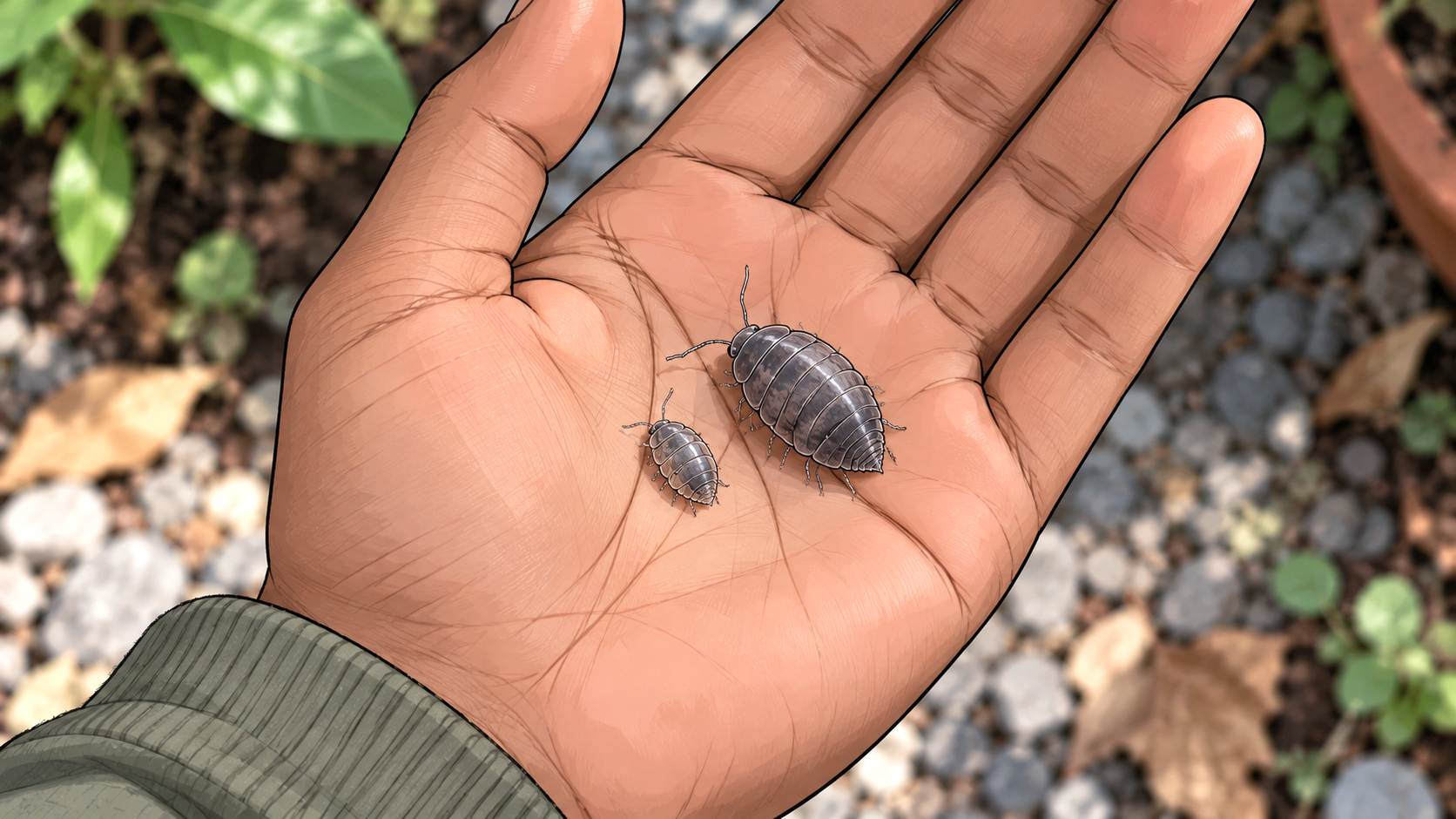
A fully grown common roly-poly (Armadillidium vulgare) usually measures about 10–18 mm long, or roughly 3/8 to 3/4 inch. Many adults are near the middle of that range rather than the maximum. Newly emerged young are far smaller, beginning around 2 mm before increasing in size through repeated molts.
An 18 mm Roly-Poly Is Near the Upper End
The common pillbug can become surprisingly large when compared with the tiny juveniles often found alongside it. The University of Florida reports that mature Armadillidium vulgare reaches about 8.5–18 mm in length, while the British Myriapod and Isopod Group lists the common pill woodlouse at up to 18 mm long. The Woodland Trust gives the same 18 mm maximum for adult pill woodlice.
Most individuals are not three-quarters of an inch long. University of Michigan’s Animal Diversity Web gives an average adult length of approximately 10 mm for A. vulgare, about 0.4 inch. A roly-poly close to half an inch long is therefore entirely normal, while one approaching 18 mm represents a particularly large adult.
Their broad, armored bodies can make them appear larger than the measurement suggests. Seven overlapping body plates and seven pairs of walking legs give a 10–15 mm animal considerably more visual presence than a narrow arthropod of the same length. This difference is obvious when comparing terrestrial isopods with much smaller animals such as springtails and isopods, which can share the same damp habitat despite being very different in scale.
Young Roly-Polies Start at Only About 2 mm
The smallest roly-polies are not miniature 10 mm adults immediately after hatching. Females carry their eggs and developing young in a brood pouch called a marsupium. UF/IFAS reports that the young reach approximately 2 mm long before leaving the mother’s pouch. They then continue growing through successive molts.
At two to three months old, common pillbug juveniles are often around 5–7 mm long, according to University of Michigan’s BioKIDS data. A mixed colony beneath a flowerpot can consequently contain tiny pale juveniles only a few millimeters long beside adults several times their length.
Very small individuals can be confused with other moisture-loving arthropods when viewed quickly. Size helps narrow the possibilities: typical household springtails are much smaller than an adult pillbug, although a newly independent roly-poly closes some of that gap. The plated body remains the more reliable identification feature.
Species and Age Explain Much of the Size Variation
“Roly-poly” is a common name rather than a measurement for every terrestrial isopod capable of rolling up. Armadillidium vulgare is the familiar species commonly meant by the term, but other pill woodlice differ somewhat in adult dimensions. Even within A. vulgare, age alone creates a range from approximately 2 mm young to adults approaching 18 mm.
Regional identification guides reflect that variation. The University of Maryland describes common pillbugs and sowbugs encountered around homes as approximately 1/2 to 3/4 inch long, while UF/IFAS gives about 13 mm as a typical length when discussing household pillbugs and sowbugs generally. These figures are compatible rather than contradictory: one source may describe a usual household size while another reports the full documented range for a particular species.
A specimen substantially longer than about 18 mm deserves a closer identification rather than automatically being called an unusually large roly-poly. Pill millipedes and other segmented arthropods can produce a similar rounded appearance, especially when curled.
Measure One While It Is Fully Extended
A rolled-up roly-poly is difficult to measure accurately because its body forms a compact sphere. Adult size figures refer to body length while the animal is extended, measured from the front of the head to the rear of the body rather than around the curve of the shell.
A millimeter ruler beside the animal is usually sufficient. Photographing the roly-poly from directly above while it is walking reduces perspective distortion and also makes the overlapping plates visible. For scale, 10 mm equals roughly 0.4 inch, 13 mm is about half an inch, and 18 mm is just under three-quarters of an inch.
The Museu de Biodiversidade at the University of Évora independently records Armadillidium vulgare reaching approximately 18 mm. An extended specimen within roughly 10–18 mm therefore falls comfortably within the normal adult size range for the common roly-poly.