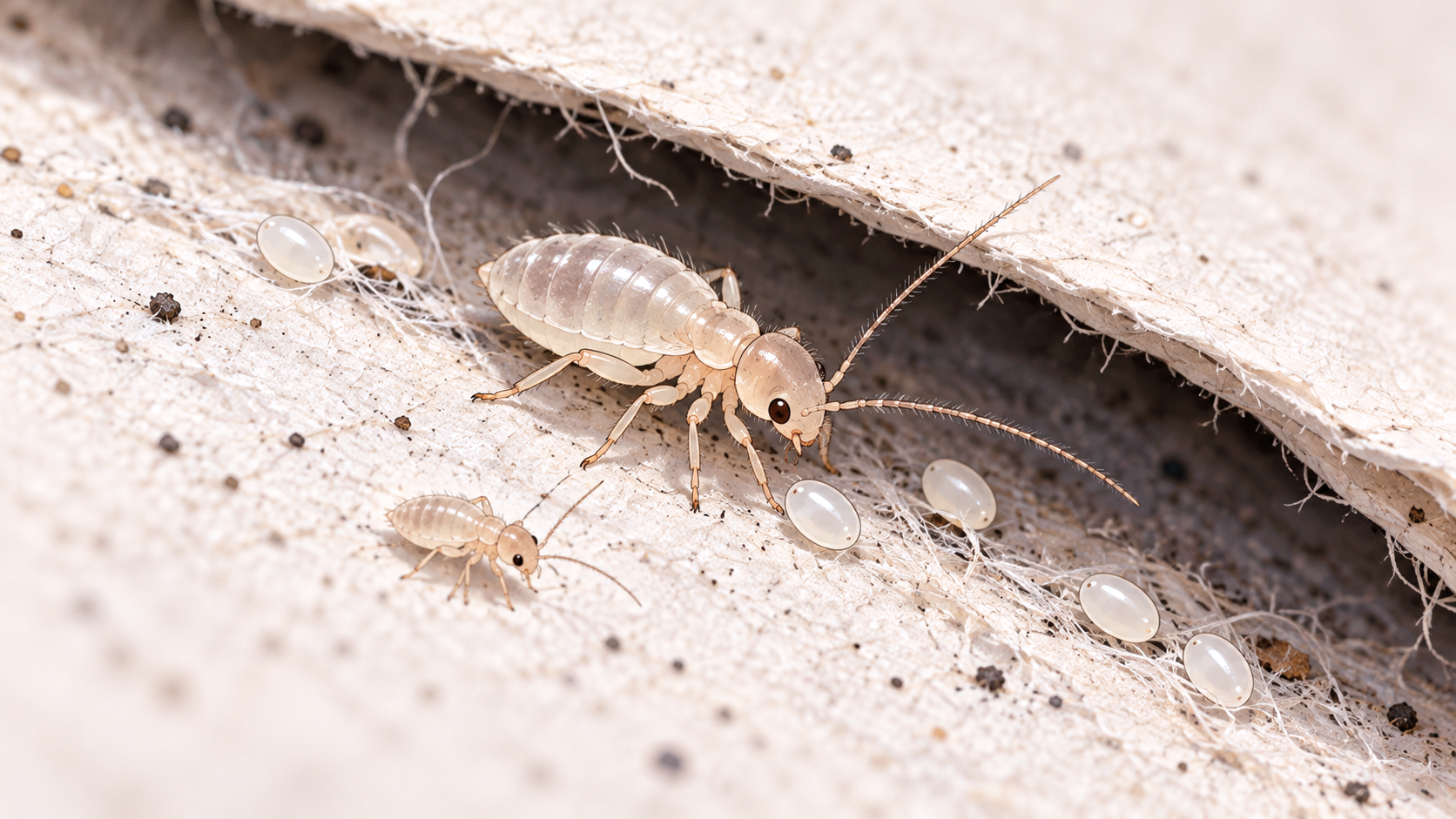
Booklice reproduce by laying eggs, but there is no single egg total that applies to every species. Some common indoor species can reproduce without mating, and laboratory studies of Liposcelis booklice have recorded roughly 50 to 75 eggs per female under particular temperatures, with higher lifetime totals reported for some strains and conditions. Reproductive output changes substantially with species, temperature, humidity, food, and adult lifespan.
Some Booklice Can Produce Offspring Without a Male
Reproduction is unusually efficient in some of the booklice most closely associated with buildings and stored products. Many populations of Liposcelis bostrychophila reproduce through thelytokous parthenogenesis, meaning females produce female offspring from unfertilized eggs. A single transported female can therefore have reproductive potential without first encountering a male. This trait contributes to the species’ ability to establish populations in isolated packages, cupboards, storage areas, and other small indoor habitats.
Parthenogenesis is not universal across all booklice. Sexual reproduction also occurs within L. bostrychophila, including documented populations containing both males and females, so the species itself cannot accurately be described as exclusively female everywhere. The existence of sexually reproducing L. bostrychophila populations alongside parthenogenetic lineages illustrates how reproductive biology can differ even within one named species. Other psocids reproduce sexually as well, making “booklice reproduce without males” accurate only for particular species and lineages rather than the entire group.
The reproductive mode does not change the basic booklice life cycle: eggs hatch into nymphs, and those nymphs molt through immature stages before adulthood. Booklice do not have a larval or pupal stage.
Egg Counts Depend on Which Booklouse and the Conditions Around It
A fixed statement such as “every booklouse lays 60 eggs” is too precise. Egg production is measured under specific environmental conditions, and different species respond differently. In laboratory work with L. bostrychophila, females produced about 51.9 eggs at 20°C and 74.7 eggs at 27.5°C under the tested conditions, showing that temperature alone can shift fecundity substantially. Other work on this species has reported lifetime production around or above 100 eggs under favorable conditions, so those numbers should not be treated as competing universal totals.
Other Liposcelis species have their own reproductive responses. The stored-product species L. paeta produces the most eggs within a particular middle temperature range rather than simply laying more as temperatures rise, and reproduction becomes poor near unsuitable temperature extremes. Its development and fecundity change sharply with temperature, while L. badia shows a different optimum altogether. Egg count is therefore better understood as a biological range controlled by species and environment than as one number attached to the common name “booklice.”
For a household infestation, the important implication is population potential rather than the exact lifetime total of one female. Several females reproducing repeatedly under favorable conditions can produce numerous nymphs even if each lays eggs individually rather than depositing one large clutch.
Females Lay Small Eggs Through the Habitat, Not in One Egg Sac
Booklice do not produce a conspicuous egg case comparable to a cockroach ootheca, nor do they construct a central nest containing one visible pile of eggs. Females deposit tiny eggs on or among suitable material. Stored-product psocids can lay eggs randomly within the food source, while household eggs may occur in cracks, cardboard, shelving, books, stored products, or other protected surfaces used by the insects.
The individual appearance of booklice eggs makes them easy to miss. They are extremely small, pale, and oval, and some booklice conceal eggs with debris. A household can therefore contain a reproducing population without presenting an obvious cluster that a person can locate and remove.
Egg placement also follows habitat quality rather than attachment to people or pets. Booklice are environmental insects, so reproduction occurs where the adults can survive and the emerging nymphs can find suitable conditions. Eggs attached firmly to human hairs would point toward a different insect rather than normal booklouse reproduction.
Warmth Changes Both How Soon Egg Laying Starts and How Many Eggs Are Produced
Adult females do not necessarily begin laying immediately after becoming adults. A preoviposition period occurs between adult emergence and the start of egg production, and its duration is temperature dependent. For L. bostrychophila, laboratory data show that this period can fall from roughly 18 days at cooler conditions to only a few days at warmer favorable temperatures. Faster onset of oviposition, shorter immature development, and continued egg production can combine to accelerate population growth considerably.
Heat has limits. Increasing temperature does not indefinitely improve reproduction; temperatures outside a species’ viable range reduce fertility, development, or survival. L. paeta, for example, showed little successful development or reproduction at 20°C and 40°C in experimental conditions, despite reproducing well within the intervening range. The temperature effect therefore forms an optimum rather than a simple hotter-is-better relationship.
This helps explain why the time booklice remain alive does not by itself determine how quickly an infestation grows. A female living for a long time under poor reproductive conditions may contribute less population growth than one experiencing a shorter but highly favorable warm period.
Humidity Can Decide Whether Reproduction Continues at All
Booklice cannot convert unlimited egg-laying capacity into an infestation if the environment is too dry. Adults, eggs, and nymphs are all moisture sensitive, and controlled experiments with several Liposcelis species found severe mortality when insects were held at 43% or 50% relative humidity. The survival of multiple psocid life stages falls sharply under dehumidified conditions, while high humidity supports both the insects and many of the fungal foods they exploit.
That environmental dependence places reproduction within the broader biology of why booklice need humidity. A female may be physiologically capable of producing dozens of eggs, but those eggs cannot generate a persistent population if adults die, embryos fail, or newly hatched nymphs encounter unsuitable dryness.
Warm, humid environments can have the opposite effect. Natural populations of Liposcelis entomophila have increased during periods when higher temperature and humidity coincided with favorable fungal growth. Rapid household population increases can therefore reflect an environmental window that improves reproduction and juvenile survival at the same time.
One Female Can Matter More Than an Obvious Cluster of Eggs
Parthenogenetic reproduction changes how an infestation can begin. With a lineage capable of producing viable eggs without mating, one mature female introduced inside packaging or another suitable object is biologically different from a solitary female of a species that must first mate. There does not need to be a visible pair of adults before reproduction begins.
A growing population will eventually contain several sizes of insects because baby booklice resemble smaller, paler versions of adults. Finding tiny nymphs alongside adults can consequently provide stronger evidence of reproduction at that location than unsuccessfully searching for eggs that are almost impossible to see.
The number of offspring that survive is also not identical to the number of eggs laid. Egg viability, nymph survival, temperature, humidity, food quality, and crowding all affect how many individuals ultimately reach adulthood. Experimental measurements of psocid population growth on different stored commodities show substantial differences in progeny production even when the insects belong to the same general stored-product group.
Questions About Booklice Reproduction
Do booklice need to mate before every batch of eggs?
No. Parthenogenetic lineages can produce eggs without mating, while sexually reproducing booklice follow a different reproductive system. The answer therefore depends on the species and population involved.
Do booklice give birth to live young?
No. Booklice are egg-laying insects. The emerging immature stage is a nymph rather than a live-born miniature delivered directly by the female.
Can booklice eggs survive better than adults under some treatments?
Yes. Eggs can be more tolerant than nymphs or adults to certain environmental stresses and pest-control treatments. Experiments with several stored-product psocids found that eggs were generally the most cold-tolerant life stage, which is one reason disappearance of visible adults does not always prove that every life stage has been eliminated.
Can booklice reproduce inside food packaging?
They can if the package contains suitable food, moisture, and access. Stored-product psocids can complete their development within infested commodities, and the tiny nymphs can exploit very small spaces around packaging.
Does seeing a single booklouse egg mean there is an infestation?
Not necessarily. An infestation is better supported by repeated activity and multiple developmental stages. The usual signs of an established booklice population provide more context than one unidentified pale speck.
How quickly can a new generation appear?
Development varies widely with species and temperature. Under favorable warm conditions, some Liposcelis species can progress from egg to adult in roughly two to three weeks, while cooler conditions can extend development considerably. Egg-to-adult timing is therefore not a fixed calendar period for every household population.