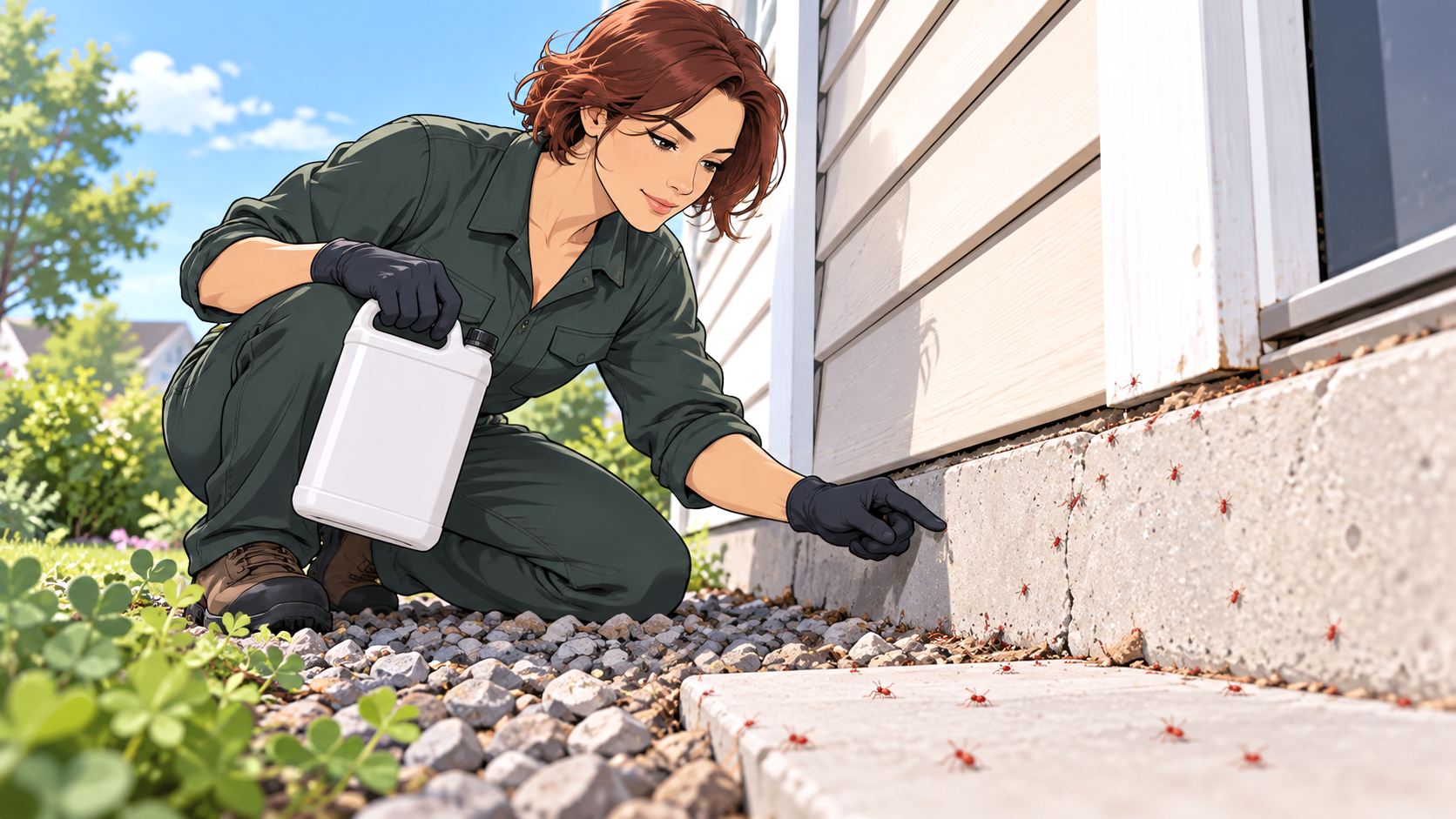
Bifenthrin kills clover mites, and unlike many household substances promoted for this purpose, current pesticide labels specifically include clover mites as a target pest. Bifenthrin is a synthetic pyrethroid that disrupts normal nerve signaling in arthropods. It works through contact and ingestion, making it a legitimate chemical option when a clover mite infestation warrants pesticide treatment. The active ingredient alone does not tell you where a product can be sprayed. Bifenthrin is sold in hundreds of formulations, including liquids, granules, and aerosols, and their permitted uses vary. A current bifenthrin label can include clover mites on ornamentals, while another product may permit lawn or structural applications under different directions. The product label, rather than the word bifenthrin on the front of the container, determines the legal treatment sites and application method.
Clover Mites Appear on Current Bifenthrin Labels
The evidence for bifenthrin is unusually direct. Clover mites are explicitly listed among the pests controlled by current bifenthrin ornamental treatments, with full-coverage foliar application directions. They also appear on the pest list of a current granular bifenthrin lawn product. That is much stronger support than simply knowing that a chemical can kill some species of mites.
The appropriate formulation depends on where the population is active. Clover mites can feed on lawns and other vegetation, yet homeowners may first notice them after they migrate onto foundations, patios, windows, or interior surfaces. A product labeled for turf cannot automatically be transferred to every one of those locations. Current pesticide information can be checked by product name or registration number before treatment.
Coverage Has to Match Where the Mites Are Living
Bifenthrin cannot compensate for treating the wrong area. Spraying a few mites visible on a wall may kill those individuals while leaving the population producing them untouched. When clover mites are moving toward a building from nearby turf or ornamentals, treatment needs to follow the locations permitted by the label and the actual distribution of the mites.
Heavy activity on brick and siding can indicate migration from the surrounding landscape rather than an infestation originating inside the wall. Likewise, recurring clusters on window sills often point toward an entry route. Locating that outdoor activity first prevents a bifenthrin application from becoming an indiscriminate spray around the entire property.
Bifenthrin Is Usually More Useful Outdoors Than Across Indoor Surfaces
Clover mites found indoors generally do not require rooms to be treated with a residual pyrethroid. They can be vacuumed from walls, floors, and window areas without crushing them, while continued arrivals can be reduced by addressing exterior sources and openings.
Even though bifenthrin products exist for residential indoor and outdoor pest control, those registrations do not make every formulation suitable for every surface. Pesticide labels are legally enforceable directions, and using a pesticide inconsistently with its labeling is prohibited. Do not improvise an indoor clover mite application from directions intended for turf, ornamentals, foundations, or another treatment site.
Runoff and Pollinators Deserve Particular Attention
Bifenthrin is broad-spectrum rather than clover-mite-specific. It can affect organisms that were never meant to be treated. The compound binds strongly to soil, but contaminated soil can move into surface water through runoff, and bifenthrin is highly toxic to fish and small aquatic organisms. Applications near drains, ponds, streams, pools, or areas where runoff can carry residues therefore require close attention to the environmental precautions on the product label.
Bees and other beneficial arthropods can also be affected. Avoid treating blooming plants or other locations prohibited by the label when pollinators may be exposed. A clover mite problem concentrated near a building does not justify blanketing the entire landscape with a broad-spectrum pyrethroid, particularly when outdoor clover mite control can combine targeted treatment with changes to the immediate habitat.
Bifenthrin Does Not Replace Prevention
A successful application can sharply reduce the mites exposed to it, yet a property can remain favorable for future populations. Clover mites thrive around suitable vegetation, and dense growth immediately beside a structure gives them a short route to walls and openings. Repeated infestations are therefore better managed by pairing any necessary pesticide treatment with measures that prevent clover mites from entering.
That approach also limits unnecessary pesticide use. If a small population can be managed through vegetation changes, exclusion, and physical removal, there is little reason to escalate immediately to broad chemical treatment. Persistent or extensive populations may justify professional clover mite treatment when identifying the source or applying the product correctly becomes difficult.
Questions About Using Bifenthrin for Clover Mites
How quickly does bifenthrin kill clover mites?
There is no single kill time that applies to every bifenthrin product or treatment situation. Formulation, concentration, application method, coverage, weather, and mite exposure can all affect performance. Follow the expectations and retreatment interval on the specific product label rather than assuming an immediate result.
Can rain reduce a bifenthrin treatment?
Timing matters. Labels can restrict application when rainfall or runoff is likely, and outdoor pesticide movement into storm drains or surface water is an important concern. Allow only the conditions and application procedures specified on the product being used.
Does a higher bifenthrin concentration work better?
Do not increase the concentration beyond the labeled rate. More pesticide can increase exposure and environmental risk without providing a legitimate treatment advantage. Applying pesticides at the label rate is part of using them safely and effectively.
Should bifenthrin be the first response to a few clover mites?
Usually not. A few indoor wanderers can be physically removed, while minor exterior activity may be manageable without insecticide. Bifenthrin becomes more relevant when the size and location of the population justify a labeled insecticidal treatment for clover mites.