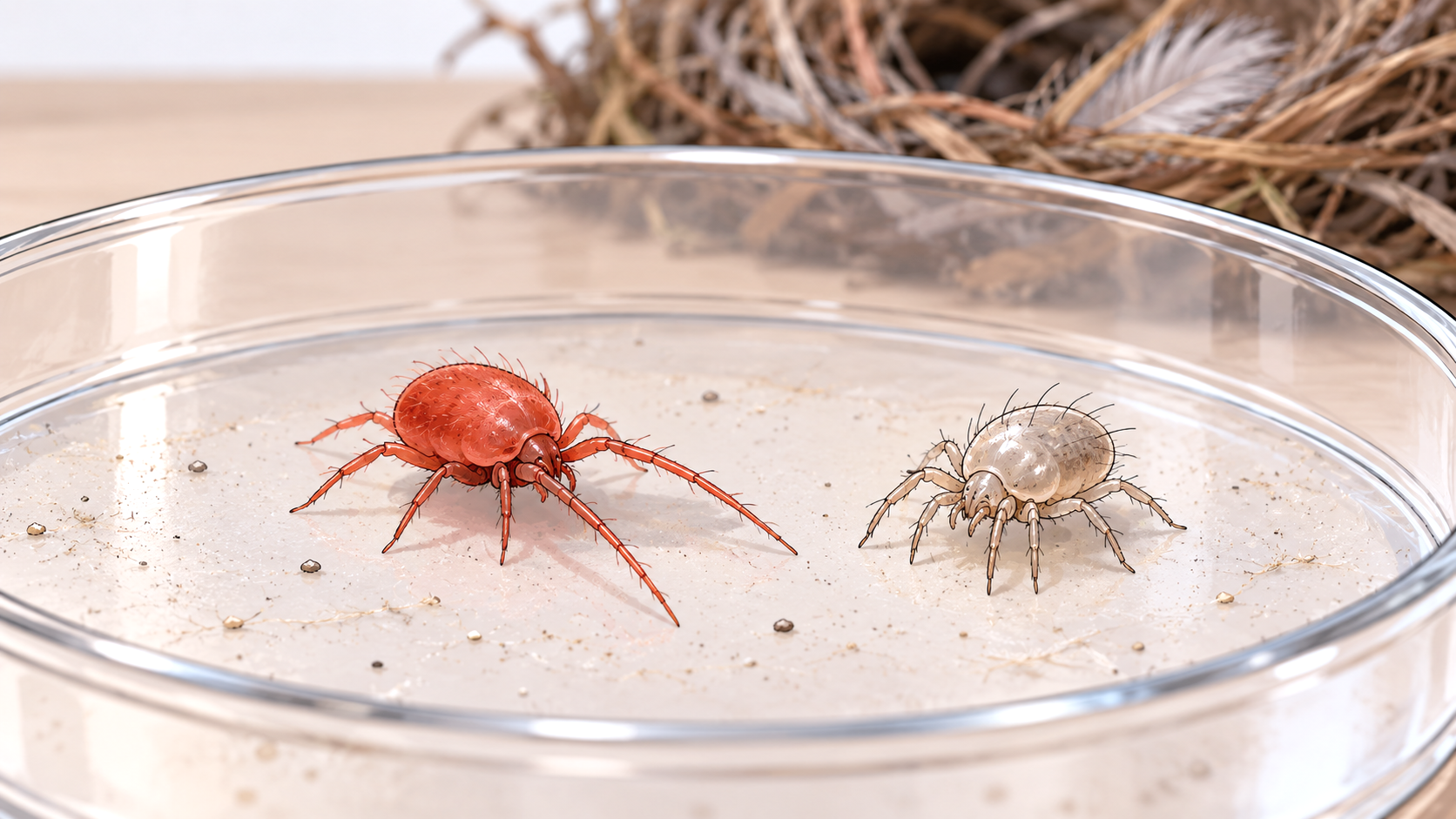
Where the mites are coming from can identify them faster than color. Tiny mites pouring from an old nest beneath the eaves point toward bird mites. Tiny red mites moving from lawn or foundation vegetation toward windows point toward clover mites. Bird mites are blood-feeding parasites associated with birds, while clover mites feed on plants and do not parasitize birds or people. The name “bird mite” covers several species rather than one pest. Northern fowl mites (Ornithonyssus sylviarum), tropical fowl mites (O. bursa), and poultry red mites (Dermanyssus gallinae) are among the important examples. Their habits differ, but all are fundamentally different from the plant-feeding Bryobia mites commonly called clover mites.
A Bird Nest Can Explain a Sudden Indoor Mite Problem
Bird mites become household pests most often when their normal hosts are nearby or disappear. Nests belonging to pigeons, sparrows, starlings, and other birds can support large mite populations. When nestlings leave, birds abandon the nest, or a nest is removed, hungry mites may disperse into the building and bite people because their usual blood source is gone. Some bird mites can survive for extended periods without a blood meal, which can prolong the nuisance after birds have departed.
Clover mites arrive for a different reason. Outdoor populations develop around vegetation, particularly grasses and other suitable host plants, before individuals migrate across foundations and through structural openings. A property with mites concentrated on sunny walls and exterior surfaces but no nearby bird activity fits clover mites more closely. Repeated indoor appearances can also follow the conditions that make clover mites keep coming back rather than the presence of an animal host.
Human Skin Provides a Major Separation
Bird mites can bite people. Poultry red mites are documented blood feeders that bite humans when the opportunity arises, although people are not suitable hosts for maintaining their normal populations. Bird-mite bites can produce itchy papules and irritation, particularly when mites disperse from an infested nest or poultry environment.
A confirmed clover mite does not explain a typical mite bite because clover mites do not bite humans. Rare reports concerning skin reactions associated with clover mites involve a separate dermatitis question and should not be confused with the established blood-feeding behavior of bird mites. Neither group should be mistaken for scabies mites, which actually burrow into human skin.
Color Is Much Less Useful Than Body Structure
Clover mites are commonly reddish, reddish brown, greenish, or brown and are smaller than a pinhead. Their best visual clue is the exceptionally long first pair of legs, which projects forward and can resemble antennae. Crushing one may also leave a characteristic red stain.
Bird mites are extremely small and their appearance varies by species and whether they have recently fed. Some can look pale when unfed and darker or reddish after taking blood, so “tiny red mite” is not a dependable diagnosis. Northern fowl mites and poultry red mites also differ in where they spend their time: northern fowl mites commonly remain on birds, whereas poultry red mites hide in roosts, nest boxes, droppings, and structural crevices during the day and feed at night.
| Clue | Clover mite | Bird mite |
|---|---|---|
| Main food | Plant tissue | Blood |
| Normal association | Grass and other vegetation | Birds and nests |
| Human biting | No | Some species will bite |
| Strong visual clue | Extremely long front legs | Appearance varies by species and feeding status |
| Common indoor source | Outdoor vegetation near the structure | Active or abandoned bird nest |
| Reproduction on humans | No | No |
| Red stain when crushed | Characteristic | Not the defining identification feature |
Check the Building Before Reaching for a Pesticide
Suspected bird mites justify an inspection of roof edges, vents, chimneys, attics, window-mounted air conditioners, ledges, and other protected places where birds may have nested. Removing an abandoned nest at an appropriate and lawful time, excluding birds from future nesting sites, and cleaning the affected area address the source more directly than spraying rooms indiscriminately. Active nests should not simply be destroyed because native birds, eggs, and nests may have legal protection depending on species and jurisdiction.
A clover mite invasion shifts the inspection downward toward vegetation, foundations, windows, doors, and other entry points. Vacuuming indoor mites avoids crushing them, while sealing the routes clover mites use to enter can reduce repeated invasions. Finding mites on a pet does not automatically favor bird mites either, since a wandering clover mite may cross fur even though clover mites do not infest pets.
Clues That Resolve Difficult Clover Mite and Bird Mite Cases
Can bird mites live permanently on humans?
Bird mites may bite people, but humans do not replace their normal avian hosts. Important species such as the northern fowl mite maintain fertile populations on birds rather than people.
Can both mites enter bedrooms?
Yes. Either can wander into a bedroom, so room location alone proves little. A bird nest attached to or inside the structure supports bird mites, while numerous mites entering around windows beside vegetation fit the usual indoor clover mite pattern.
Could mites around a chicken coop be clover mites?
Yes, especially when they are concentrated on exterior surfaces near vegetation. Mites living on chickens, around vents, or within roosting structures require closer identification because clover mites and poultry mites pose very different risks to chickens.
Do bird mites fly from nests into houses?
No. Mites do not have wings. They disperse by crawling or can be transported with hosts and infested materials.