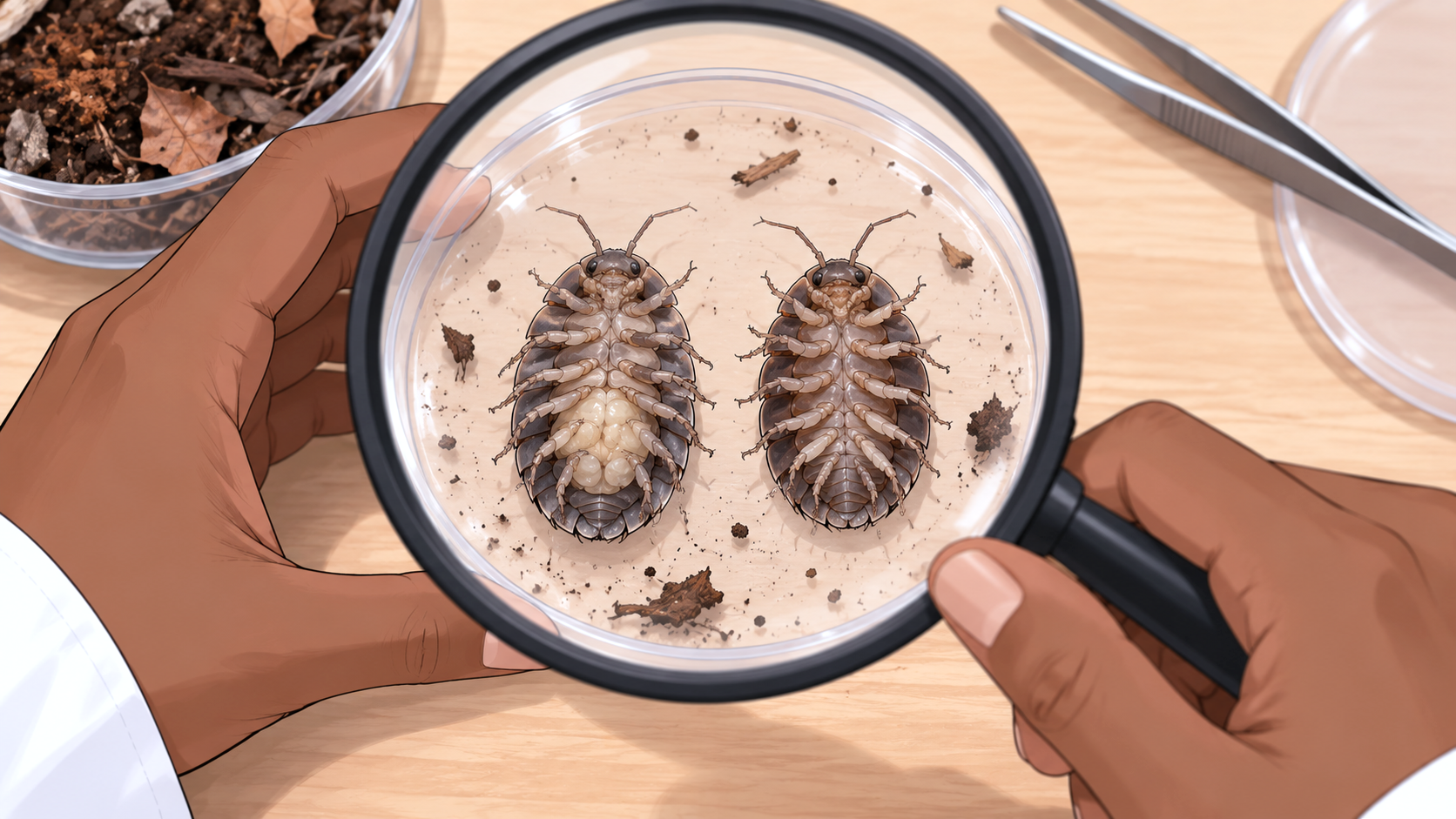
The most useful way to tell a male roly-poly from a female is to examine the underside of a mature animal, particularly the first abdominal appendages and reproductive structures. Male pillbugs have specialized pleopods used in sperm transfer, while reproductive females can develop conspicuous brood-pouch plates. Size and color alone are unreliable ways to determine sex.
Sexing a roly-poly is considerably harder from an ordinary top-down photograph. Males and females share the same basic segmented shape, antennae and seven pairs of walking legs, so the features that provide the strongest evidence are concentrated on the ventral surface.
Look at the First Two Pairs of Pleopods on a Mature Animal
Adult male Armadillidium vulgare have modified first and second pleopod endopodites. These structures are involved in sperm transfer and differ from the corresponding appendages in females. Microscopic examination has shown that the male first and second endopodites form paired copulatory structures that work together during reproduction.
You do not need to identify every microscopic component to use this difference. With adequate magnification and a clear view of the underside, a mature male’s first two pleopod pairs are more elongated and specialized than those of a typical female. The relevant structures lie toward the rear underside rather than among the conspicuous walking legs. Male differentiation does not appear fully formed in the youngest animals; developmental research on A. vulgare found that the male endopodites begin elongating during postembryonic development. Very small juveniles can consequently be much harder to sex confidently than mature specimens.
A male also possesses paired penes on the ventral side. These deliver sperm toward the specialized pleopods rather than functioning like the external penis of a mammal. Experimental manipulation of sexual differentiation in A. vulgare has demonstrated development of penes and male copulatory organs together with other male characteristics, confirming their value as sex-specific anatomy.
A Brood Pouch Is Strong Evidence That You Have a Female
A reproductive female can be much easier to recognize because plates called oostegites develop underneath the front portion of her body and form a marsupium. In A. vulgare, five pairs of these plates create the ventral enclosure used during brooding. Histological work on terrestrial isopods describes how overlapping oostegites form the marsupial chamber.
The pouch is not equally conspicuous throughout a female’s life. Female genital structures change with reproductive condition, and detailed anatomical examination of A. vulgare has documented distinct reproductive and non-reproductive states of the female genitalia. Absence of an obvious pouch therefore does not make an animal male.
A clearly developed marsupium is nevertheless a practical field clue because it identifies a female in a reproductive state. The processes occurring within that structure are part of roly-poly reproduction, whereas sex identification only requires recognizing that the ventral plates differ from the male arrangement.
Size Is Not Reliable Enough to Sex a Roly-Poly
A large pillbug is not automatically female, and a small one is not automatically male. Research on A. vulgare has found sex-related differences in average body mass within particular experimental populations, including samples in which females were significantly larger on average. The same study also found that the sizes of males and females overlapped, making body mass unsuitable as a stand-alone sex marker.
Age creates an additional source of confusion. A small individual may simply be immature, while mature size varies among individuals and among different roly-poly species. Very young mancae have not even completed the external development used for reliable adult sex identification, so baby roly-polies should not be classified as male or female merely by comparing their size with nearby adults.
Body width has the same limitation. A female carrying a brood may look fuller underneath, but general roundness from above is not a dependable diagnostic character. Examining the relevant ventral anatomy provides stronger evidence than comparing silhouettes.
Color Cannot Reliably Tell You Whether It Is Male or Female
Dark gray, brown, reddish, pale and patterned individuals can occur without those appearances functioning as dependable male-or-female labels. Pigmentation in A. vulgare involves multiple pigments, and naturally occurring color polymorphism has been documented independently of the reproductive structures used for sex identification. Research on pigmentation has identified distinct inherited body-color phenotypes in common pillbugs.
Spots are particularly easy to overinterpret. Females in some populations may show conspicuous pale markings, but variable pigmentation and population differences prevent a simple rule such as “spotted equals female” from replacing an anatomical examination. The range of normal roly-poly colors and patterns is too broad for color alone to provide dependable sex identification.
Unusual coloration can also have an entirely different cause. An intensely blue or violet animal may show iridovirus-associated discoloration, which provides information about the animal’s condition rather than its sex.
Some Individuals Do Not Fit a Simple Visual Male-or-Female Checklist
Even ventral characters have biological exceptions. Sex determination in A. vulgare is unusually complex because inherited factors and the bacterium Wolbachia can affect sexual development. Research has documented feminization of genetic males by sex-ratio-distorting factors, and functional males possessing female genital apertures have also been recorded in laboratory and wild populations. (pubmed.ncbi.nlm.nih.gov)
These cases are important when interpreting anatomy, but they do not make ordinary visual sexing useless. For a typical mature specimen, the configuration of the first pleopods and associated reproductive structures remains more informative than color or overall size. Researchers investigating unusual individuals may need microscopic examination, reproductive observations or genetic information before assigning sex with greater certainty.
Questions About Sexing Roly-Polies
Can you tell a roly-poly’s sex while it is rolled into a ball?
Usually not with confidence because the useful reproductive structures are on the underside. The defensive posture involved when a roly-poly rolls into a ball conceals much of the ventral anatomy needed for identification.
Does a female always have visible oostegites?
Female oostegites change with reproductive condition. A conspicuous marsupium identifies a reproductive female, but a female outside that condition may not display the same obvious pouch-like appearance.
Can you sex a roly-poly from a photograph?
A sharp ventral photograph of a mature animal may reveal useful structures, particularly with magnification. A dorsal photograph showing only the general appearance of the roly-poly usually provides much weaker evidence because the principal sex-specific structures are hidden underneath.
Does molting make it harder to identify the sex?
It can temporarily complicate examination because the animal is replacing portions of its cuticle and should not be handled unnecessarily. Roly-polies molt in two stages, and waiting until the new covering has hardened avoids disturbing the animal during ecdysis.