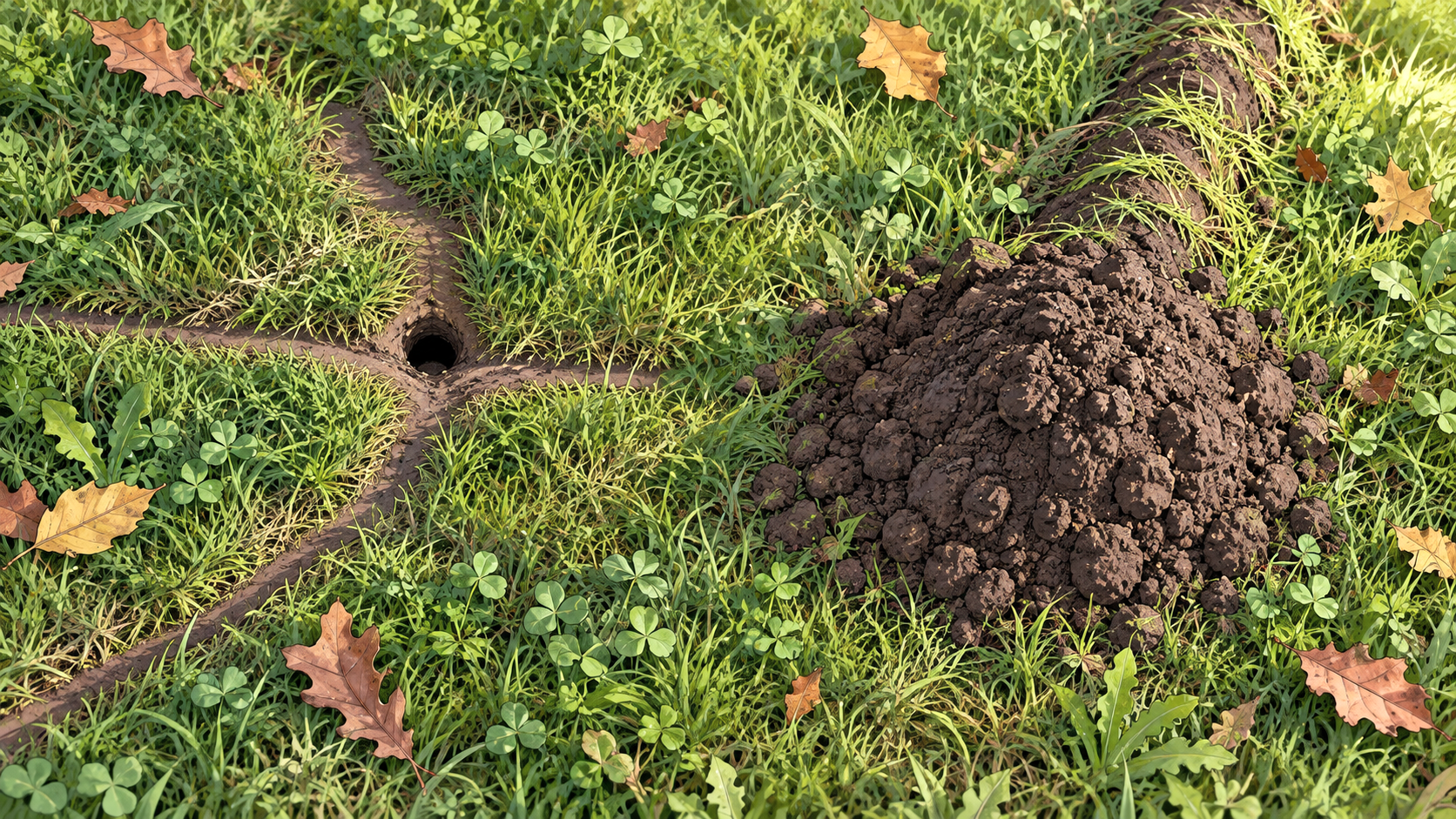
Vole holes are usually small, open entrances in the ground with little or no excavated soil around them, while mole holes are typically associated with raised tunnels or mounds of loose earth. A vole entrance often connects to narrow pathways through grass. A mole’s tunnel generally remains covered by soil, and its deeper excavations may produce a mound with no visible open entrance.
The surrounding ground is more revealing than the opening itself. A round hole beneath vegetation suggests a different animal from a line of raised, spongy soil crossing the lawn. Neither feature is absolute, particularly where older tunnels are involved or several small mammals occupy the same area.
Vole Holes vs. Mole Holes: What to Look For
| Feature | Vole | Mole |
|---|---|---|
| Visible entrance | Usually an open, round hole | Often concealed or plugged |
| Typical opening | Approximately 1–2 inches wide | No consistently visible surface opening |
| Excavated soil | Usually little or none | Often produces mounds of loose soil |
| Ground around tunnels | Generally flat or slightly depressed | Frequently raised into ridges |
| Connected surface evidence | Narrow routes through vegetation | Continuous, raised soil ridges |
| Arrangement | Several openings connected by sheltered passages | Underground network with surface ridges and deeper tunnels |
| Best identification clue | Open holes associated with flattened grass | Raised ridges or soil mounds associated with closed tunnels |
These differences are most recognizable when the ground disturbance is fresh. Rain, mowing, foot traffic, and collapsing soil can change the appearance of older burrows.
Small, Open Holes Usually Point Toward Voles
A typical vole entrance appears as a dark, rounded opening between grass stems, beneath low-growing plants, or in exposed soil beside vegetation. The opening may be clearly visible from above or partly concealed by overhanging growth. In many grassland situations, the entrance blends into the surrounding ground because excavation has produced little noticeable soil displacement.
Common vole openings measure approximately 1½ to 2 inches across, although their size and appearance vary. Several may occur within a relatively small area, sometimes connected by surface pathways. Their edges are not necessarily perfectly circular; roots, stones, and loose soil can produce irregular outlines.
The surrounding soil usually remains close to its original level. An entrance may have a few loose particles nearby, but large piles are not typical of the surface burrows made by meadow voles. Vole holes and shallow burrows can also differ between species, particularly because woodland voles spend more time excavating belowground.
A cluster of openings beneath dense grass is more suggestive of voles than a single isolated hole. However, some small animals occupy abandoned burrows, and openings of similar diameter can originate from other species. The actual animal responsible cannot be identified from dimensions alone.
Mole Activity Often Appears as Raised Soil Rather Than an Open Hole
Moles excavate tunnels beneath the soil surface, pushing earth upward as they move. In lawns, the resulting disturbance often resembles a narrow, irregular ridge running beneath the grass. The surface remains largely intact, but the soil underneath has been displaced.
These raised mole tunnels form when soil is pushed upward from below. Fresh ridges can feel soft or springy because the earth beneath the turf has been loosened. Their outlines often curve through the lawn, sometimes connecting with additional sections or disappearing beneath undisturbed ground.
Deeper excavation produces a different sign: a mound of loose soil deposited at the surface. Molehills commonly have rounded margins, and the opening through which the soil was pushed is generally plugged. A mound may therefore lack the obvious open entrance associated with a vole burrow.
The presence of raised ridges and fresh soil mounds provides stronger evidence of mole activity than a small depression with no excavated earth. Some mole tunnels remain entirely concealed, however, and not every underground passage produces a mound visible from the lawn. Mole tunneling can also displace soil without leaving a neatly formed pile. The surrounding pattern should be examined before deciding that an unusual patch of disturbed earth was created by a particular animal.
Look at Whether the Ground Is Raised or Worn Down
The direction of soil displacement offers a useful way to distinguish the two patterns. Moles push earth upward when constructing shallow tunnels, whereas voles moving through grass commonly leave a relatively flat or slightly recessed pathway.
An exposed vole route may resemble a narrow channel where vegetation has been pressed aside or clipped close to the soil. The track itself is not necessarily an underground tunnel. It is often a passage through grass that connects surface openings.
This is why vole runways in grass can look like winding grooves, while mole activity produces low ridges under otherwise intact turf. The different patterns of lawn disturbance are especially noticeable where the grass is short enough to reveal the ground surface.
A useful comparison involves examining two nearby lines in the lawn. One consists of raised earth with grass stretched over it. The other contains flattened stems and a narrow exposed strip at ground level. The first favors a mole, while the second favors a vole.
Rain and settling can eventually flatten a mole ridge. Similarly, a vole pathway may lose its distinct channel as vegetation regrows. Older signs require more supporting evidence than freshly formed ones.
What Soil Mounds Can Tell You
A conspicuous pile of freshly excavated earth makes a typical meadow vole entrance less likely. Mole excavations can produce rounded mounds containing loose soil or small clumps, usually with the passage beneath the mound closed.
The shape and location of molehills reflect the movement of excavated soil through underground tunnels. Several mounds may occur along the same deeper passage, even when no animal or exposed opening is visible.
Not every small mound belongs to a mole. Woodland voles can push limited amounts of soil to the surface, and other burrowing animals produce their own characteristic excavations. A small pile beside an open entrance therefore needs closer examination than a substantial molehill connected with raised ridges.
Mounds should also be distinguished from ordinary soil disturbances caused by gardening, displaced mulch, or weather. A recognizable tunnel pattern strengthens an identification that would otherwise depend on the appearance of one pile.
Can Voles Use Holes or Tunnels Made by Moles?
Yes. Voles can occupy passages originally excavated by moles, which means an opening or tunnel may have been created by one animal and subsequently used by another.
This shared use complicates identification when a property contains several types of ground disturbance. An old mole tunnel can remain accessible after its original occupant stops using it. The presence of a vole nearby does not establish that the vole excavated the passage, just as a mole’s previous activity does not prove that it remains there.
The overlap in mole and vole tunnel use also helps explain why raised ridges may occur near clipped plants or narrow grass pathways. Different signs can belong to different animals, even when they appear connected.
Supporting evidence is especially valuable in this situation. Vole droppings or freshly clipped vegetation within a ground-level route can indicate vole use, while newly raised soil provides evidence of recent excavation. Neither observation establishes that the animals were present simultaneously.
When a Single Hole Is Not Enough to Identify the Animal
A solitary hole without fresh soil, tracks, recognizable pathways, or an animal sighting offers limited information. Its diameter may fit a vole entrance, but similar openings can be made or occupied by other small mammals.
The recognition of small holes in lawns requires examining their surroundings because several animals produce openings of comparable size. A hole beneath a tree, one beside a foundation, and another in dense grass may have different origins despite looking similar from above.
The most useful inspection includes the opening itself and the immediately surrounding ground. Look for raised soil, a plugged mound, vegetation pressed into a narrow route, or several connected entrances. A photograph showing the broader pattern preserves more information than a close-up of the hole alone.
A fresh sequence of signs associated with vole activity may strengthen a vole identification. Where raised soil dominates instead, mole excavation becomes the more plausible explanation. A photograph or direct observation of the animal can resolve uncertainty that ground evidence alone cannot settle.
If neither pattern is evident, leave the identification open rather than assuming that every small hole belongs to a vole or every disturbed patch of soil belongs to a mole.