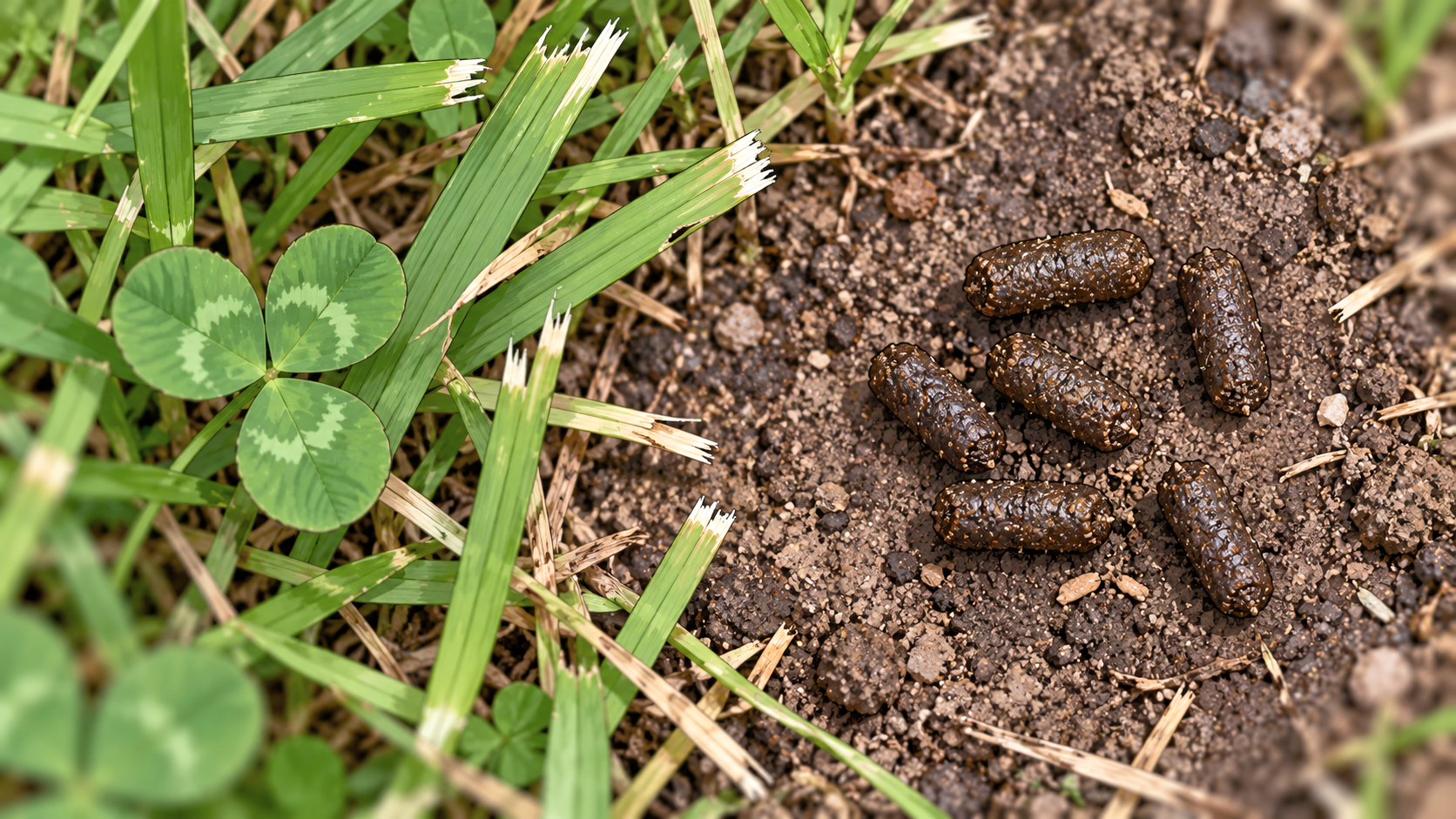
Vole poop looks like tiny, elongated pellets resembling miniature grains of rice. The droppings are typically about 3/16 inch (4.5–5 mm) long, with a greenish color when fresh that gradually changes to brown or gray as they age. They may occur individually or in small accumulations, particularly along well-used travel routes in grass and near burrow entrances.
The pellets are easy to overlook because they blend into soil, dried vegetation, and other organic debris. Their appearance offers useful identification evidence, but a small dropping found on its own cannot conclusively establish that a vole produced it.
Size, Shape, and Color of Vole Droppings
A typical vole dropping is oblong, with a slightly rounded or tapered outline. It is much smaller than an ordinary grain of rice, although its overall shape is similar. Individual pellets can appear smooth and compact, with minor variations in their length and thickness.
California vole identification records describe droppings approximately 0.18 inch (4.5 mm) long. This is a useful reference measurement for familiar North American Microtus species, but it should not be applied as an exact dimension to every vole worldwide. The different types of voles vary in body size and feeding habits, so their fecal pellets need not be identical.
Color is another recognizable characteristic. Fresh droppings may appear greenish or olive-brown, reflecting the plant material passing through the animal’s digestive system. Older pellets typically lose their green coloration and become brown or gray. Fresh vole feces are commonly greenish before changing color with exposure, although environmental conditions influence how quickly those changes become visible.
There is no single shade that establishes when a pellet was deposited. Moisture, sunlight, soil contact, and the animal’s recent food intake can all affect its appearance. A dark pellet is not necessarily fresh, and a brown one is not automatically old.
Where Vole Droppings Usually Accumulate
The most revealing place to find vole feces is inside a frequently used passage through grass. Small pellets may lie directly on the ground along the route, sometimes mixed with short pieces of clipped vegetation. Accumulations are particularly noticeable where the animals repeatedly move through the same sheltered section.
Well-traveled vole runways can contain both feces and vegetation fragments. The pellets may be scattered rather than concentrated in a single pile, with some concealed beneath surrounding grass stems. Gently separating the vegetation can reveal material that was not visible from above.
The arrangement is closely associated with surface travel routes used by meadow voles. Repeated movement through the same passage provides opportunities for droppings to accumulate, but finding feces there does not establish how many animals contributed them.
Small deposits may also occur near vole burrow openings, particularly where the surrounding ground provides protective vegetation. Woodland voles spend more time underground, so their droppings are less likely to be encountered in conspicuous surface pathways. The absence of exposed feces does not rule out an underground-dwelling vole.
In orchards and other cultivated areas, pellets may be visible beneath ground cover or along sheltered passages between plants. Agricultural monitoring guidance recognizes feces beside active vole runways and entrances as supporting evidence of occupation.
Can You Tell Whether Vole Droppings Are Fresh?
Fresh droppings often retain their greenish coloration and may appear alongside recently clipped grass. Older material tends to become brown or gray as it dries and remains exposed to the environment. The surrounding signs are useful because color alone does not provide a dependable age.
An accumulation of pellets mixed with fresh vegetation fragments is more suggestive of recent activity than isolated droppings lying among decaying leaves. Greenish or brown, rice-shaped pellets within surface runways are recognized as evidence associated with vole activity, particularly where the passages remain clear of plant regrowth.
Environmental conditions can complicate interpretation. Rain may scatter pellets or alter their appearance, while dense vegetation can protect older material from direct sunlight. Droppings sheltered beneath grass may remain recognizable after an animal has stopped using the passage.
Fresh-looking feces should therefore be considered alongside other evidence of voles currently occupying a yard. Their presence is informative, but it cannot establish an exact deposition time or prove that a particular passage remains occupied.
Can Vole Poop Be Mistaken for Other Animal Droppings?
Yes. Small rodents produce fecal pellets with overlapping shapes and dimensions, and visual differences are not always sufficient for confident identification. A few dark, elongated pellets could originate from a vole, mouse, or another small mammal.
The similarity between vole and mouse droppings is well recognized in wildlife identification guidance. Vole pellets may have a greenish appearance and occur along grassy routes, but neither characteristic provides an absolute distinction.
The animal’s surroundings are especially important. Pellets found within a narrow passage beneath clipped grass support a vole identification more strongly than identical-looking pellets discovered on an exposed patio. Likewise, feces found near damaged stored food should not automatically be attributed to a vole merely because individual pellets appear small.
The physical differences between voles and mice can resolve uncertainty when the animal itself is observed. An identifiable photograph provides evidence that fecal pellets alone cannot supply.
What Does a Pile of Vole Droppings Tell You?
A concentration of pellets suggests that animals have repeatedly occupied or traveled through the location, particularly if the material lies along a sheltered route. It does not provide a reliable count of the animals responsible.
One vole can leave droppings over multiple visits, while several animals may use overlapping portions of the same passage. Accumulations also depend on how long the pellets remain undisturbed. The number of voles living in a shared area varies among species, and fecal deposits cannot distinguish individual contributors without specialized analysis.
Nor does the presence of feces establish whether plant damage nearby was caused by voles. Identifying the animal responsible requires considering the pellets alongside other physical evidence, rather than treating their proximity to an injured plant as proof.
The combination of droppings, clipped vegetation, and surface passages is substantially more informative than any one feature viewed separately.
How to Examine Suspected Vole Droppings
A photograph showing the pellets in their original position is more useful than collecting or crushing them. Include a ruler or another fixed-size reference in the photograph, and preserve a wider view showing the surrounding grass, soil, or burrow entrance. Close-up images can reveal shape and approximate dimensions, while the wider view preserves the context needed for identification.
Avoid touching pellets with bare hands, breaking them apart, or disturbing dried material to inspect its contents. The CDC’s rodent-exposure precautions emphasize avoiding direct contact with rodents and their waste. Handling precautions are separate from determining which animal produced the droppings.
If the pellets are too small or indistinct to identify confidently, record their appearance and location without assigning a species. A visible vole using the surrounding area, combined with characteristic feces, provides much stronger evidence than an isolated pellet.