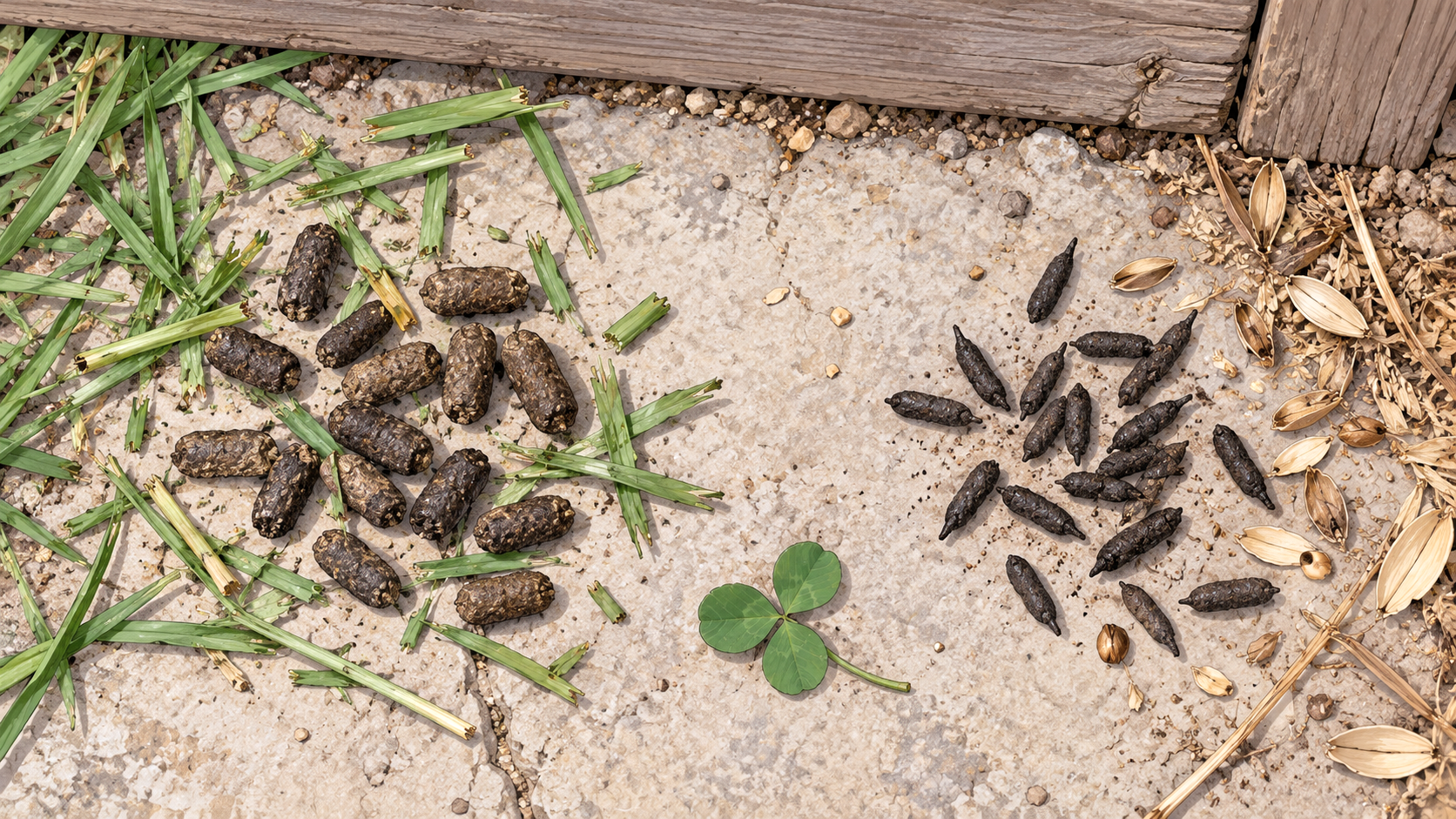
Vole droppings and mouse droppings look remarkably similar, but vole pellets are often slightly shorter and more rounded, while house mouse droppings are typically slender with tapered or pointed ends. Both can measure approximately 3–6 millimeters long, so size alone cannot reliably distinguish them. Where the droppings occur and what other evidence surrounds them usually provide stronger identification clues.
Pellets discovered in narrow grassy runways alongside freshly clipped vegetation are more suggestive of voles. Similar-looking droppings inside kitchen cabinets, behind appliances, or along indoor walls are more consistent with house mice. Neither location nor pellet shape provides absolute proof, particularly around sheds and other structures where both animals may occur.
The Size Difference Is Smaller Than You Might Expect
Vole pellets are not consistently larger or smaller than mouse pellets. Descriptions of vole droppings commonly give a length of approximately 4.5 millimeters, or 3/16 inch, while house mouse droppings generally measure about 3–6 millimeters. The overlap is substantial. A four-millimeter pellet could fall within either range, and an unusually short mouse dropping may resemble a typical vole dropping.
A practical comparison highlights the limits of the visible differences.
| Feature | Vole droppings | House mouse droppings |
|---|---|---|
| Typical length | Approximately 3–5 mm | Approximately 3–6 mm |
| Shape | Short, oblong, often rounded at the ends | More elongated, often tapered or pointed |
| Fresh color | May appear greenish or dark brown | Usually dark brown to black |
| Weathered color | Brown, gray, or faded | Brown, grayish, or faded |
| Common location | Grass runways, burrow entrances, sheltered vegetation | Indoor walls, cabinets, storage areas, and sheltered outdoor locations |
| Most useful additional clue | Runways with clipped plant material | Indoor travel routes and evidence around stored food |
The approximately 4.5-millimeter length of vole droppings falls directly within the familiar range for mouse feces. House mouse droppings averaging about 1/4 inch may be somewhat longer, but individual pellets vary.
Measuring a single dropping is therefore less informative than examining the overall pattern of several pellets and the location where they accumulated.
Are Vole Droppings More Rounded Than Mouse Droppings?
The ends of the pellets can provide a useful visual clue, although the difference is not dependable enough for identification by itself. Vole droppings often have a compact, oval or short cylindrical appearance, with ends that look rounded or only slightly tapered. House mouse droppings tend to resemble narrow grains of rice, frequently narrowing toward one or both tips.
The tapered appearance of typical house mouse feces is a familiar feature in rodent identification. However, natural variation means that not every mouse dropping has two sharply pointed ends. Moisture, drying, and physical damage can also change a pellet’s apparent shape. A broken mouse dropping may look shorter and blunter than an intact one, while a vole dropping can appear more elongated depending on its orientation.
For this reason, a photograph showing only one dark pellet against a plain background is rarely enough to establish which animal produced it. The normal appearance of vole droppings must be considered alongside the animal’s surroundings rather than treated as a unique shape that no other rodent produces.
Can Their Colors Help You Tell Them Apart?
Fresh vole droppings sometimes have a greenish tint associated with the animal’s plant-based diet. Mouse droppings are more commonly described as dark brown or black.
In established vole pathways, fresh greenish pellets can occur beside clipped grass stems. That combination provides stronger evidence than color alone because both the feces and nearby feeding material fit the same animal’s activity.
Once exposed to weather, vole droppings can turn brown or gray. Mouse droppings may also become duller and lighter as they dry, making older material particularly difficult to distinguish.
Diet introduces additional variation. A vole consuming seeds or other plant material may not produce pellets that look exactly like those from an animal feeding heavily on fresh vegetation. The color of an individual pellet therefore cannot establish its producer, age, or health status. We would give a fresh greenish pellet some identification value when it appears in a recognizable grass runway. A greenish pellet found by itself in a garage deserves much less confidence.
Where You Find the Droppings Is Often More Revealing
A cluster of small pellets in a narrow, worn pathway beneath dense grass strongly favors vole activity. Voles regularly travel through surface runways connecting sheltered areas and burrow entrances, often leaving droppings and vegetation fragments along those routes.
House mice use different environments. They frequently travel along walls and sheltered edges inside buildings, leaving droppings near food, nesting material, and regular routes between protected spaces. Their association with buildings and stored food makes indoor location a valuable clue.
The comparison becomes less straightforward in places where outdoor and indoor habitats overlap.
A garden shed with grass growing against its foundation may be accessible to both animals. A mouse can travel outdoors through vegetation, while a vole may occasionally enter a sheltered structure. Droppings found immediately inside the doorway cannot be assigned confidently without other evidence.
Likewise, small pellets in an outdoor compost area could come from several rodents. Their position near vegetation does not automatically make them vole droppings.
The differences between voles and mice become more useful when a living animal, clear tracks, or an identifiable nesting area can be examined.
The Evidence Around the Pellets Can Settle a Difficult Comparison
When size, shape, and color overlap, examine the nearby activity rather than searching for increasingly subtle differences in the feces.
For example, imagine finding six dark pellets beneath a raised garden bed. Without additional evidence, either animal is plausible. If the pellets lie inside a narrow grass runway leading to shallow burrow openings and freshly clipped stems, the evidence points toward voles. If similar pellets appear beside gnawed food packaging inside a storage cupboard, house mice become more likely.
The combination of runways, burrow openings, and fresh plant clippings is more characteristic of vole activity than any individual pellet measurement.
Several additional observations can strengthen the assessment without requiring direct contact with the waste:
- Grass condition: Short, worn pathways through otherwise taller vegetation favor voles.
- Associated feeding: Newly clipped stems near pellets support an outdoor plant-feeding rodent.
- Building access: Droppings following protected indoor edges favor mice.
- Stored materials: Gnawed packaging, shredded paper, and indoor nesting evidence favor house mice.
- Animal sightings: A clear view of the tail, ears, and body proportions can provide much stronger identification than feces.
These clues should be considered together. A vole can consume seeds, and a mouse can feed on outdoor vegetation, so neither diet nor location is exclusive to one animal.
Where fresh signs of vole activity occur alongside matching pellets, identification becomes more convincing. Old runways and old droppings, however, may reflect activity from different periods.
What If You Find Both Types of Droppings in One Area?
Different-looking pellets do not necessarily indicate that both voles and mice are present. A single animal can produce feces that vary somewhat in size and shape, and drying can make pellets within the same accumulation look different.
Nevertheless, mixed rodent activity is possible, especially around agricultural buildings, sheds, and properties bordering fields. The presence of vole runways outside does not exclude a separate mouse problem indoors.
One useful distinction is whether the evidence forms two recognizable patterns. Pellets consistently associated with clipped vegetation and surface runways may indicate outdoor vole activity, while a separate accumulation inside cabinets or behind appliances may reflect house mice.
Do not assume that finding a mouse-like dropping inside a building proves that the outdoor vole population has moved indoors. The animals have different habitat preferences, and multiple species may use the same property independently.
How Certain Can You Be Without Seeing the Animal?
Droppings can support a probable identification, but they are rarely sufficient to distinguish voles from house mice with certainty.
The most difficult examples are isolated pellets, weathered material, and waste found where the animals’ habitats overlap. Measurements cannot eliminate that uncertainty because their typical size ranges substantially overlap.
Avoid crushing, smelling, or handling droppings to investigate their contents. Their texture is not a dependable species-level identification test, and unnecessary disturbance creates avoidable exposure to contaminated material.
If the pellets must be removed, safe cleanup of vole and other rodent droppings involves wet disinfection rather than dry sweeping or vacuuming. The precautions for cleaning rodent-contaminated surfaces apply even when the exact rodent species remains unknown.
For an uncertain identification, photograph the pellets in their original location with a ruler nearby, without touching or rearranging them. Include surrounding vegetation, openings, or structural features in additional photographs. Those details provide more useful evidence than a highly magnified image of a single pellet.
One thought on “Vole Droppings vs. Mouse Droppings: How to Tell Them Apart”