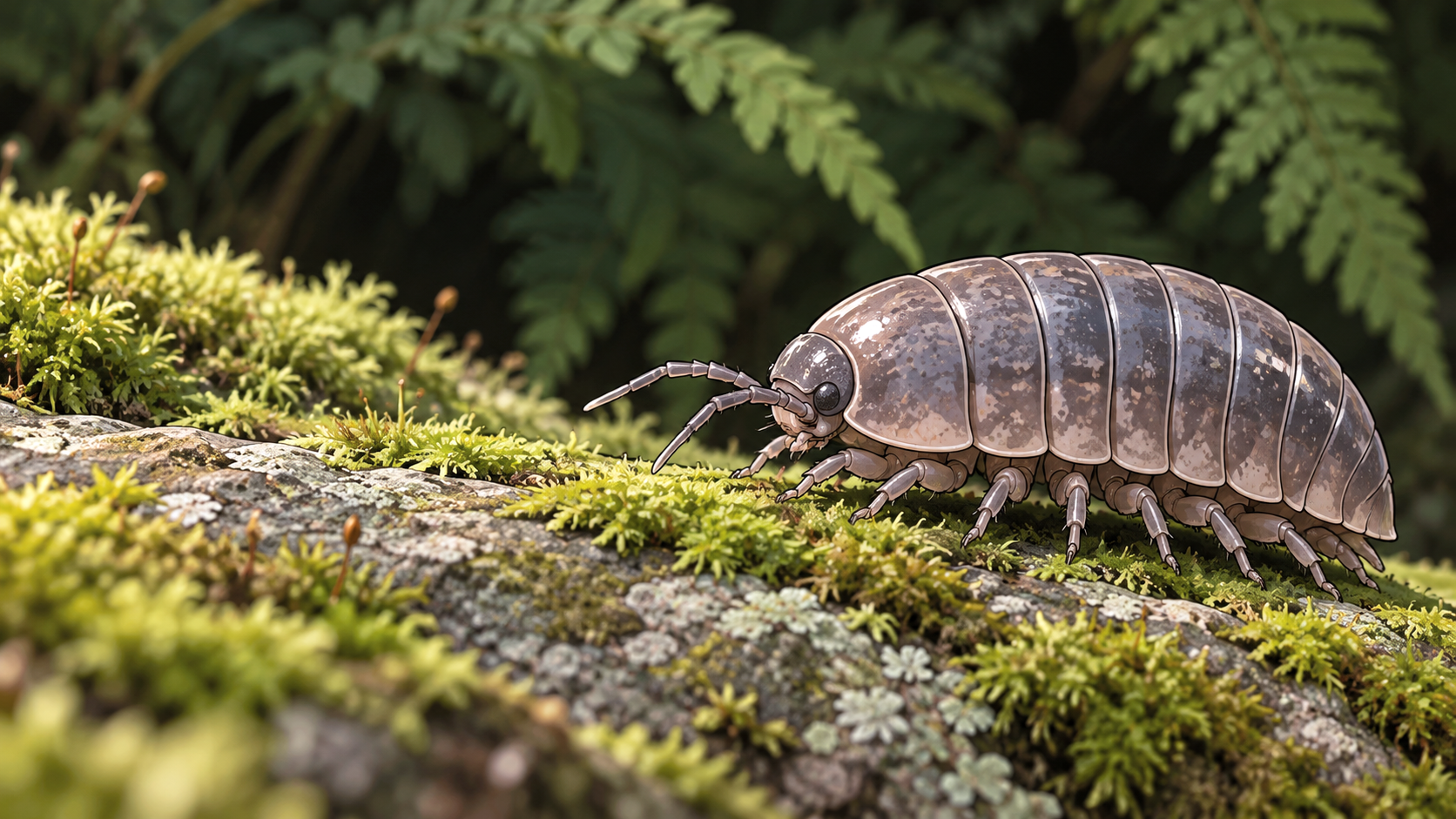
The scientific name for the common roly-poly is Armadillidium vulgare, a species of terrestrial crustacean belonging to the order Isopoda and the family Armadillidiidae. The name identifies the familiar pill bug that curls into a tight ball when disturbed. However, roly-poly is a common name shared by several related species, so Armadillidium vulgare does not refer to every animal called a roly-poly. The scientific classification of Armadillidium vulgare recognizes it as a valid species. Its name was established by Pierre André Latreille in 1804, although the species was originally described under a different genus.
What Does Armadillidium vulgare Mean?
The scientific name consists of two parts. Armadillidium is the genus, while vulgare is the specific epithet identifying the species within that genus. The Latin word vulgare means common or ordinary, reflecting its status as the common pill bug.
The genus name is associated with the animal’s armored appearance and its resemblance to an armadillo when curled. Both animals have protective body coverings and can adopt defensive postures, although they belong to entirely different groups.
Scientific names are written in italics, with the genus capitalized and the specific epithet lowercase. The full name is therefore Armadillidium vulgare, not Armadillidium Vulgare or armadillidium vulgare. Once the genus has been established, the abbreviated form A. vulgare is acceptable.
Its original scientific name was Armadillo vulgaris, published in 1804. The accepted taxonomic record retains that earlier combination as a synonym rather than treating it as a separate living species. The name Armadillidium vulgare (Latreille, 1804) includes parentheses around the author and date because the species was originally described under another genus.
Where Do Roly-Polies Fit in Scientific Classification?
Although roly-polies are commonly called bugs, they are crustaceans rather than insects. Their classification places them in the same broad crustacean lineage as crabs and shrimp, while recognizing their separate evolutionary branch within the terrestrial isopods.
| Taxonomic rank | Classification |
|---|---|
| Kingdom | Animalia |
| Phylum | Arthropoda |
| Subphylum | Crustacea |
| Class | Malacostraca |
| Order | Isopoda |
| Suborder | Oniscidea |
| Family | Armadillidiidae |
| Genus | Armadillidium |
| Species | Armadillidium vulgare |
The National Center for Biotechnology Information’s taxonomy record places the common pill bug within Oniscidea, the group containing terrestrial isopods commonly called woodlice.
The order Isopoda includes aquatic and land-dwelling species, so being an isopod does not automatically make an animal a roly-poly. For example, the small crustaceans sometimes confused with springtails during identification belong to a different arthropod lineage from springtails, despite sharing damp environments.
Do All Roly-Polies Have the Same Scientific Name?
Different pill bug species have their own scientific names, even when they share the familiar rounded body and defensive curling behavior.
The genus Armadillidium contains multiple species, including the common pill bug and several other pill woodlice. Some are visually similar enough that casual inspection cannot reliably establish their identity.
Examples include:
| Scientific name | Common name |
|---|---|
| Armadillidium vulgare | Common pill woodlouse |
| Armadillidium nasatum | Nosy pill woodlouse |
| Armadillidium depressum | Southern pill woodlouse |
| Armadillidium pictum | Painted pill woodlouse |
The southern pill woodlouse, Armadillidium depressum, reaches 20 millimeters in length and has a raised plate between its antennae. The species identification description also identifies differences in its rear body segments that distinguish it from A. vulgare.
The painted pill woodlouse, Armadillidium pictum, has a noticeably mottled appearance and reaches approximately 9 millimeters. Its diagnostic markings include a dark patch on the seventh lateral body plate, a feature absent from the common pill bug.
A scientific name therefore identifies a particular species rather than every member of a group sharing the same everyday nickname.
Is Armadillidium vulgare the Same as a Sowbug?
Sowbugs and common pill bugs belong to the terrestrial isopods, but the name Armadillidium vulgare applies specifically to the common pill bug. Animals commonly called sowbugs include species belonging to other genera, particularly Porcellio and Oniscus.
The common pill bug’s identification characteristics include its ability to close into a protective ball. Typical sowbugs have flatter bodies and rear appendages that prevent them from forming the same tightly enclosed sphere.
Even the ability to curl up requires some care when identifying species. Armadillidium nasatum, for example, cannot form the completely closed sphere characteristic of A. vulgare. Its antennae remain visible through a small opening. The woodlouse identification guide documents differences in how related species roll up. For an unidentified garden specimen, Armadillidium vulgare is an appropriate scientific name only when the animal’s identifying features support that species. Otherwise, Armadillidium sp. identifies an individual within the genus without assigning an unsupported species name.