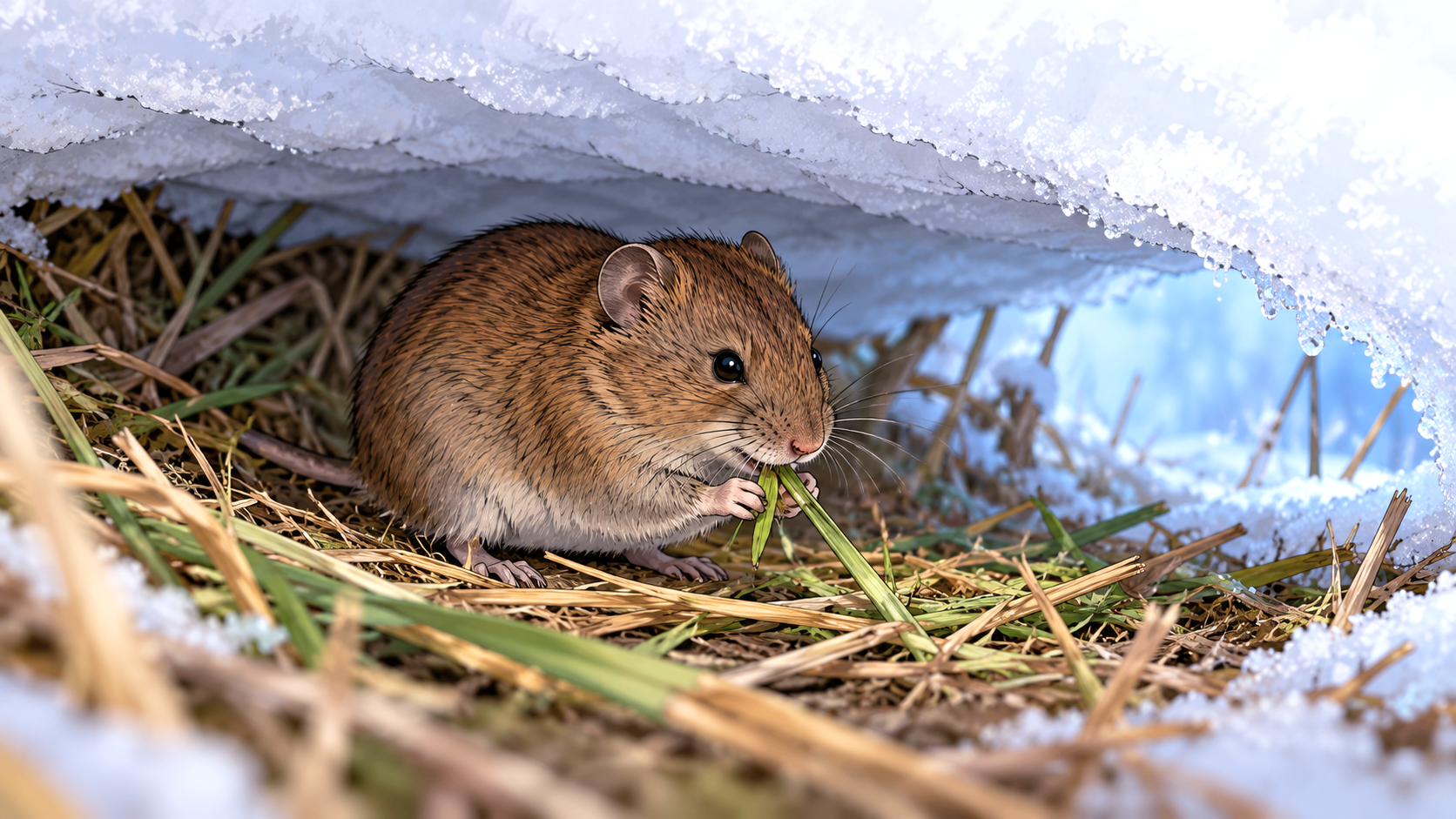
Voles do not hibernate in winter. They remain active throughout the cold months, moving through sheltered passages beneath snow, using burrows, and resting in insulated nests. Meadow voles, woodland voles, and several other North American species continue their normal activities despite freezing temperatures. Snow cover can actually provide protection from extreme cold, allowing voles to travel beneath it while remaining hidden from view. A lawn that appears completely undisturbed in January may still contain active voles. Their movements often take place beneath the snow rather than across its surface, so the absence of visible animals is not evidence of winter dormancy.
Snow Creates a Sheltered Space Where Voles Can Remain Active
Deep snow can separate the cold air above from the comparatively stable temperatures near the ground. The sheltered space between the soil surface and the overlying snowpack is called the subnivean zone. It provides an environment where small mammals can travel, rest, and maintain access to ground-level vegetation without being continuously exposed to winter air.
Voles are among the mammals that occupy this environment. The National Park Service’s account of small mammals in Denali identifies several vole species that remain active year-round and use spaces beneath the snow. Their winter movements can occur entirely out of sight, even in landscapes covered by substantial snowfall.
Snow depth and structure influence how well this shelter functions. A loose, continuous snowpack can insulate the ground more effectively than thin or icy cover. Research on meadow voles in Sudbury, Ontario, documented greater winter mortality when snow was shallow or icy and when nests became saturated during thawing conditions. The study of snow conditions and meadow vole survival illustrates why a winter with persistent snow cover presents different challenges from one marked by freezing rain and repeated thaws.
The habitats occupied by voles influence how much protection is available before snow accumulates. Dense vegetation, existing ground cover, and natural objects can provide sheltered spaces, while snow changes the environment through which the animals travel.
Winter Vole Movements Can Differ From Autumn Activity
Radio-tracking research on meadow voles (Microtus pennsylvanicus) documented changes in how the animals used space as temperatures fell. Individuals that had occupied more widely separated areas during early autumn began concentrating their movements and using communal winter shelters.
The field investigation of meadow vole winter movements found that movement became more localized as daily temperatures approached freezing. Once snow covered the ground, however, the animals moved more freely beneath it than they had during exposed cold conditions.
This helps explain why an established vole runway through grass may remain hidden for months while the animals continue using the surrounding area. Winter movement is shaped by the conditions beneath the snow, not simply by whether temperatures above the snowpack are below freezing.
Individual species also differ. Woodland voles (Microtus pinetorum) already spend much of their time in shallow underground passages. Their winter shelter is therefore closely associated with an existing subterranean lifestyle. The Canadian woodland vole status assessment documents continued winter activity, food storage, and communal nesting in this species.
Voles Use Their Nests to Conserve Body Heat
Cold-weather survival requires more than remaining beneath snow. Voles also reduce heat loss through their coats, nesting materials, and resting behavior.
Meadow voles develop seasonal changes in their fur and nesting behavior as daylight hours shorten. An experimental study of winter adaptations in meadow voles found that animals exposed to shorter daylight periods gathered more nesting material, developed longer dorsal hairs and additional underfur, and showed reduced energy requirements compared with those experiencing longer days.
These changes prepare the animals for cold conditions without requiring prolonged physiological dormancy. They remain capable of moving and responding to their surroundings while using insulated resting spaces to reduce heat loss.
Communal nesting provides another advantage in some species. Research on taiga voles (Microtus xanthognathus) in Alaska documented winter groups sharing nests that remained warmer than the surrounding ground. Group nesting reduced the energy required to maintain body temperature.
Winter social behavior varies among voles, so sharing a nest should not be assumed for every species or individual. The social organization and colony sizes of voles also change with species and season, rather than following one universal arrangement.
What Happens When There Is Little or No Snow?
A snow-free winter removes much of the protection that an insulated subnivean environment provides. Voles must then rely more heavily on existing vegetation, underground passages, and other sheltered locations. Frozen ground, wind exposure, and abrupt changes in temperature can restrict movement and increase the difficulty of maintaining body heat.
Conditions become especially hazardous when snow melts and refreezes. Ice layers can restrict movement and access to protected spaces, while water entering a nest can compromise its insulation. The research on seasonal snow conditions and meadow vole survival documented the consequences of these changing winter environments rather than treating the entire cold season as one uniform period.
A warmer winter is not automatically easier for voles. Frequent thaws can disrupt previously sheltered spaces, particularly when meltwater collects near the ground and subsequently freezes. The condition of the snowpack can be more informative than air temperature alone.
Why Vole Activity Often Becomes Obvious After Snow Melts
Once spring exposes the ground, homeowners may discover flattened grass pathways, damaged vegetation, or openings that were hidden beneath snow. These signs can reflect activity accumulated over the preceding months rather than a sudden arrival of voles during spring.
The winter activity of meadow voles can also result in damage to woody plants during cold weather. The specific foods available to voles in winter influence where feeding takes place, although visible damage may not become apparent until snow recedes.
An exposed pathway does not establish that voles are still occupying it. Old routes can persist after activity has shifted elsewhere, and several openings may belong to the same network. The signs of voles in a yard are more useful when considered together with fresh evidence rather than interpreted from a single trail.
For a homeowner concerned about winter activity, the most useful approach is to record where signs appear after snowmelt and compare them with areas showing recent activity. Avoid assuming that freezing weather has eliminated voles or that every exposed pathway requires treatment. If damage continues during the cold months, winter conditions affect which vole-control methods are practical, particularly where snow and frozen ground limit access.