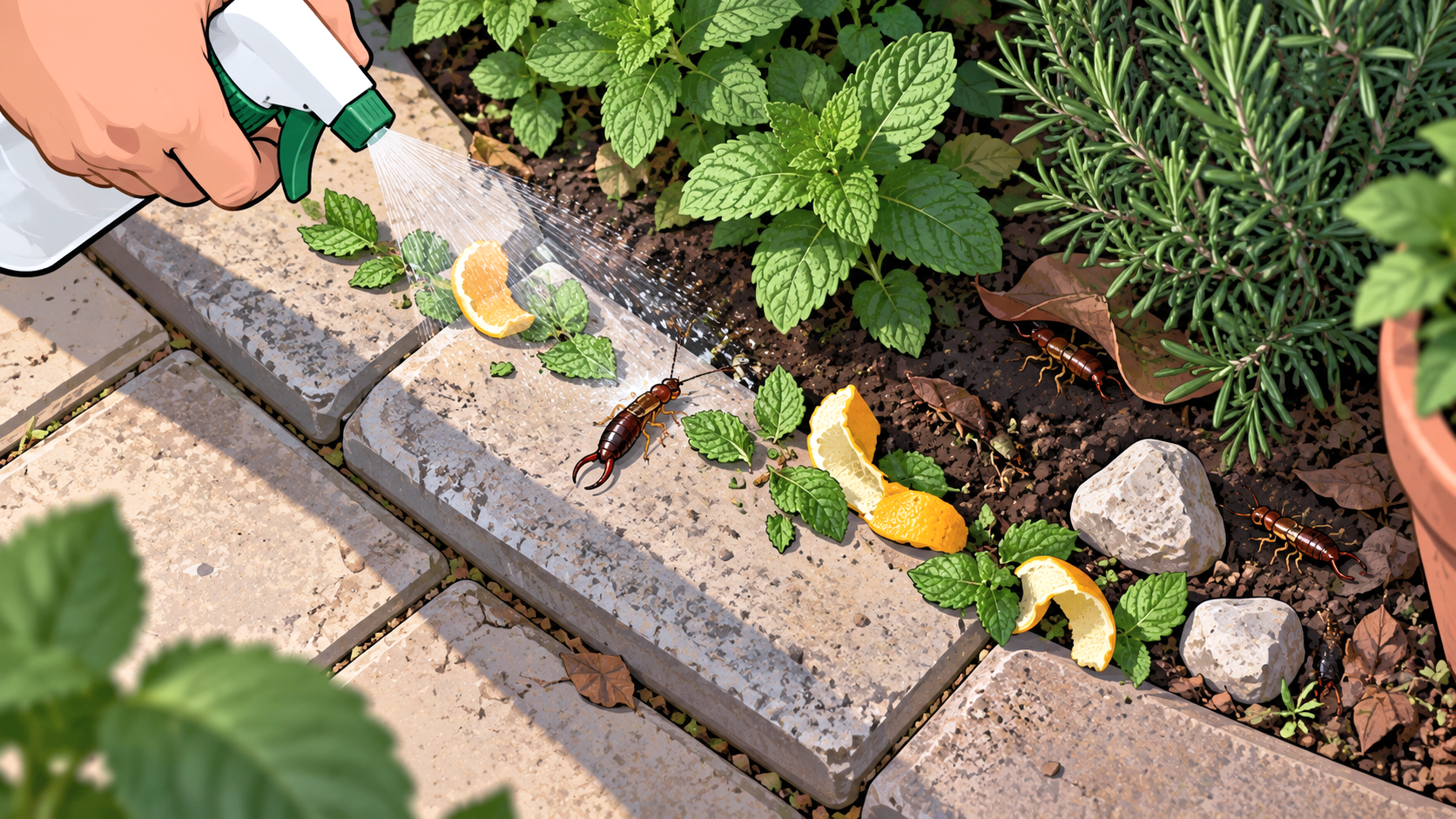
Search for what smell earwigs hate and you will quickly run into the same familiar suggestions: peppermint, lavender, eucalyptus, cinnamon, citrus, vinegar and coffee. They sound reasonable because each has a noticeable odor to us. The missing step is proving that an earwig responds to that odor strongly enough for it to work as a useful repellent.
There is no well-established household smell that we can confidently call a smell earwigs “hate.” Popular recommendations such as peppermint, lavender, vinegar and citrus should not be treated as proven earwig repellents without earwig-specific evidence. If the goal is to keep earwigs away, changing the conditions they use for shelter is more dependable than choosing a strong fragrance.
That answer is less satisfying than finding one magic scent, but it prevents a common pest-control mistake. A substance smelling powerful to a person tells us almost nothing about how an earwig will respond to it.
“Strong Smelling” and “Repellent to Earwigs” Are Not the Same Thing
A surprising number of homemade repellent claims begin with human perception. Peppermint smells intense, vinegar smells sharp, garlic is pungent and eucalyptus has an unmistakable aroma. From there, it is easy to assume a small insect must find the smell even more unpleasant.
Insect repellency does not work that simply. A substance has to produce a behavioral response in the particular insect being targeted. Even when a plant compound repels one insect species, that does not establish the same response in another. This is why we would not build an earwig-control plan around a list of strong-smelling household substances.
Earwigs actually have a more interesting relationship with odors than the usual “they hate strong smells” explanation suggests. European earwigs can aggregate in response to chemical cues associated with other earwigs. They also produce their own odorous defensive secretions when disturbed. That familiar unpleasant odor is explained further in our guide to why earwigs smell when you kill or disturb them.
Odor clearly matters in earwig biology. What does not follow is that every strong fragrance becomes a useful repellent.
Peppermint Is Popular, but It Needs Its Own Question
Peppermint deserves special mention because it appears so often in natural pest-control advice. It is also a good example of why we prefer to separate a specific remedy from a broad article about earwig behavior.
Peppermint oil contains biologically active compounds and has been investigated against various arthropods. However, effectiveness against one pest does not automatically establish effectiveness against earwigs. A homeowner applying peppermint around a doorway needs an answer about earwigs specifically, not evidence borrowed from ants, mosquitoes, spiders or another unrelated pest.
For that reason, we cover whether peppermint oil repels earwigs separately rather than declaring peppermint the smell earwigs hate. The distinction matters because “peppermint has insect-repellent properties” and “peppermint reliably keeps earwigs away” are two different claims.
The same caution applies to lavender, eucalyptus, cinnamon and citrus. A long list of fragrant oils may make an article sound useful, but adding more unverified scents does not make the underlying advice stronger.
Coffee Grounds Have the Same Problem
Coffee creates a slightly different version of the smell argument. Used grounds have a noticeable aroma, and caffeine itself can affect certain insects under specific experimental conditions. Neither fact establishes the smell of coffee as an earwig repellent.
That matters because coffee grounds are sometimes scattered around plants as though they create an invisible scent barrier. The better question is whether earwigs actually avoid the material under realistic garden conditions. Our dedicated look at whether coffee grounds repel earwigs keeps that question separate from claims about caffeine toxicity or the effects of coffee on unrelated insects.
We would not use coffee grounds simply because they smell strong. Garden additions also change the physical environment around a plant, so their effects cannot be reduced to odor alone.
The Smells Earwigs Produce Themselves Tell Us Something More Interesting
Earwigs are not passive insects wandering around with no chemical communication of their own. Adults can release a foul-smelling defensive secretion when disturbed, and the chemistry of defensive secretions has been studied in several earwig species. Research on the European earwig, Forficula auricularia, found benzoquinones in its defensive secretion.
Young earwigs have chemical defenses too. Research on European earwig larvae found that they released a volatile secretion when attacked by ants. The secretion discouraged feeding by the ants, although it did not produce the same response in the spiders tested.
That last detail is particularly useful. Even an odor produced by an earwig specifically for defense does not affect every other arthropod in the same way. It is a neat demonstration of why “insects hate strong smells” is too crude a rule for pest control.
Earwig chemical communication also works in the opposite direction. Research has demonstrated aggregation behavior associated with chemical material from other European earwigs. So the more accurate picture is not an insect that simply runs from powerful odors. It is an animal capable of responding differently to different chemical cues.
What Earwigs Respond to More Predictably Than a Scent
For practical control, we would pay far more attention to where earwigs spend the day than to what a room or garden smells like. European earwigs are nocturnal and commonly hide in protected places during daylight. Their tendency to use dark, confined shelters is predictable enough that official control guidance deliberately turns that behavior against them.
Simple refuge traps work for exactly this reason. Rolled corrugated cardboard, newspaper, bamboo and similar sheltered spaces can collect earwigs during the day. Oil traps are another established option. Earwigs are strongly attracted to fish oil, with vegetable and other oils also used in traps.
That is much more useful than knowing that an essential oil smells unpleasant to us. Instead of hoping an odor changes the insect’s behavior, you exploit behavior already documented for the insect.
The same principle applies in a garden. Earwigs commonly occupy dark, protected areas, and populations can become troublesome around plants when suitable shelter and moisture are available. Checking plants after dark can help determine whether earwigs are actually responsible for damage before you start trying to drive them away. Our guide to what attracts earwigs goes deeper into those environmental conditions.
Make the Area Less Useful to Earwigs Instead of Making It Smell Different
A scent-based strategy has an awkward limitation even before we ask whether the scent works. It leaves the underlying earwig habitat untouched.
Suppose earwigs are hiding beneath dense debris beside a foundation and entering through gaps around the building. Making the doorway smell like mint does not remove the shelter or close the opening. If the odor disappears or the insect simply takes another route, the original problem remains.
Indoors, European earwigs are nuisance invaders and do not reproduce inside homes. Repeated sightings therefore make exterior conditions and entry routes more useful places to investigate than the scent of the room. Our guide to keeping earwigs out of the house focuses on that boundary rather than trying to perfume it.
Outside, the answer depends on whether the earwigs are causing meaningful plant damage. Earwigs can be both predators and plant feeders, so eliminating every earwig from a garden is not automatically desirable. Where damage is confirmed, garden earwig control can concentrate on the affected plants, nearby shelter and trapping rather than treating the whole yard.
This is where we think the “what smell do earwigs hate?” question becomes more useful. The best answer is not another scent to buy. It is recognizing that an earwig’s need for shelter gives you a more dependable control point than its supposed dislike of your spice rack.
Other Questions About Smells and Earwigs
Can I use several strong smells together to repel earwigs?
Combining several household substances does not establish an effective earwig repellent. It can also introduce unnecessary safety or surface-damage concerns depending on what is mixed. We would choose a documented earwig-control method instead of trying to make an increasingly strong-smelling homemade mixture.
Do earwigs have a sense of smell?
Earwigs can detect and respond to chemical cues in their environment. European earwig aggregation behavior, for example, has been demonstrated using chemical extracts associated with other earwigs. That does not mean their perception of odor corresponds to what humans describe as pleasant or unpleasant.
Why do earwigs sometimes gather together if they are not a colony?
Aggregation is different from living in a social colony such as an ant colony. European earwigs can gather in shared shelters, and chemical cues contribute to that behavior. Our guide to whether earwigs live in colonies explains that distinction in more detail.
What should I use if I simply want fewer earwigs around my home?
Start with the conditions that allow them to shelter near the building and the routes they can use to enter. Remove unnecessary hiding places close to likely entry points, correct persistent moisture problems where practical, seal accessible gaps and remove indoor earwigs with a vacuum or broom. For a broader plan, see our guide to deterring earwigs.
One thought on “What Smell Do Earwigs Hate?”