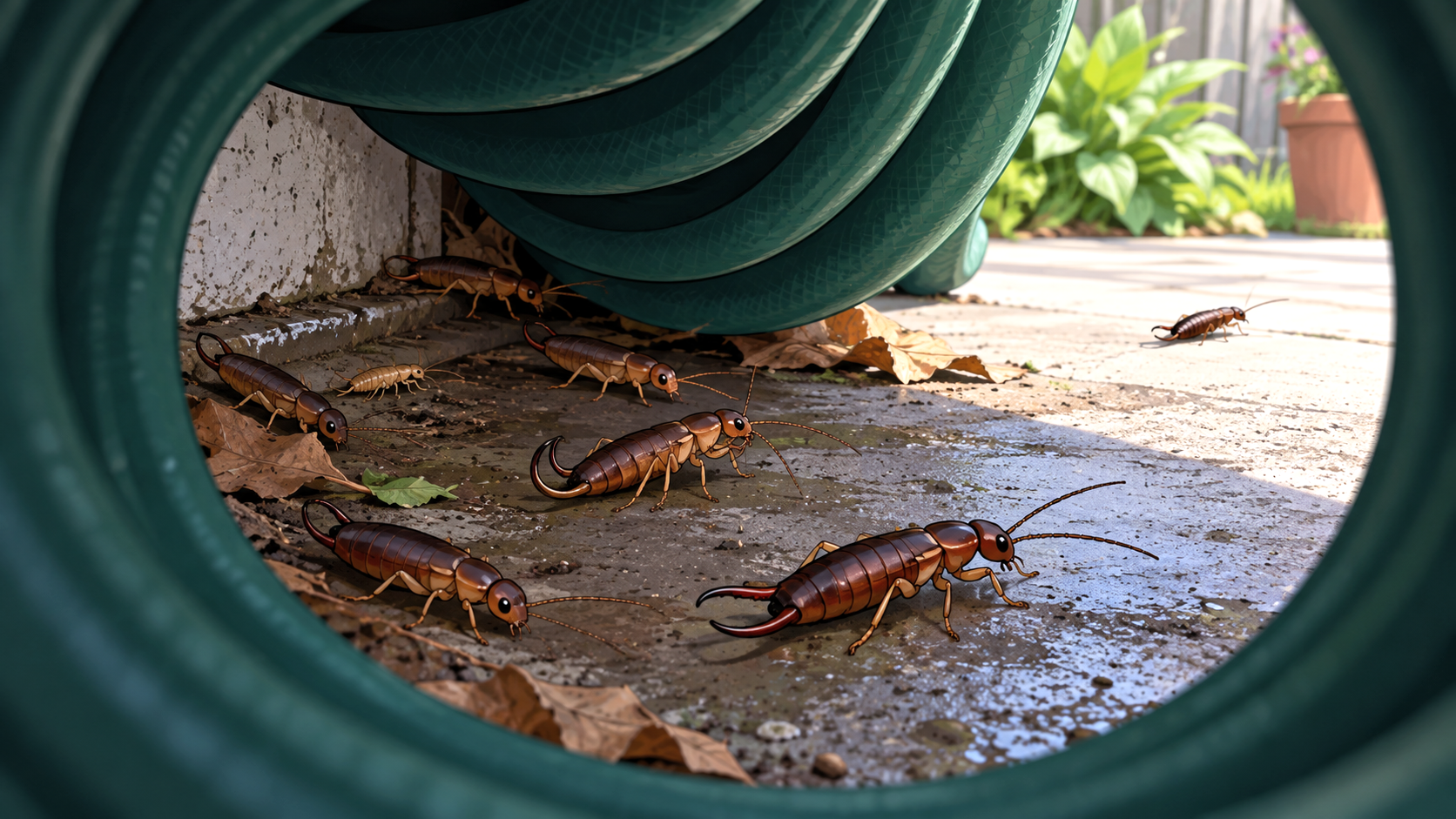
Lift a damp board and finding ten earwigs underneath it can look a lot like discovering a colony. That description is misleading, though. The insects may have deliberately gathered together, but they are not organized into the kind of permanent society that the word “colony” usually suggests.
Earwigs do not form colonies like ants, bees or termites. However, many earwigs are not strictly solitary either. European earwigs can gather in groups, sometimes in considerable numbers, and females live with their eggs and young for part of the life cycle. An earwig group is better described as an aggregation or family group than a colony.
A Group of Earwigs Is Not the Same as a Colony
The word “colony” carries a lot of baggage when we talk about insects. An ant or termite colony is an organized social unit. Individuals live together while performing different roles that support the group, and reproduction is concentrated in particular members of the society.
That is not how the European earwig, Forficula auricularia, lives.
Earwig social behavior is much more flexible. A major review of social life across the order Dermaptera describes earwigs living both alone and in groups. Depending on the species and circumstances, those groups can involve family members or unrelated individuals and range from only a few insects to several hundred.
That makes “earwigs live alone” too simple, but “earwigs live in colonies” goes too far in the other direction. Aggregation is the more useful word when multiple adult or juvenile earwigs gather together.
This distinction also matters when you find several in your yard or house. Ten earwigs underneath one object do not automatically represent a nest containing a self-sustaining colony.
Why Earwigs Gather Together
European earwigs do more than accidentally bump into one another because they all like damp places. They show documented aggregation behavior.
During the day, these nocturnal insects retreat into protected spaces. Tight gaps beneath bark, debris and other shelter can hold multiple individuals at once. Research in orchards has found European earwigs forming groups in tight spaces, including tree bark, fruit clusters and debris.
Chemical cues also help bring them together. European earwigs are attracted to cues associated with other earwigs. Experiments have demonstrated aggregation responses to chemical material left by earwigs, while field research has confirmed that shelters previously occupied by earwigs can attract additional individuals.
That changes how we interpret a pile of earwigs under a flowerpot. They are not necessarily ten independent insects that happened to choose the same hiding place by chance. Their tendency to aggregate can actively contribute to the cluster.
It also explains why earwig traps often collect several insects rather than one. Corrugated cardboard shelters are used to monitor European earwigs precisely because the insects readily occupy confined shelters together.
Earwig Groups Can Be Surprisingly Large
A cluster does not have to contain only two or three insects. European earwig aggregations can become much larger.
A 2024 behavioral study notes that adult European earwigs naturally vary considerably in how social they are. Some individuals remain solitary, while others live in groups ranging from a few individuals to several hundred. In other words, there is no fixed group size that defines normal earwig behavior.
Field monitoring shows how concentrated they can become. In one orchard study, researchers recorded average peaks of more than 20 adult earwigs per cardboard shelter, with the exact numbers changing over time and between years.
We think this is the most useful fact for homeowners because a large cluster looks far more alarming than a single wandering earwig. Numbers alone do not turn that gathering into an ant-style colony. Earwigs can simply concentrate heavily in a shelter they find suitable.
That is also why the number underneath one board does not necessarily tell you how many earwigs occupy the entire property.
Female Earwigs Form a Different Kind of Group With Their Young
There is one period when an earwig’s social life becomes much more intimate. Female earwigs provide maternal care.
A female European earwig creates a nest in the soil and lays her eggs there. She remains with them, protects the nest and tends the eggs. After hatching, first-stage and some second-stage nymphs remain with their mother before the older nymphs disperse to forage.
This behavior is unusual enough that we cover how earwigs take care of their young separately. It also means that a female surrounded by eggs or young nymphs should not be confused with a queen surrounded by workers.
The mother and offspring form a family group, not the beginning of a permanent colony. As the earwig life cycle progresses, the young become increasingly independent and leave the maternal nest.
There is no lifelong worker caste staying behind to expand the nest, gather food for a queen and raise future generations. Earwig maternal care is impressive precisely because it sits somewhere between completely solitary insect life and the highly organized societies most people picture when they hear “colony.”
Finding Lots of Earwigs Indoors Does Not Mean They Built a Colony There
This distinction becomes especially useful inside a house.
European earwigs may seek shelter inside buildings, but they do not reproduce indoors. Consequently, finding several together in a basement, garage or another sheltered location does not mean there is an indoor colony producing generations of earwigs somewhere behind the wall.
Multiple insects can enter from outdoors and end up concentrated where conditions provide suitable shelter. Their natural tendency to congregate makes a group sighting possible without indoor reproduction.
That is quite different from pests whose indoor populations can establish and multiply. With earwigs, repeated sightings are more useful as a reason to investigate why earwigs are entering the house than to hunt for a central queen or colony.
The same logic applies to the word “infestation.” A large number of earwigs around a property can certainly become a nuisance, but their social organization does not suddenly change. Our guide to the signs of an earwig infestation deals with the practical evidence of high activity without treating them as colony-forming insects.
Treat the Shelter as the Clue, Not the Group as a Colony
When you uncover a cluster of earwigs, the location tells you something useful. Rather than searching for a queen or permanent nest, look at why that particular spot is serving as shelter.
European earwigs hide during the day in dark, tight and moist places. Therefore, boards lying against soil, dense debris, protected cracks and similar cover can concentrate insects. The same conditions help explain what attracts earwigs around a property.
Removing unnecessary hiding places can make an area less favorable. Around a house, correcting persistent moisture problems and limiting protected debris near the foundation can also reduce places where earwigs gather. If the insects are repeatedly getting indoors, focus on keeping earwigs out of the house rather than looking for an indoor colony that behaves like an ant nest.
That is the practical difference the terminology makes. A colony suggests that destroying a central social unit is the objective. An earwig aggregation points you toward shelter, outdoor abundance and entry routes instead.
Other Questions About Earwig Groups
Do male and female earwigs gather together?
Yes. European earwig aggregation is not restricted to one sex. Adults of both sexes can participate in group living, although individual earwigs vary in how strongly they aggregate.
Do earwigs have a queen?
No. Earwigs do not have a reproductive queen caste comparable to ants or termites. Adult females reproduce and provide maternal care to their own offspring.
Do earwigs build communal nests?
European earwig females make soil nests for their eggs and young. Those maternal nests are different from the permanent communal nests built by highly social insects. Adult earwigs can also gather together in shared shelters without turning the shelter into a reproductive colony.
Can one earwig live by itself?
Yes. Earwigs can occur alone as well as in groups. Research on European earwigs has documented substantial individual variation in aggregation behavior, so being capable of group living does not make every earwig dependent on a group.
Why do I sometimes find many earwigs in one hiding place and none nearby?
Earwigs can concentrate in suitable shelters rather than spreading evenly across an area. Their preference for protected daytime hiding places combines with aggregation behavior, so one particularly favorable shelter can contain numerous individuals while another nearby spot contains few or none.
2 thoughts on “Do Earwigs Live in Colonies or Alone?”