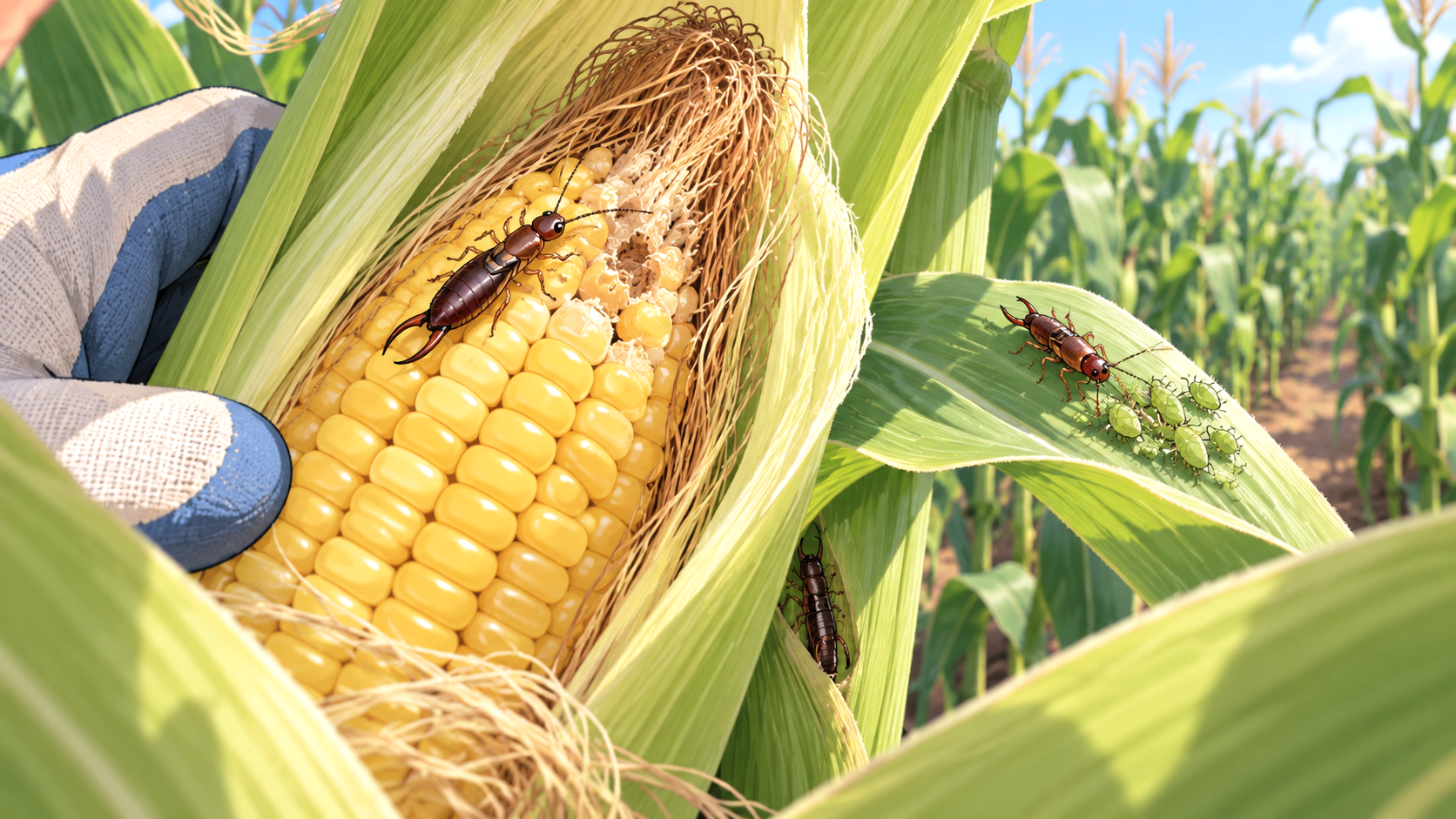
Seeing earwigs disappear into the folds of a corn plant looks worse than it necessarily is. Their presence alone does not tell you whether the crop is in trouble. The more important clue is what is happening to the silks, because earwig feeding there can interfere with the development of the ear.
Earwigs can be a real problem in corn when they feed heavily on fresh silks. Damaged silks can interfere with pollination, leaving an ear with poor kernel development and missing kernels. However, earwigs also prey on aphids, caterpillars, mites and other small pests, so control makes sense when actual corn damage is occurring, not simply because earwigs are present.
The Real Earwig Problem in Corn Is the Silk
A corn ear does not need every insect on the plant removed. It needs successful pollination.
That makes earwig feeding on the silk unusually important. European earwigs, Forficula auricularia, are omnivores that eat both plant and animal material. In corn, they can feed on the silks and interfere with pollination. The eventual symptom appears on the ear as poor development with kernels missing from the cob.
Corn silks are directly connected to kernel formation. Each potential kernel has a silk associated with it, and pollen must reach the silk for fertilization to occur. Consequently, extensive silk loss during the pollination period can matter much more than a few cosmetic holes elsewhere on the plant.
This gives you a better way to judge an earwig problem. Do not begin with the number of insects you happen to see. Look at whether fresh silks are being eaten while the corn needs them for pollination.
That is also why earwigs in corn deserve their own discussion rather than being treated exactly like earwig damage on dahlias. On an ornamental flower, the visible chewing itself may be the main loss. In corn, silk feeding can affect what develops beneath the husk.
Missing Kernels Can Be the Result
The clearest consequence may not become obvious until the ear develops.
When earwigs remove enough silk to disrupt pollination, the affected cob can develop poorly and contain many missing kernels. Poor kernel development is a recognized result of earwig silk feeding. Instead of an evenly filled ear, portions of the cob can remain undeveloped.
However, a poorly filled ear does not prove that earwigs caused it. Pollination can fail for reasons unrelated to insects. Likewise, other corn pests can attack silks and ears.
This is one place where timing matters. Finding earwigs around damaged silks during the pollination period provides much stronger evidence than discovering an incompletely filled cob later and working backward from that symptom alone.
We would therefore avoid diagnosing an earwig problem from the harvested ear by itself. The useful evidence is the combination of earwig activity and silk damage while the corn is still developing.
An Earwig Inside a Corn Ear Is Not Automatically the Culprit
Corn can create excellent hiding places for earwigs. The overlapping leaves, husks and other narrow spaces give these nocturnal insects somewhere dark and protected to spend the day.
Another pest can also make an ear easier for earwigs to enter. Corn earworm larvae feed around the ear tip, and the resulting injury can create openings that later attract earwigs. In that situation, an earwig found inside a damaged ear may have arrived after another insect had already opened it.
This distinction is easy to miss. Finding the most visible insect at the scene does not necessarily identify the insect that started the damage.
Corn earworms leave a different set of clues. Their larvae feed on the ear and produce frass around the feeding area. Earwigs, meanwhile, are recognizable by the pair of forceps-like cerci at the rear of the abdomen. Checking the insect itself and the type of injury helps prevent one corn pest from being blamed for another’s work.
Earwigs Can Help the Same Corn They Damage
The strange part of an earwig problem is that the insect does not fit neatly into a “good” or “bad” category.
European earwigs eat plant material, fungi, decaying organic matter and small invertebrates. Their prey includes aphids, scales, caterpillars, maggots and mites. Several of those groups contain important plant pests.
As a result, an earwig walking around a corn plant may be feeding on the crop at one point and hunting another insect at another. That mixed diet is why our broader discussion of whether earwigs are good or bad for a garden does not treat them as insects that should automatically be eliminated.
This dual role changes the management threshold. Low populations can be tolerated, while intervention becomes appropriate when crop damage reaches an unacceptable level.
For a home gardener, “unacceptable” does not need to be an agricultural formula. Fresh silks repeatedly disappearing and subsequent ear development being affected are meaningful reasons to intervene. A few earwigs hiding in the plants without measurable injury are not.
Check the Corn After Dark Before Deciding What to Do
Daytime inspection can underestimate earwig activity because these insects normally hide while the sun is up. They become active at night and move out to feed.
When fresh silk appears damaged, return to the corn after dark with a flashlight. Night inspection is an established way to confirm whether earwigs are responsible for plant injury. Concentrate on the silks and the tight spaces around developing ears rather than searching the entire plant at random.
This is more useful than assuming every ragged silk tip came from an earwig. Corn has several potential insect pests, and correct identification matters before any control decision.
The timing also works in your favor. Because earwigs are nocturnal, inspecting after dark gives you a chance to catch them where feeding is occurring rather than discovering them later in an unrelated hiding place.
Trapping Makes More Sense Than Treating Earwigs on Sight
Once earwigs are confirmed as the source of unacceptable silk damage, trapping offers a way to reduce numbers without treating every insect in the corn patch as an enemy.
Corrugated cardboard rolled into a tube can serve as a shelter trap. Moistened rolled or crumpled newspaper and grooved pieces of wood can work on the same principle. Earwigs seek protected daytime hiding places, so these traps give them an attractive refuge that can later be checked and emptied.
Baited container traps are another established option. Earwigs can be attracted with strong-smelling oils, and traps can both monitor and reduce their numbers. Our DIY earwig trap guide covers that method separately, so there is little value in turning a corn-specific article into a full trap-building tutorial.
Nearby habitat deserves attention too. Weeds, plant debris and other protected hiding places can support earwigs around a crop. Removing unnecessary shelter can reduce the places available to them during the day.
The important part is to keep checking the corn rather than judging success only by the trap count. Fewer damaged silks and better ear development are more meaningful outcomes than simply catching a large number of earwigs.
Protect the Pollination Window Instead of Chasing Every Earwig
For corn, the best management goal is not an earwig-free garden. It is getting the ears through their vulnerable silking and pollination period without enough feeding to interfere with kernel development.
That makes targeted monitoring especially useful. Check fresh silks, confirm nighttime feeding, use traps where damaging populations are present, and reduce unnecessary hiding places around the crop. Where earwigs are present but the silks remain intact, their presence alone is a weak reason to intervene.
This is one of those garden problems where restraint can actually be the more informed response. Earwigs have a broader garden diet that includes both plants and other insects. Removing them indiscriminately also removes their predatory role.
When damage extends beyond the corn or earwig populations become troublesome throughout the property, the broader approach in our guide to getting rid of earwigs in the garden is a better fit. For corn alone, protect the silks and let the condition of the developing ears guide the response.
Other Questions About Earwigs and Corn
Do earwigs eat corn kernels?
Earwigs can feed on corn kernels as well as silks. However, silk feeding is particularly important because enough damage during pollination can result in poor ear fill. An earwig found feeding on a mature kernel is therefore a different problem from silk loss earlier in ear development.
Why are earwigs hiding between corn leaves?
Earwigs spend daylight in dark, tight and moist shelters. The narrow spaces formed where corn leaves overlap the stalk can provide that kind of refuge, so a hidden daytime earwig is not necessarily feeding at the moment you find it.
Are earwigs more common in corn later in summer?
European earwig populations can build to their highest densities during mid- to late summer as nymphs mature. Whether that coincides with vulnerable corn silks depends on when the crop was planted and local growing conditions, so calendar timing alone does not determine the risk.
Can earwigs get into an ear after another pest damages it?
Yes. Damage caused by corn earworms can create openings at the ear tip that facilitate later earwig presence. Finding both pests in a damaged ear therefore does not mean they played the same role in causing the original injury.
Should I remove every earwig I find on corn?
No. Earwigs can prey on soft-bodied plant pests as well as feed on crops. Management guidance recommends controlling them when their plant damage becomes unacceptable rather than treating their presence alone as the threshold for action.