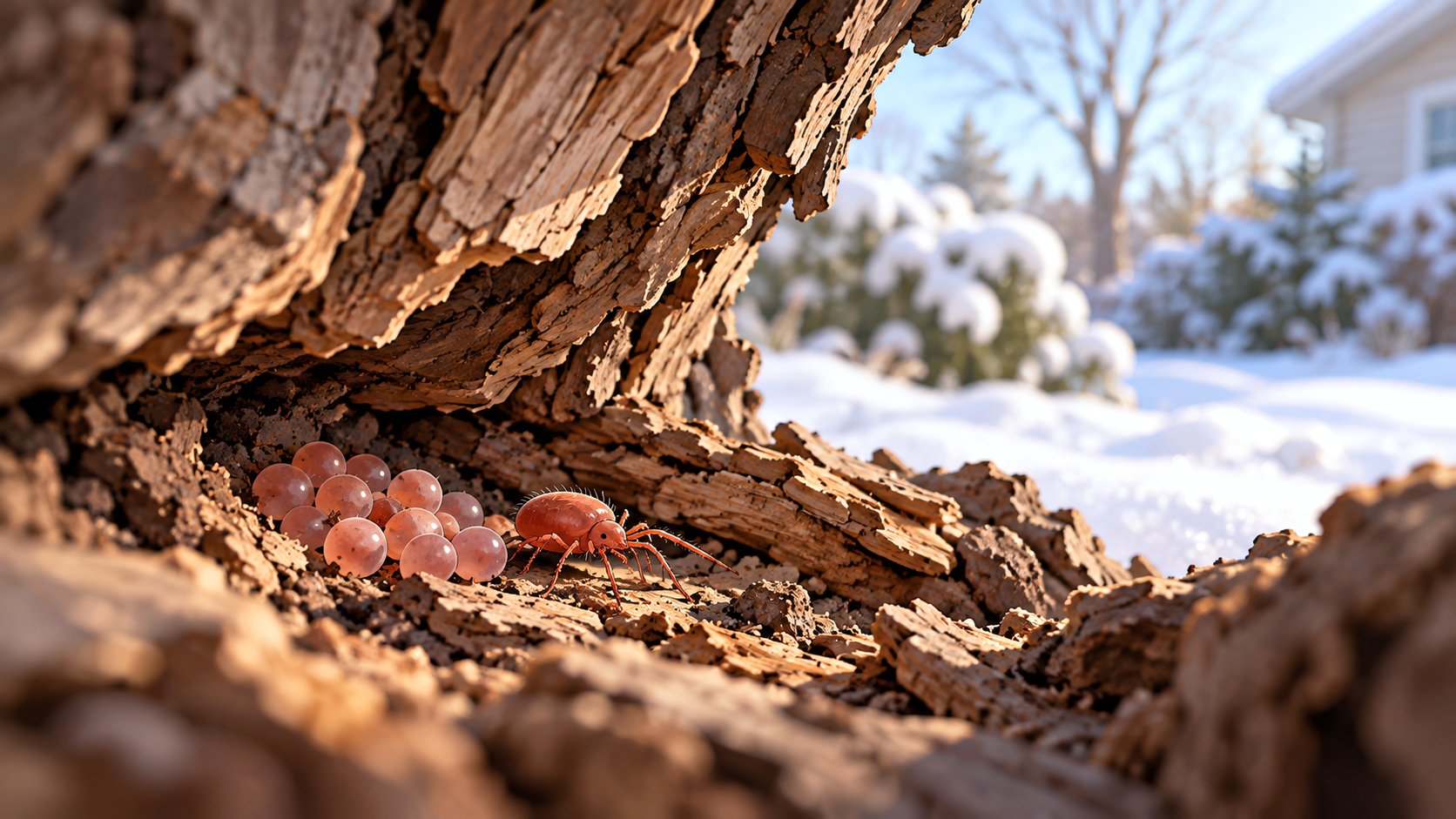
Clover mites spend winter in dry, protected places, primarily as dormant eggs. Common overwintering sites include cracks in concrete and foundations, spaces beneath tree bark, wall voids, siding, shingles, and gaps around windows. They do not simply disappear when freezing weather arrives. Most remain protected and inactive until conditions become suitable again, although adults and other stages can occasionally survive the winter too.
Most Clover Mites Overwinter as Eggs
Eggs are the main overwintering stage of clover mites. Females place them in sheltered locations where they receive protection from severe winter temperatures. These overwintering eggs remain dormant during cold conditions rather than continuing normal development.
This strategy allows a population to survive weather that would be much harder on exposed active mites. The eggs are extremely small, so crevices that look insignificant to us can provide substantial shelter. Large numbers can accumulate in the same protected area.
Eggs are not the only stage capable of making it through winter. Clover mites can overwinter in several life stages, although eggs predominate. Adults are among the stages documented surviving cold periods, which explains why an occasional winter sighting does not always involve a newly hatched mite. The tiny red clover mite eggs are therefore particularly important to winter survival, but finding active mites during winter is still possible.
Protected Cracks and Crevices Provide Winter Shelter
Clover mites choose remarkably small spaces for overwintering. Cracks in concrete, spaces beneath tree bark, and gaps between building walls are established winter refuges. Around structures, they can also shelter beneath siding and shingles or inside foundation crevices.
Window areas provide additional hiding places. Clover mites can settle around window frames and within their channels, where the surrounding structure buffers them from direct exposure.
These locations have something important in common: protection. Clover mites are not burrowing deep underground for winter or building nests. They use existing spaces that shield them from harsh conditions.
Their extremely small size gives them plenty of options. The same ability that lets clover mites crawl into narrow structural gaps also lets them occupy crevices suitable for overwintering.
Clover Mites Usually Become Inactive in Cold Weather
Cold conditions sharply reduce clover mite activity. During typical winter weather, overwintering mites remain dormant rather than continuing to crawl and feed normally. Adults and eggs can remain dormant through winter, protected until temperatures become more favorable.
This dormancy is why a property that had obvious clover mite activity earlier can appear completely clear during a prolonged cold period. The population may still be present in protected locations even though nothing is moving across exposed surfaces.
Winter inactivity also differs from the summer dormancy clover mites enter during excessive heat. Both periods suppress visible activity, but they occur in response to opposite temperature extremes.
Warm Winter Days Can Wake Clover Mites Up
Winter dormancy is not necessarily continuous. Clover mites tolerate cool conditions well enough that adults can become active when temperatures rise above freezing. A brief warm spell can therefore produce unexpected activity in the middle of winter.
Sunny conditions can make this especially noticeable around buildings. Clover mites are sometimes seen on sunny winter days, even in regions with otherwise cold winters. Mites sheltering around siding, windows, or walls can respond quickly when those surfaces warm.
Once temperatures fall again, activity declines. A January or February sighting therefore does not mean winter dormancy has permanently ended. It may simply reflect a temporary period warm enough for sheltered mites to start moving.
Their activity is strongly influenced by temperature, which is more useful for understanding these winter appearances than relying on the calendar alone.
Other Questions About Clover Mites in Winter
Can clover mites survive freezing weather?
Yes. Protected overwintering stages can survive winter cold. Eggs are particularly important because sheltered egg masses provide the main route through the winter.
Do clover mites hibernate?
Dormancy or overwintering is more precise. Clover mites remain largely inactive during unfavorable winter conditions, with eggs forming the majority of the overwintering population.
Can clover mites overwinter under tree bark?
Yes. Spaces beneath tree bark are documented overwintering sites, along with concrete cracks and protected spaces associated with buildings.
Why am I seeing clover mites during winter?
A temporary rise in temperature can reactivate overwintering mites. Their appearance during a warm winter spell is therefore possible even though winter is normally an inactive period.