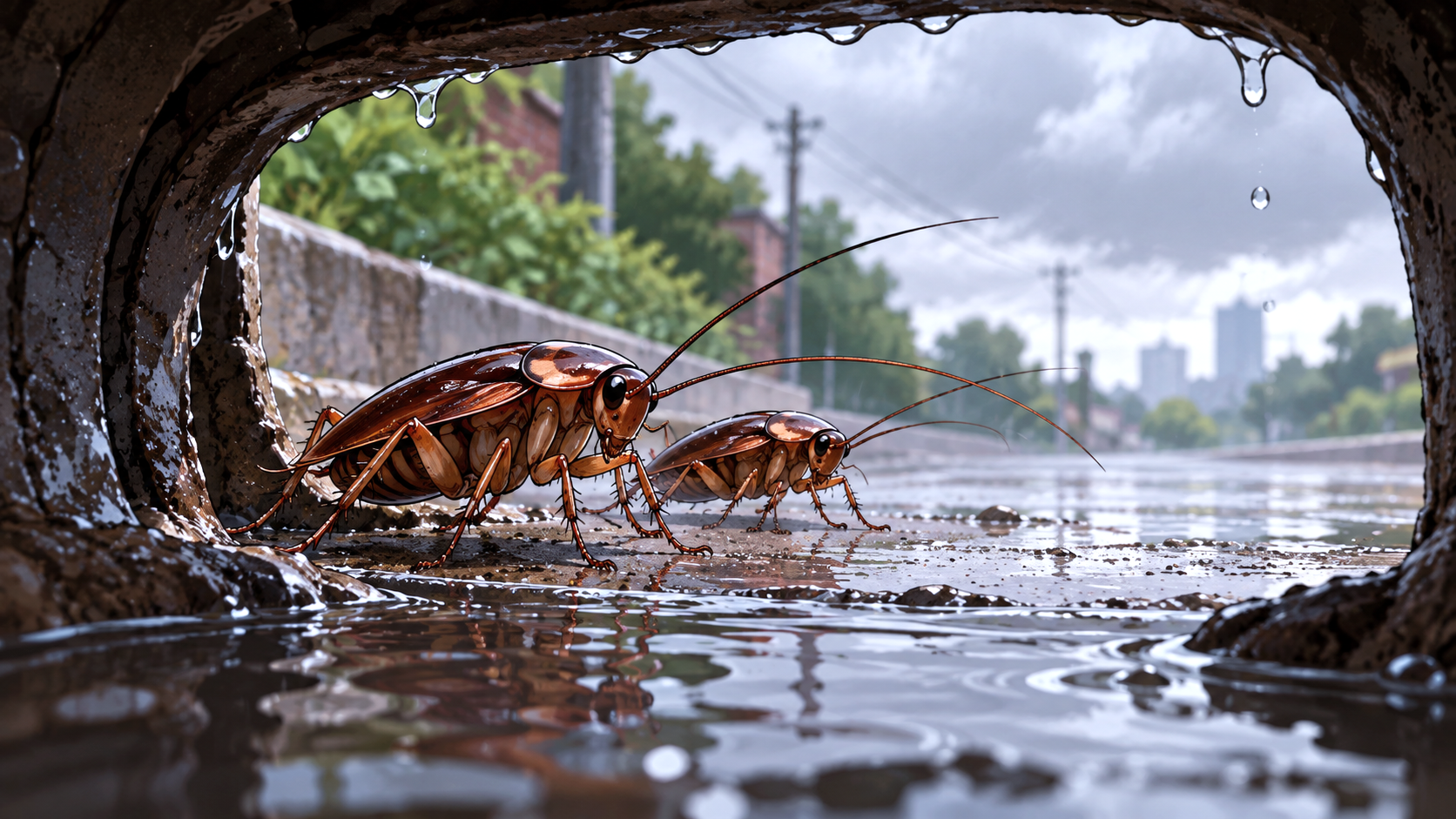
Heavy rain can send cockroaches out of their usual hiding places and into nearby buildings. Flooded soil, saturated mulch, overflowing drainage systems, and disturbed outdoor shelters can force cockroaches to relocate, sometimes bringing them across doorways or into basements and bathrooms. American and Oriental cockroaches are particularly associated with these rain-related encounters.
Rain does not create new cockroaches or cause an infestation to develop overnight. In many cases, the insects were already living around the property or in connected drainage infrastructure. A storm changes their immediate surroundings, making them more visible or bringing them into contact with people.
Heavy Rain Can Flood the Places Where Cockroaches Hide
Outdoor cockroaches commonly occupy protected spaces beneath vegetation, around foundations, within decaying material, and in drainage infrastructure. These locations may normally offer suitable moisture without prolonged flooding.
When heavy rainfall saturates the ground, water can enter crevices and displace insects from their resting places. Cockroaches may move into nearby sheltered areas, including the underside of a porch, a garage, or a building interior.
The University of Florida’s account of American cockroach habitat specifically notes that infestations can occur following heavy rain. It identifies sewers, drainage systems, hollow trees, woodpiles, and mulch as environments associated with this species.
The effects are not identical across habitats. Rain falling on well-drained soil may produce little disruption, while the same amount falling on already saturated ground can create substantial standing water. A raised, sheltered site may remain suitable when a low-lying refuge becomes flooded.
Cockroaches can tolerate damp surroundings, but preferring moisture is not the same as tolerating prolonged submersion. An insect leaving a flooded crack may simply be seeking another location where it can remain sheltered without being immersed.
Stormwater Can Displace Cockroaches From Sewers and Drains
American cockroaches frequently inhabit sewer systems, where they occupy protected areas along walls and other structural surfaces. Changes in water level can alter which portions of that environment remain accessible.
A 2011 study published in the Journal of Medical Entomology investigated American cockroach populations and movement within Malaysian sewer systems. Researchers documented substantial resident populations and movement between connected manholes. The study supports the ability of cockroaches to move through sewer infrastructure, although it did not establish that every rainfall event forces them into houses.
More recent research examining American cockroach monitoring in sewer systems reported that municipal specialists observed cockroaches retreating into deeper network sections during rainfall. Rainfall-related displacement therefore does not always mean upward movement toward buildings; insects may relocate elsewhere within the drainage network.
Where connections or openings provide access to a structure, displaced cockroaches may enter basements or other interior spaces. Potential routes include gaps surrounding utility pipes and certain plumbing openings.
A cockroach appearing near a drain after a storm does not prove that it traveled through the drainpipe itself. It may have entered through an adjacent gap or another nearby opening. Location and repeated observations are needed before identifying a likely route.
Oriental Cockroaches Are Particularly Associated With Damp Ground-Level Areas
Oriental cockroaches (Blatta orientalis) often occupy cool, dark, moist environments, including crawl spaces, basements, drainage areas, and ground-level outdoor shelters.
The University of Minnesota’s household cockroach guidance identifies excess rainfall as one condition that can prompt Oriental cockroaches to enter buildings. It also describes the species’ association with sewers, drains, and leaking plumbing.
Their strong association with moisture sometimes leads to the mistaken belief that Oriental cockroaches actively seek indoor spaces whenever it rains. The more immediate explanation may be that an established outdoor refuge has become unsuitable.
Interestingly, prolonged dryness can also influence their movements. Penn State Extension reports that Oriental cockroaches may enter structures during drought, apparently seeking higher humidity. These apparently opposite responses reflect the importance of suitable shelter conditions. A damp environment can be favorable, while a flooded or excessively dry one may encourage relocation.
Oriental cockroaches are usually encountered near ground level, making basement doors, foundation gaps, and similar openings especially relevant when sightings follow a storm.
Rain Can Make Outdoor Cockroaches More Noticeable Without Increasing Their Numbers
A sudden appearance of several cockroaches does not necessarily indicate a sudden increase in the local population.
Suppose cockroaches normally remain concealed beneath a garden border or in an exterior utility recess. If those spaces become waterlogged, the insects may emerge into exposed areas where they are easier to see. Their visibility increases even if the number of individuals living on the property has not changed.
Rain can also change the routes that insects use. Standing water may make one pathway unsuitable while nearby walls, paved surfaces, or raised ground remain accessible. A cockroach moving across an exposed patio after rainfall may be relocating between shelters rather than searching for a new permanent habitat.
The distance cockroaches can travel between resting areas varies by species and environment. A single sighting therefore cannot establish whether the insect originated a few feet away or farther along a connected route.
In warm conditions, moisture may also make certain outdoor areas temporarily more favorable for activity. Consequently, not every cockroach seen after rain has necessarily been displaced by flooding. Some may simply be moving through newly moist surroundings.
Why Cockroaches May Enter a House Immediately After a Storm
Entry often results from a combination of nearby cockroach activity and an accessible opening.
A storm can move outdoor insects toward a building at the same time that wind-driven rain or saturated soil changes conditions around its foundation. Gaps beneath exterior doors, poorly fitted utility penetrations, and openings around crawl spaces can then become routes indoors.
The U.S. Environmental Protection Agency recommends sealing gaps around doors, windows, pipes, and other building openings to reduce pest entry. These openings can remain unnoticed until environmental conditions bring insects directly toward them.
A building does not need to be dirty for a cockroach to enter during a storm. The insect may be seeking temporary refuge rather than responding to food inside the house.
Where an entry route exists, the ability of cockroaches to climb vertical surfaces can allow them to reach openings above ground level. However, many rain-related encounters involve ground-level routes that require no climbing.
The broader ways cockroaches enter buildings include several possibilities unrelated to storms, so rainfall should be treated as one possible contributing factor rather than a complete explanation for every indoor sighting.
Does Seeing One Cockroach After Rain Mean You Have an Infestation?
One large cockroach discovered immediately after severe weather may be an accidental visitor. Repeated appearances of cockroaches of different sizes, especially small nymphs, deserve closer attention because they can indicate an established population.
The species makes a substantial difference. The University of California’s cockroach management guidance distinguishes species that commonly live outdoors and occasionally enter buildings from German and brown-banded cockroaches, which are more strongly associated with indoor populations.
An American cockroach appearing near a patio door after a storm is therefore not equivalent to multiple German cockroach nymphs repeatedly appearing in kitchen cabinets.
A useful comparison is whether sightings continue after conditions return to normal.
| Observation | More likely interpretation |
|---|---|
| One large outdoor-associated cockroach following a major storm | Possible temporary entry |
| Several large cockroaches near a basement or exterior doorway during flooding | Possible displacement from nearby shelter |
| Repeated indoor sightings over subsequent dry days | Continuing access or established activity |
| Adults and nymphs appearing regularly in interior rooms | Greater concern for an indoor population |
These patterns are clues rather than definitive diagnoses. A rain-related encounter and an existing indoor population can also occur at the same property.
The physical evidence of occupied cockroach shelters can help establish whether repeated sightings reflect sustained activity. However, finding no obvious shelter does not prove that the insect arrived from outdoors.
What Should You Check After Rain-Related Cockroach Sightings?
If cockroaches appear immediately after a storm, begin with the location where they were seen rather than assuming the entire house is infested.
Near exterior doors, check for visible gaps beneath the threshold or around the frame. In basements and bathrooms, inspect accessible pipe penetrations, floor-level openings, and areas where water has accumulated. Record whether the ground outside remains saturated or whether drainage problems persist.
The EPA’s advice on moisture and pest prevention recommends repairing leaks, preventing standing water, and blocking openings around plumbing and other structural features.
Existing floor drains should remain functional, with appropriate trap seals maintained. Never permanently obstruct a drain needed for flood protection or plumbing safety. Where drainage or sewer connections appear defective, a qualified plumber can evaluate the problem without compromising the system.
For several days after the rain, sticky monitoring traps placed near suspected entry areas can help determine whether cockroaches continue appearing. The Utah State University guidance for Oriental cockroaches recommends traps for identifying active locations and evaluating movement.
The most useful outcome is not merely catching another insect, but establishing a pattern. Activity concentrated near an exterior opening may suggest continuing entry, while repeated captures deeper inside the building can warrant a more extensive inspection.
A brief surge that ends as conditions dry out is consistent with temporary displacement. Continued activity after the storm has passed should be investigated on its own merits rather than repeatedly attributed to the weather.