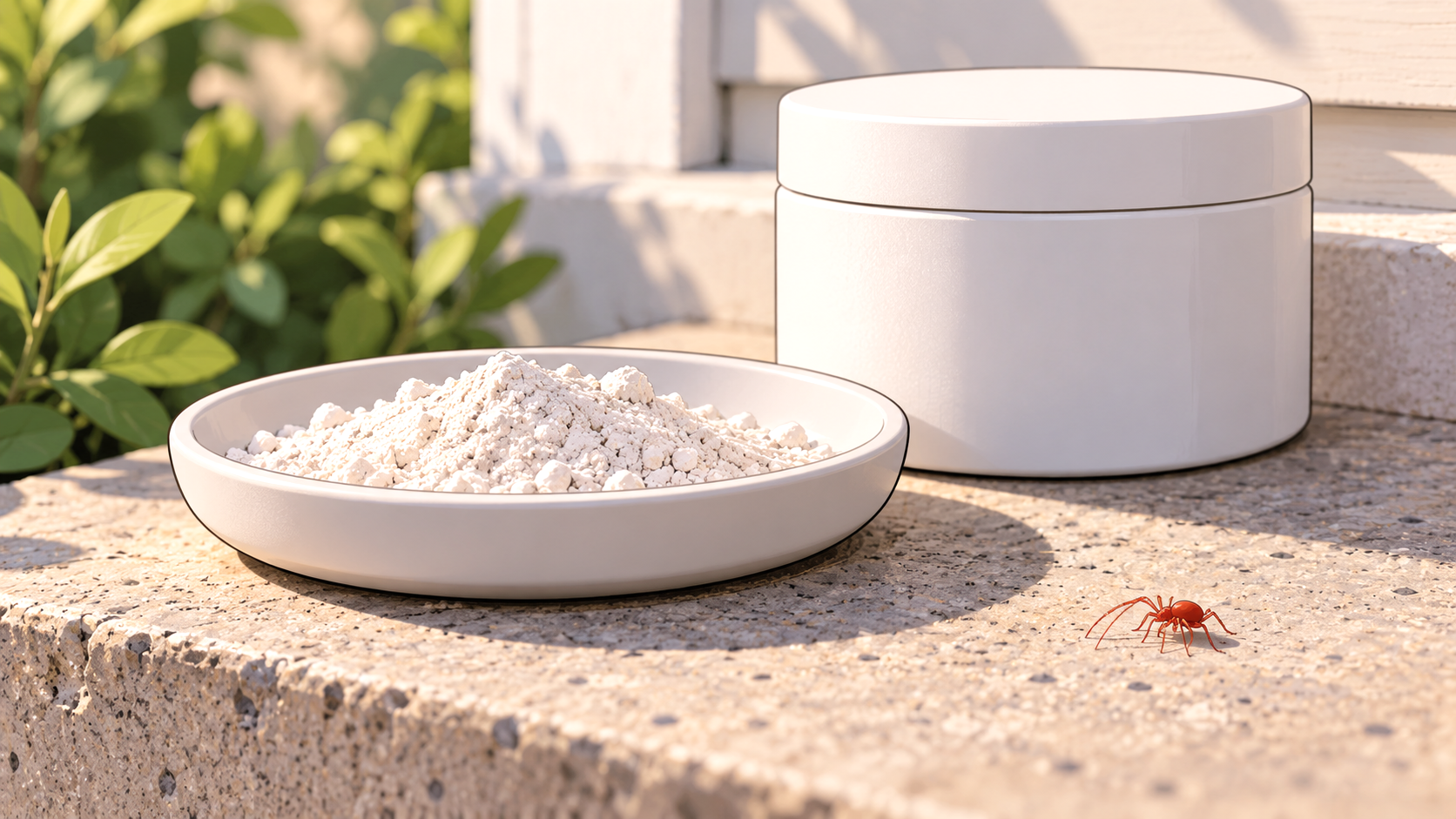
Diatomaceous earth can kill clover mites when they contact an appropriately labeled pesticide-grade product, but it is not a fast or complete solution for a large outdoor population. Diatomaceous earth works physically rather than through a conventional chemical poison. Its abrasive, absorbent particles can damage the protective outer layer of small arthropods and absorb surface oils, promoting moisture loss until they dehydrate. An EPA-registered diatomaceous earth pesticide label specifically lists clover mites among its target pests. That provides direct product-label support for diatomaceous earth as a clover mite control option, although it does not establish that every DE formulation performs equally well or that dusting will eliminate a large outdoor infestation.
Dry Dust and Mite Contact Determine Whether It Works
Diatomaceous earth cannot affect a clover mite that never encounters it. EPA-registered DE labeling for crawling pests states that direct contact with dry dust is required for effective control. A light application positioned along a route the mites actually cross, where the product label permits it, is therefore more rational than dumping piles of powder around the property.
Moisture interferes with the effectiveness of dry DE deposits. Rain, irrigation, heavy dew, or another source of water can temporarily reduce their usefulness, and outdoor applications may require maintenance or reapplication according to the product label. This limitation matters for clover mites because their normal habitat includes lawns and other vegetation, where keeping a dust consistently dry can be difficult. Some DE pesticide products also permit applications as water-based slurries, but those are separate labeled methods rather than evidence that any dry-dust formulation should be mixed with water.
A Barrier Can Be More Useful Than Dusting the Lawn
Diatomaceous earth has a more convincing role where clover mites repeatedly cross a defined boundary. A fine dust barrier can be placed around permitted entry areas when the chosen product label allows it, and clover mite exclusion guidance specifically includes diatomaceous earth among dusts that may impede migrations around windows and other entry points.
That use fits the pest’s movement toward structures. If mites repeatedly collect on window sills or travel across brick and siding, a labeled dust placed where permitted can intercept some migrants. It does not remove the outdoor population supplying them, so properties with repeated invasions still benefit from preventing clover mites from reaching indoor openings through vegetation management and structural exclusion.
Do Not Substitute Pool-Grade or Random Food-Grade DE
Not every bag labeled “diatomaceous earth” is intended for pest control. EPA advises using a registered pesticide product when diatomaceous earth is being used as a desiccant pesticide rather than substituting DE sold for swimming-pool filtration, food, or another purpose. Pesticide products have directions governing the permitted treatment sites, application methods, precautions, and amounts. An EPA label listing clover mites supports the registered product’s pest-control claim under its approved directions; it does not demonstrate that every DE product has the same effectiveness or authorized uses.
The distinction is especially important indoors because loose airborne dust can be inhaled. Most diatomaceous earth consists predominantly of amorphous silica, although some products contain small amounts of crystalline silica. The National Pesticide Information Center explains that inhaled diatomaceous earth can irritate the nose and respiratory passages, while prolonged exposure to respirable crystalline silica poses more serious health risks. Even DE with little crystalline silica can irritate the airways when its dust becomes airborne. Pesticide-grade does not mean harmless, so follow the product’s ventilation, protective-equipment, and placement instructions rather than spreading visible blankets of powder across floors or occupied living areas.
The EPA product examples discussed here concern United States pesticide registrations. Their approval does not establish that the same products are authorized in Canada or other countries. Before purchasing or applying DE as a pesticide, check the registration and labeling requirements that apply where the treatment will take place.
Diatomaceous Earth Does Not Solve the Conditions Producing Clover Mites
A dry barrier may kill mites crossing it while eggs and active stages remain elsewhere around the property. Clover mites feed on numerous plants, and populations can become especially troublesome around favorable turf. Their feeding sites around lawns and landscaping are therefore separate from the narrow location where DE might intercept migrating individuals.
For a substantial outdoor population, correcting those conditions has greater reach than continually replacing wet or disturbed powder. Nonchemical clover mite control can include vegetation separation, appropriate lawn management, exclusion, and physical removal, while severe infestations may justify a properly labeled clover mite insecticide instead of relying on DE alone.
Questions About Diatomaceous Earth and Clover Mites
How quickly does diatomaceous earth kill clover mites?
Do not expect an instant knockdown. Desiccant dusts depend on physical contact and subsequent water loss, so death is not necessarily immediate. Conditions, exposure, and the particular product can affect performance. A registered product may advertise a specific killing time, but that should not be treated as a guaranteed result for every clover mite or every application.
Can you mix diatomaceous earth with water and spray it?
Yes, some registered pesticide-grade diatomaceous earth products permit water-based slurry applications, but only for the sites and methods specified on their labels. For example, the EPA-accepted Harris Diatomaceous Earth label includes slurry directions for certain outdoor, livestock, poultry, and crop applications, while stating that slurry treatments are not intended for human living areas. Other DE products may be intended only for dry application. Do not assume that adding water to an ordinary dust product creates an authorized or effective clover mite spray.
Can you put diatomaceous earth everywhere inside the house?
No. Broadly scattering airborne dust through occupied rooms creates unnecessary exposure. EPA’s guidance for desiccant pesticides emphasizes limiting dust applications to appropriate labeled locations, and the instructions on the particular product take priority. For clover mites already indoors, vacuuming and closing their entry routes are generally preferable to widespread dusting.
Will one DE application stop clover mites from returning?
No guarantee can be made. Outdoor dust can be displaced or wetted, while new mites can continue moving from nearby vegetation. Persistent recurrence points toward a continuing source rather than proof that more powder is needed.