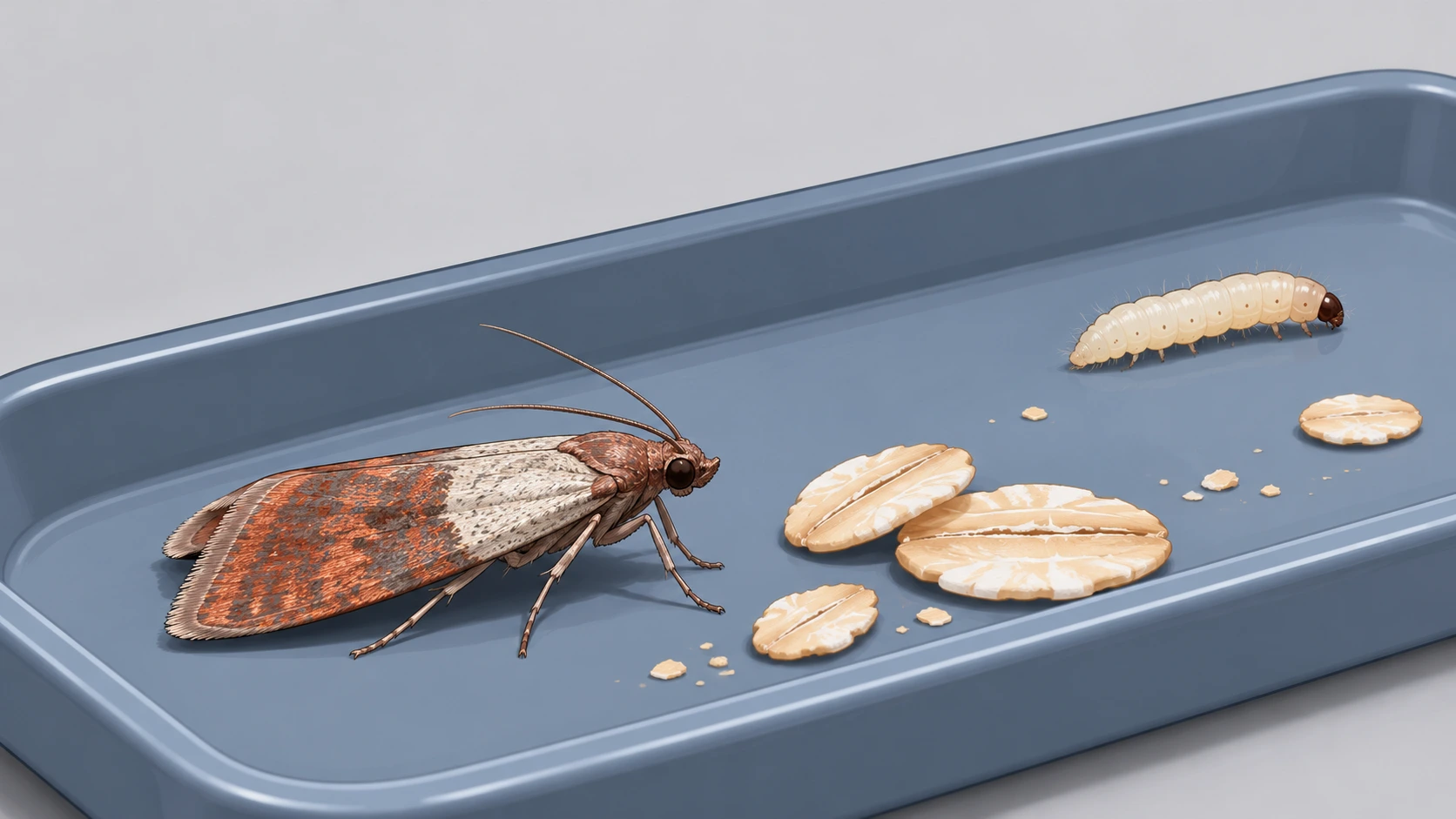
Indian meal moths can produce pink or green caterpillars, spin silk through stored food, travel across ceilings, and appear in rooms far from where they developed. Some can even survive unfavorable conditions by temporarily suspending development. These are just a few of the surprising facts about one of the most familiar household pantry pests.
The Indian meal moth (Plodia interpunctella) is easy to underestimate. The adult is a small, copper-colored moth that often looks more like a minor household nuisance than an insect capable of causing a substantial stored-food infestation.
Its biology tells a much more interesting story. The caterpillars behave differently from the adults, their appearance can change with what they eat, and their interactions with food, light, temperature, and even other insects have been the subjects of scientific research.
Here are 15 evidence-based facts that explain what makes Indian meal moths unusual, along with several popular misconceptions that deserve correcting.
1. Indian Meal Moth Caterpillars Can Be Pink or Green
<AsyncImage query=”Indian meal moth Plodia interpunctella caterpillar pale pink green brown head macro entomology” aspectRatio=”16:9″ maxHeight={260}/>
An Indian meal moth caterpillar is not always white. Depending on its diet, the larva may appear creamy, yellowish, pinkish, or greenish, usually with a brownish head.
That color variation can make identification confusing. Someone expecting a white pantry moth larva may discover a pale pink caterpillar in stored food and assume it belongs to an entirely different species.
The documented variation in Indian meal moth larval color shows why color alone is an unreliable identification feature. Body shape, head color, location, and associated silk provide additional clues.
A greenish caterpillar is not necessarily a different moth, and a pinkish one is not automatically diseased or contaminated with a particular chemical.
2. Their Caterpillars Make Silk Like Silkworms
Indian meal moth larvae produce silk as they move and feed. Unlike the silk associated with commercial silkworm production, their threads typically become mixed with grain particles, seed fragments, and other stored-food material.
Over time, these threads can bind food into clumps or form sheets of webbing across the surface. An infested package may therefore look as if someone has stretched fine cobwebs through its contents.
The silk provides shelter, but it also makes an infestation more noticeable. In fact, the appearance of Indian meal moth webbing is one of the more distinctive signs of larval activity.
The surprising part is that an insect only about half an inch long when mature can produce enough silk to visibly change the texture of a package of dry food.
3. The Caterpillars May Travel Far From Their Food Before Becoming Moths
<AsyncImage query=”Indian meal moth mature larva crawling on white interior wall ceiling corner small caterpillar realistic entomology” aspectRatio=”16:9″ maxHeight={260}/>
Finding a caterpillar on a ceiling does not mean it has been eating the ceiling.
Mature Indian meal moth larvae commonly leave their feeding material and search for sheltered places to pupate. Their destination may be a cabinet joint, the underside of a shelf, a package fold, or a wall-ceiling junction.
The journey can take them well beyond the original food source. One documented example involved a larva pupating inside the lid of a cardboard container on a different pantry shelf from the infested material.
That behavior helps explain why Indian meal moth larvae appear on walls and ceilings.
A caterpillar in a hallway may have spent most of its life feeding somewhere else. Its final crawling route is not a reliable map of where the infestation began.
4. Adults Can Follow Lights Into Rooms With No Stored Food
An Indian meal moth found near a bedroom lamp may have developed in a kitchen cupboard.
Adult Indian meal moths are attracted to certain light sources and can move through rooms away from the original infestation. As a result, the room where someone finally notices an adult may contain no suitable food at all.
This is one reason people sometimes mistake them for clothes moths. A small moth resting in a closet looks suspicious, even though its location does not establish that it feeds on fabric.
Light attraction is also variable. The response of Indian meal moths to different lights cannot be used to identify the original breeding site.
The myth is that the moth must be living where the light is. In reality, the light may simply have made a wandering adult easier to notice.
5. The Adult Moths Usually Do Not Eat
The winged Indian meal moth is not the stage responsible for consuming stored food.
Most of the nutrients used during adulthood were accumulated while the insect was a feeding caterpillar. The adult relies primarily on these stored resources for movement and reproduction.
There is an unexpected anatomical detail: adult Indian meal moths have a well-developed proboscis, a mouthpart associated with taking up liquids. Regular adult feeding has nevertheless not been demonstrated.
The feeding capability of adult Indian meal moths is therefore more complicated than the common claim that adults simply have no mouth.
A moth flying around an opened food package is not necessarily trying to eat its contents. It may be investigating a location suitable for its offspring.
6. An Indian Meal Moth Can Live Among Whole Grain Without Entering a Single Intact Kernel
Indian meal moths are classified as secondary stored-grain pests. Their larvae feed externally on accessible material such as broken kernels and grain dust.
That creates an interesting difference between living inside a bag of food and living inside an individual piece of grain.
A caterpillar may be several inches beneath the surface of a grain pile, surrounded by whole kernels. Yet it can still be feeding only on fragments and accessible material between those kernels.
The Canadian Grain Commission’s classification of Indian meal moths specifically notes that the larvae cannot penetrate undamaged grain.
This separates them from insects whose immature stages can develop inside intact kernels. The difference between primary and secondary stored-grain pests explains why being hidden among food does not make a caterpillar an internal kernel feeder.
7. Their Eggs Can Be Smaller Than a Grain of Table Salt
<AsyncImage query=”Plodia interpunctella Indian meal moth microscopic egg macro scientific photo on food substrate” aspectRatio=”16:9″ maxHeight={230}/>
Indian meal moth eggs measure approximately 0.3 to 0.5 millimeters long. They are pale and can be difficult to distinguish from tiny food particles without magnification.
That small size helps explain why a package may appear normal even when eggs are present.
There is no need for a dramatic number of visible adult moths before an infestation begins. Eggs can remain unnoticed, and very young caterpillars are also difficult to see in mixed food material.
The appearance and placement of Indian meal moth eggs are more useful for careful identification than treating every pale speck in a cupboard as an egg.
Their size is impressive, but it also creates a common misconception: a visually clean package is not necessarily guaranteed to be insect-free.
8. Indian Meal Moths Can Pause Their Development
The growth of an Indian meal moth is not always a continuous progression from egg to adult.
Under unfavorable conditions, some larvae can enter diapause, a physiological state in which development is suspended or greatly reduced. Temperature, food conditions, and other environmental cues can influence this response.
The laboratory-recorded development of Indian meal moths varies greatly with temperature. Under suitable conditions, development can be comparatively rapid, while adverse conditions can prolong it substantially.
Diapause is not the same as an adult moth sleeping through winter. The relevant stage and environmental history matter.
The biological advantage is that a larva may persist through a period when conditions are unfavorable for ordinary development, then resume development when conditions improve.
9. A Heated Building Can Support Indian Meal Moths During Winter
Indian meal moth activity is not confined to summer.
In consistently heated buildings, suitable temperatures can allow reproduction and development to continue even when outdoor conditions are cold.
The same insect may behave differently in an unheated storage building, where low temperatures slow development and affect survival.
This is one reason an Indian meal moth appearing indoors in January is not automatically an insect that recently entered from outdoors.
A warm indoor environment and suitable stored material can provide conditions for activity throughout the year.
The seasonal behavior is more complicated than saying pantry moths disappear during winter. For a detailed look at outdoor survival, see whether Indian meal moths can live outside.
10. They Can Survive Outdoors in Some Climates
Despite their association with kitchens and cupboards, Indian meal moths are not restricted to living inside houses.
They can survive and reproduce outdoors when suitable food, shelter, and climate conditions are available. Their success outside varies considerably by region.
Florida, for example, has documented outdoor populations. That does not mean Indian meal moths can establish year-round outdoor populations in every climate.
A moth around a porch light could be an outdoor individual or one that moved from a nearby building. The sighting by itself cannot distinguish those possibilities.
The myth is that finding one outdoors proves it escaped from someone’s pantry. Indian meal moths have a broader ecological range than that assumption allows.
11. The Same Moth Can Look Like Two Different Colors Depending on Its Wings
<AsyncImage query=”Plodia interpunctella adult Indian meal moth closeup folded forewings two tone tan copper red scientific macro” aspectRatio=”16:9″ maxHeight={260}/>
Adult Indian meal moths have striking two-toned forewings. The portion closer to the body is usually grayish or pale tan, while the outer portion is reddish brown or coppery.
When the moth rests with its wings folded over the body, these colors form a recognizable pattern. The wings may appear darker under some lighting conditions, and worn scales can make the markings less distinct.
A particularly dark specimen can therefore look different from a brightly illuminated photograph of the same species.
The identification features of Indian meal moth adults are more dependable when considered together rather than judging a moth by a single shade of brown.
The coppery appearance is a useful clue, but not every small brown moth with a similar color is an Indian meal moth.
12. Their Flying Pattern Can Be Surprisingly Erratic
An Indian meal moth does not always fly in a straight line toward its destination.
Adults are frequently described as weak or fluttering flyers. When disturbed during the day, they may move in a zigzag pattern.
That flight pattern can make them seem disoriented, but erratic movement alone does not indicate injury or poisoning.
The documented flight behavior of Indian meal moths is one reason an adult can be difficult to follow across a kitchen. It may flutter unpredictably and settle somewhere that seems unrelated to the food it originally came from.
Flight behavior is an observation, not a reliable identification test. Many other small moths can also flutter or change direction abruptly.
13. Some Tiny Wasps Can Turn Indian Meal Moth Eggs Into Wasp Offspring
Indian meal moths have natural enemies that are almost invisible to most homeowners.
Certain Trichogramma wasps deposit their eggs inside moth eggs. When parasitism succeeds, a wasp develops instead of an Indian meal moth caterpillar.
Other parasitoids, including Habrobracon hebetor, attack the caterpillar stage.
This relationship is unusual because the wasps do not simply chase and eat flying moths. They exploit particular developmental stages.
Controlled experiments have demonstrated significant suppression of Indian meal moth populations when suitable parasitoids are present, especially when egg- and larval-attacking species are combined.
The research behind wasp-based Indian meal moth control shows how biological control can reduce future moth production. It does not mean releasing unidentified wasps inside a home is a sensible treatment.
14. Scientists Can Interfere With Their Mating Using Artificial Pheromones
Indian meal moths use chemical signals when finding mates. Scientists and pest managers can exploit this communication by releasing synthetic pheromones into a building.
The aim is not necessarily to capture moths. It is to make it harder for males to locate females, potentially reducing successful reproduction.
A field study involving 33 pet-supply stores found that male moth catches in monitoring traps dropped by approximately 68% immediately after mating-disruption treatment began. Larger average reductions were observed during treatment.
The pet-store mating-disruption study offers an important lesson about interpreting the results: fewer moths in a pheromone trap do not automatically mean an equal percentage of the population was killed.
The pheromone can interfere with the male’s ability to find the trap itself.
This makes mating disruption a fascinating example of using insect communication against the pest, but its effectiveness must be evaluated through more than trap catches.
15. An Infestation Can Continue Producing Adults After Its Food Source Is Removed
One of the most counterintuitive Indian meal moth facts is that removing an infested package may not cause the visible moths to disappear immediately.
Some larvae may already have moved away from the food and formed cocoons in protected locations. Those insects can continue developing after the original package has been discarded.
That is why adult sightings can persist temporarily even when the main feeding source has been successfully removed.
The pattern matters more than one isolated moth. A declining number of adults over the following weeks is more encouraging than steady or increasing activity accompanied by fresh larvae or silk.
The expected timeline for an Indian meal moth infestation to clear explains why two to three weeks of residual adult activity can occur and when continued sightings warrant another investigation.
The myth is that every moth appearing after cleanup proves the original effort failed. Sometimes it is simply an insect that had already completed most of its development.
Five Indian Meal Moth Myths Worth Correcting
Many misunderstandings about Indian meal moths begin with an accurate observation followed by the wrong explanation.
| Common myth | What the evidence actually supports |
|---|---|
| A caterpillar on the ceiling must be eating the ceiling | Mature larvae often climb away from food before pupation |
| An adult beside a lamp must have developed in that room | Adults can fly toward lights far from the original source |
| A larva buried among grains must be inside the kernels | Indian meal moths feed externally and cannot normally penetrate sound grain |
| All Indian meal moth caterpillars are white | Their coloration can vary with diet, including pinkish and greenish shades |
| A pheromone trap catching fewer moths proves the infestation is gone | Trap catches can change because of moth behavior, not just population size |
These corrections share a common lesson. What an Indian meal moth is doing when you notice it may be completely different from what it was doing during the earlier stages of its life.
What Is the Most Surprising Thing About Indian Meal Moths?
The combination of silk production, long-distance larval wandering, and delayed adult emergence is probably the most useful surprise for someone who has encountered these insects at home.
A caterpillar can feed inside a package, leave it, crawl into a different location, form a cocoon, and eventually emerge as an adult near a light in another room. By the time you notice the adult, its feeding location may be nowhere in sight.
That sequence explains several household mysteries without requiring a separate infestation in every room.
The more technical findings are just as interesting. Indian meal moths can enter diapause, retain adult mouthparts despite rarely feeding, and respond to pheromone-based methods that interfere with reproduction.
Together, these facts explain why Plodia interpunctella has become an important subject for stored-product insect research.
The Bottom Line
Indian meal moths are more than small brown insects flying around a pantry. Their caterpillars can change color with their food, create silk-filled shelters, and travel far from their feeding sites before pupating. Adults may appear near lights, while the insects’ ability to pause development can complicate their seasonal behavior.
Scientific work has also revealed unusual features of their nutrition, reproductive communication, and relationships with parasitoid wasps.
The most useful lesson is that an Indian meal moth’s appearance and location rarely tell the whole story. Understanding which developmental stage you are seeing helps explain whether the insect is feeding, wandering, pupating, or reproducing, without mistaking one behavior for another.