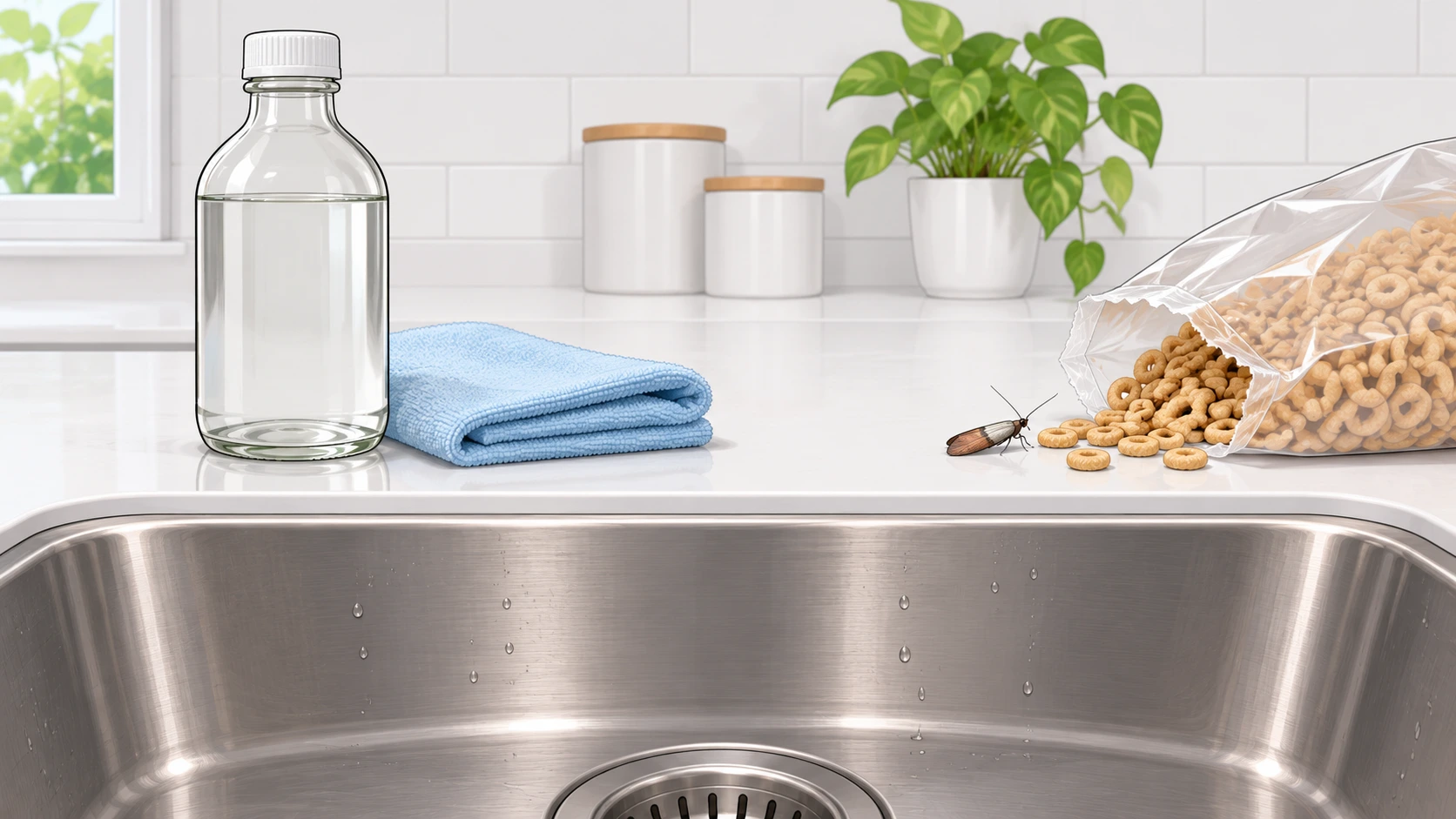
Vinegar is not a proven way to kill Indian meal moths or eliminate their eggs and larvae. Ordinary household vinegar may help remove some residues from pantry shelves, but there is no reliable evidence that wiping or spraying with it will eradicate an Indian meal moth (Plodia interpunctella) infestation.
This distinction matters because vinegar is frequently recommended as a natural pantry moth remedy. Some instructions claim it kills eggs on contact, removes pheromones, or keeps moths from returning. Those claims are often presented without controlled tests showing that ordinary vinegar works against this particular species.
A pantry may look and smell clean after a vinegar wipe while live larvae remain inside a food package. Newly emerging adults can then make the treatment appear to have failed, when the vinegar never addressed the source in the first place.
For household use, vinegar is best regarded as an optional surface cleaner. Physical removal of insect debris and infested material is what makes cleaning useful for Indian meal moth control.
What Does Vinegar Actually Do to Indian Meal Moths?
Household white vinegar usually contains approximately 5% acetic acid in water. Its acidity makes it useful for certain cleaning tasks, but that chemical property does not automatically make it an effective insecticide.
Acetic acid can affect biological tissues at sufficient concentrations and exposure levels. However, the effects of a concentrated chemical in a laboratory cannot be applied directly to diluted cooking vinegar.
To establish that vinegar kills Indian meal moths, researchers would need to test defined concentrations against known life stages and measure mortality under controlled conditions. They would also need to determine whether the treatment works in realistic locations, including cracks, silk-covered surfaces, and stored products.
We could not verify published, species-specific evidence demonstrating that ordinary 5% vinegar consistently kills Indian meal moth adults, eggs, larvae, or pupae under household conditions.
That evidence gap does not prove that vinegar can never injure an individual insect. Directly wetting a small moth with liquid might immobilize or kill it, but the result would not establish a dependable pesticidal effect.
The difference becomes clearer when the claims are considered separately.
| Vinegar claim | Evidence assessment | Practical meaning |
|---|---|---|
| Kills adult Indian meal moths on contact | Not established as a reliable species-specific treatment | Do not rely on a vinegar spray for adult control |
| Kills Indian meal moth eggs | No verified household kill rate or exposure time | Wiping with vinegar cannot be assumed to destroy eggs |
| Kills larvae hidden in food | Unsupported and impractical | Vinegar cannot reliably reach larvae protected inside dry products |
| Kills pupae inside cocoons | No reliable demonstration | Protected pupae may remain after surface wiping |
| Repels adult moths | No dependable household evidence | Vinegar odor should not be treated as a protective barrier |
| Cleans residue from suitable surfaces | Useful as an ordinary cleaner in some circumstances | Actual removal of debris matters more than the vinegar itself |
These assessments separate demonstrated cleaning properties from insect-killing claims. They do not assign an invented percentage to vinegar’s effectiveness.
Does Vinegar Kill Indian Meal Moth Eggs?
There is no reliable evidence that ordinary vinegar wipes kill Indian meal moth eggs consistently. The claim is particularly difficult to justify because eggs are small and can occur on or near food, inside packaging, and on sheltered surfaces.
An egg must actually receive a sufficiently harmful exposure before a contact treatment could affect it. Simply wiping the visible shelf surface does not establish that every egg has been found, contacted, or killed.
Even if a cloth physically removes an egg, that is different from vinegar chemically destroying it. The egg may have been collected by the cloth regardless of which suitable cleaning solution was used.
This is why a claim such as “vinegar kills pantry moth eggs on contact” should not be treated as established science without a concentration, contact time, and measured result for the species.
The location and appearance of Indian meal moth eggs also make visual confirmation difficult. Their small size means a shelf can appear clean even when not every surface or food package has been examined.
Does White Vinegar Kill Moth Eggs Better Than Apple Cider Vinegar?
There is no verified evidence that white vinegar or apple cider vinegar provides reliable egg control against Indian meal moths.
Both products are acidic, but acidity alone cannot tell us how effectively either one kills eggs. Commercial products vary in concentration, and apple cider vinegar contains other compounds that affect its smell and composition.
A stronger smell does not mean a stronger insect-killing effect. Likewise, the word natural does not establish that a treatment can penetrate an insect egg or destroy it.
For cleaning shelves, ordinary white vinegar is generally the more practical option because it is inexpensive and usually leaves less color or food-derived residue. That is a cleaning preference, not evidence of superior moth control.
Will Vinegar Kill Indian Meal Moth Larvae?
Vinegar should not be relied upon to kill Indian meal moth larvae.
The larvae are small caterpillars that consume stored food and produce silk as they develop. A larva inside a package of grain may be surrounded by food particles and webbing. Wiping the outside of the package with vinegar does not deliver a meaningful treatment to that insect.
Pouring vinegar into the food would be equally inappropriate. It would introduce moisture and acid into a dry product, potentially ruining the food while providing no verified guarantee that every larva had been killed.
An exposed larva on a shelf might be physically removed with a cloth. If the cloth happens to contain vinegar, the removal should not automatically be attributed to the acid.
The feeding habits and hiding places of Indian meal moth larvae explain why treating a smooth shelf is unlikely to affect the insects developing within food.
A vacuum or damp cleaning cloth can collect visible larvae and debris, but the useful action is physically removing the insects and material rather than assuming a vinegar solution is poisoning them.
Can Vinegar Kill Adult Indian Meal Moths?
Directly spraying an adult Indian meal moth with vinegar might wet or temporarily immobilize it, but vinegar is not an established adult moth insecticide.
A flying adult is a small, delicate insect. Many liquids can interfere with its movement when they soak its wings or body. That physical effect does not demonstrate that the liquid contains a reliable insecticidal ingredient.
There are also practical problems with spraying vinegar at moths indoors. Droplets may land on food, dishes, painted surfaces, or electrical fixtures. Repeated spraying can create mess and damage materials without eliminating the developing infestation.
If an adult moth is accessible, physically collecting it is more straightforward. The presence of an adult also indicates that another life stage has already completed development somewhere.
Adult Indian meal moths differ from the feeding caterpillars. Their biology is discussed in whether adult Indian meal moths eat, but the practical limitation here is simple: killing a flying adult does not remove eggs or larvae already present.
Does Vinegar Repel Indian Meal Moths?
There is no dependable evidence that vinegar odor prevents adult Indian meal moths from entering or using suitable stored food.
A strong scent can be noticeable to humans without having a meaningful repellent effect on a particular insect. It may affect an insect’s behavior under some conditions, but avoidance must be demonstrated rather than assumed.
To verify a repellent claim, a study would need to show that Indian meal moths consistently avoid a vinegar-treated area compared with an appropriate untreated area. The result would also need to remain useful under ordinary pantry conditions.
We could not verify evidence supporting that level of performance for household vinegar.
That means bowls of vinegar placed in cupboards should not be regarded as protective barriers. Nor should a vinegar wipe be expected to prevent females from depositing eggs on suitable materials that remain accessible.
The moth’s attraction to potential breeding materials is a separate biological question from whether a particular cleaning odor is unpleasant to people. Factors that attract Indian meal moths into homes cannot be reliably neutralized with the smell of vinegar alone.
Do Indian Meal Moths Hate the Smell of Vinegar?
The claim that Indian meal moths “hate vinegar” is not supported by reliable species-specific evidence.
An insect moving away from a freshly sprayed surface could be reacting to wetness, disturbance, airflow, or another condition. That observation would not establish a long-lasting repellent effect.
Vinegar’s smell also fades as it evaporates. Even if a temporary behavioral response occurred, that would not prove that a dry cupboard remains protected afterward.
We would not recommend using vinegar odor as a substitute for closed containers and removal of contaminated products.
Does Cleaning Pantry Shelves With Vinegar Help?
Vinegar can be useful for wiping certain pantry surfaces, but the benefit comes from cleaning away residue rather than killing Indian meal moths through a proven chemical action.
Imagine a pantry shelf with spilled flour along the back edge. A damp cloth can lift accessible flour and some loose insect debris. If vinegar is used in that cloth, it may help with particular residues, but the act of wiping is doing much of the work.
A shelf with flour trapped inside a narrow joint presents a different problem. Running a vinegar-soaked cloth across the visible surface may leave the material inside the joint untouched.
That is why stored-food pest sanitation guidance emphasizes removal of infested products and vacuuming cracks and corners. It also notes that washing shelves with detergent or disinfectants does not keep pantry pests from returning.
In other words, a surface may be clean enough without vinegar, and a surface may still contain food debris despite being wiped with vinegar.
Vinegar vs. Warm Soapy Water
Warm water with an appropriate dish detergent is generally a straightforward choice for removing everyday pantry grime and food residue from washable surfaces.
Vinegar can work as an additional cleaner for some materials, but it does not offer a verified Indian meal moth control advantage over soap and water.
The recommended cleaning approach for Indian meal moth infestations includes vacuuming and washing cupboards with warm soapy water after affected materials have been identified and removed.
For someone deciding between the two, we would prioritize a cleaning method that safely removes visible residue from the specific shelf material. There is no reason to add vinegar solely because moths were present.
Does Vinegar Remove Indian Meal Moth Pheromones?
Claims that vinegar neutralizes Indian meal moth pheromones are not adequately supported by verified household evidence.
Pheromones are chemical signals used by insects. Indian meal moths use sex pheromones in mate finding, but that does not establish that vinegar wiping reliably destroys those compounds or interrupts reproductive behavior.
Removing surface residues through ordinary cleaning may reduce the amount of material left on a shelf. However, the claim that vinegar specifically neutralizes moth pheromones requires chemical or behavioral testing, not simply the observation that vinegar has a strong odor.
The same caution applies to claims that vinegar dissolves all larval silk. Silk and other debris may loosen during wet cleaning, but the more dependable objective is to physically remove them.
The webbing produced by Indian meal moth larvae can hold food particles and debris together. Wiping may help collect loose remnants from a washable surface, but webbing inside an infested food package is not resolved by wiping the outside.
No household vinegar concentration or wiping time has been established as a guaranteed way to remove all pheromone traces or prevent further moth activity.
Could Vinegar Damage Your Pantry?
Vinegar is acidic, and repeated use can damage certain household materials.
Natural stone, some finishes, and particular wood surfaces may react poorly to acidic cleaning solutions. The material limitations of cleaning with vinegar include possible damage to stone surfaces and hardwood.
A pantry with sealed laminate shelves may tolerate ordinary vinegar wiping differently from one with unfinished wood, exposed metal, or natural stone.
Do not soak seams or unfinished cabinet joints. Excess moisture can penetrate edges, affect adhesives, or encourage deterioration of vulnerable surfaces. This risk exists whether the water contains vinegar or not.
Check the cabinet or countertop manufacturer’s cleaning instructions before using an acidic solution. A product being safe to eat does not mean it is safe for every household finish.
Never Mix Vinegar With Bleach
Vinegar and chlorine bleach must never be mixed.
The acid in vinegar can react with bleach and release toxic chlorine gas. This is especially dangerous in enclosed kitchens, pantries, or cupboards where ventilation may be limited.
The hazards of combining household cleaning products include severe breathing problems from mixing acids with chlorine bleach.
Do not combine vinegar with bleach to make a stronger moth treatment, and do not assume that adding another cleaner improves vinegar’s insecticidal performance. If a shelf has been treated with one cleaning product, follow its instructions before applying anything else.
Use ordinary cleaning products according to their labels rather than experimenting with mixtures.
Is Strong Cleaning Vinegar More Effective Than Regular Vinegar?
A higher concentration of acetic acid does not establish that a vinegar product is effective against Indian meal moths.
Cleaning vinegar may contain more acetic acid than standard food-grade vinegar. Industrial or horticultural acetic acid preparations can be substantially stronger and present serious risks to the skin, eyes, and respiratory system.
These concentrated products should not be used as improvised pantry insecticides.
The National Pesticide Information Center’s guidance on acetic acid products explains that higher-concentration acetic acid can cause significant chemical injuries and that registered pesticide uses have their own label requirements.
A product intended for weed control is not automatically suitable for insect control, and an outdoor-use chemical should never be brought into food-storage areas for an unapproved purpose.
There is no justified household Indian meal moth treatment concentration that can be inferred by simply increasing vinegar strength.
Why Moths May Keep Appearing After You Wipe With Vinegar
A vinegar-cleaned pantry can still contain Indian meal moths because the treatment does not reliably reach protected developing stages.
For example, an adult may have emerged from an infested package before you cleaned the shelf. Others may still be developing inside the same package, or a mature larva may already have moved away to pupate.
Wiping exposed surfaces does not resolve those possibilities.
Indian meal moth larvae can travel away from their feeding site, so larvae and cocoons may appear on walls or ceilings. Cleaning only the shelf beneath them does not establish that those individuals have been removed.
There is also a distinction between fresh moth activity and surviving adults. Seeing another moth shortly after cleaning does not prove that vinegar attracted insects or caused a new infestation.
If moths continue appearing, the evidence to examine is the presence of developing insects or contaminated materials. Repeating vinegar applications is unlikely to provide additional insight.
What Should You Do Instead of Relying on Vinegar?
The most useful next action is to determine whether any stored material contains feeding larvae, silk, or other clear evidence of infestation.
If you discover an infested product, remove it from use rather than trying to make it safe by adding vinegar. Acidifying a contaminated dry food does not eliminate insect debris or establish food safety.
Loose debris and accessible insects can be physically removed from storage surfaces. After that, use a cleaner appropriate for the cabinet material, and allow surfaces to dry before returning food.
That is sufficient context for deciding whether vinegar belongs in the process. The full kitchen and pantry Indian meal moth cleanup procedure involves more than choosing a wiping solution.
If you have already used vinegar and still see moths, there is no reason to assume that you used the wrong ratio or failed to leave the solution on long enough. No verified vinegar concentration or contact time has been established for household eradication of this species.
Instead, locating the source of an Indian meal moth infestation will provide more useful information than another application to the same shelf.
Common Questions About Vinegar and Indian Meal Moths
Does spraying vinegar directly on Indian meal moths kill them?
A spray may wet or immobilize an exposed moth, but there is no dependable evidence that household vinegar consistently kills Indian meal moth adults through a specific insecticidal action. Physically collecting the moth is more predictable than spraying acid around a pantry.
Does a 50/50 mixture of vinegar and water kill pantry moth eggs?
There is no verified Indian meal moth egg-kill rate for a mixture of equal parts household vinegar and water. Diluting ordinary 5% vinegar also reduces its acetic acid concentration to approximately 2.5%. A particular recipe cannot be considered effective without testing its exposure conditions and results.
Can apple cider vinegar attract Indian meal moths?
Anecdotal claims about moths approaching apple cider vinegar do not establish dependable attraction for Indian meal moths. Different insects respond to different chemical cues, and household observations may involve other species. Apple cider vinegar should not be assumed to attract, repel, or kill Indian meal moths reliably.
Will boiling vinegar kill Indian meal moths?
Boiling vinegar is not an appropriate pantry moth treatment. It creates hot acidic liquid and irritating vapors while offering no verified advantage for eliminating hidden eggs or larvae. Do not heat vinegar to fumigate a cupboard or spray hot vinegar onto household surfaces.
Does vinegar kill Indian meal moth pupae in cracks?
There is no reliable evidence that ordinary vinegar penetrates protected cocoons and kills pupae. Pouring liquid into cabinet cracks can also damage vulnerable materials. A surface wipe cannot be treated as a verified treatment for insects hidden inside a joint.
Will vinegar prevent Indian meal moths from coming back?
Vinegar does not provide established lasting protection against Indian meal moths. A cleaned surface can become associated with moth activity again if developing insects or accessible breeding material remain nearby.
The Bottom Line
Vinegar has a limited role in dealing with Indian meal moths. It can help clean certain pantry surfaces, but it is not a proven insecticide, egg killer, larvicide, pupal treatment, or reliable repellent for Plodia interpunctella.
The common claim that vinegar kills pantry moth eggs on contact lacks the species-specific evidence needed to support it. Claims about neutralizing pheromones or preventing moths from returning are similarly unverified.
Use vinegar only when it is an appropriate cleaner for the surface, and never combine it with bleach or experiment with stronger acid solutions.
If you still have Indian meal moths after cleaning with vinegar, the solution is not more vinegar. Look for the material that supports the developing insects, because a clean-looking shelf cannot stop moths emerging from an untreated source.