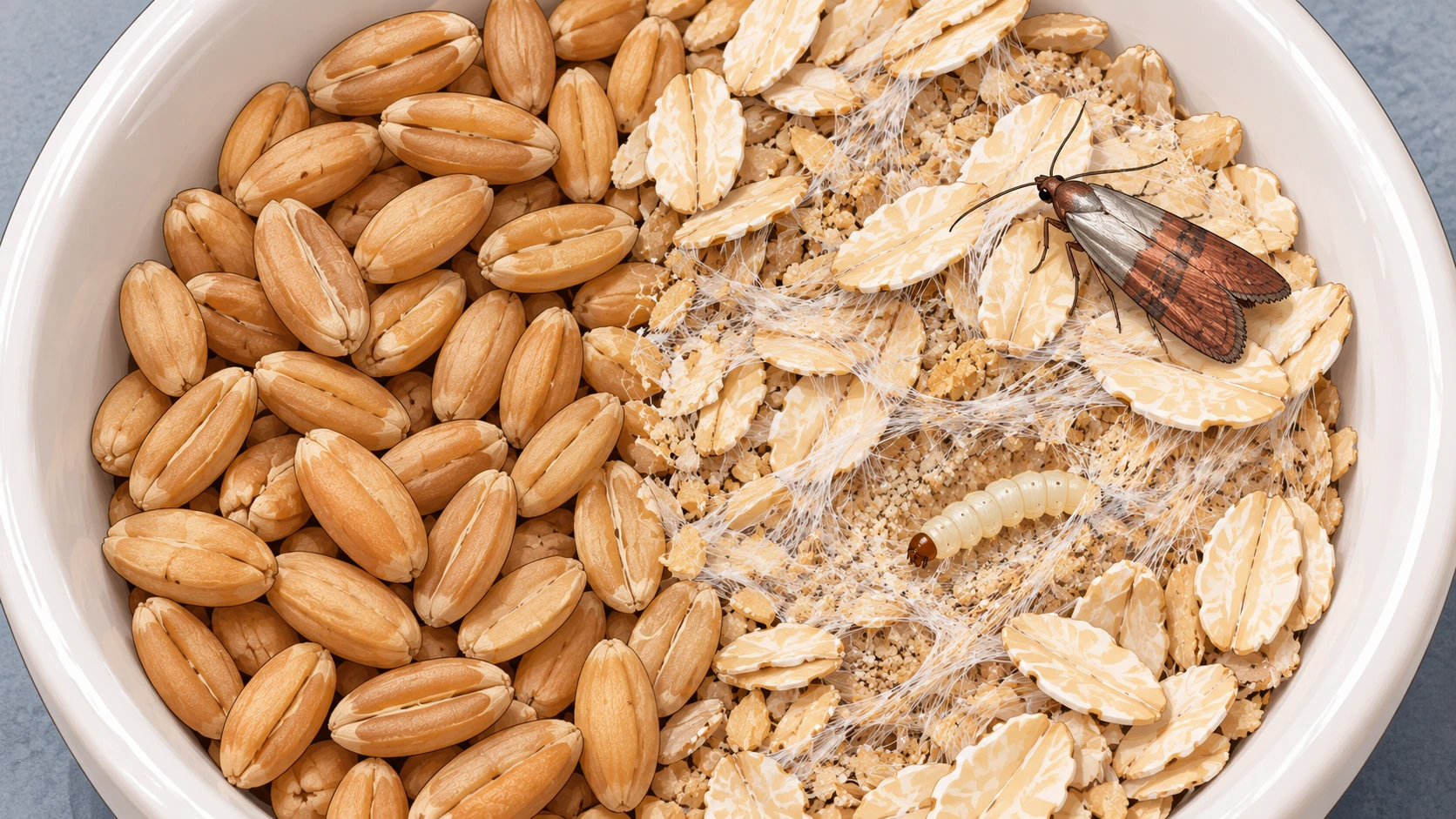
Indian meal moths are secondary stored-grain pests and external feeders. Their larvae feed on accessible food material, including broken grain kernels and grain dust, but they cannot penetrate intact, undamaged grain kernels to develop inside them.
That distinction explains something many people find confusing. You can open a bag of rice, wheat, corn, or mixed grain and discover Indian meal moth caterpillars moving among the contents. Some may be buried beneath several inches of grain, while others have spun silk that holds particles together.
The larvae are certainly living and feeding inside the food package. However, that does not mean they are internal kernel feeders.
Indian meal moths (Plodia interpunctella) belong to a different stored-grain pest category from insects whose immature stages develop concealed within individual kernels.
This matters when inspecting stored food. The position of larvae, the condition of the kernels, and the presence of silk can help explain what you are seeing and whether the damage matches Indian meal moth feeding.
Why Are Indian Meal Moths Classified as Secondary Pests?
Indian meal moths are classified as secondary pests because their larvae normally feed on grain that has already been broken, damaged, or processed into accessible material.
A primary stored-grain pest can attack sound, intact grain under suitable storage conditions. A secondary pest generally depends on existing openings, damaged kernels, grain fragments, or other food material that does not require it to penetrate the protective covering of an intact kernel.
The official classification of the Indian meal moth identifies it as both a secondary pest and a grain feeder. The same reference specifies that its larvae attack broken kernels and grain dust because they cannot penetrate undamaged grain.
The word secondary describes the insect’s relationship with stored grain. It does not mean that the insect is harmless, rare, or incapable of establishing a substantial infestation.
A bag containing cracked corn can support Indian meal moth development even when no other stored-grain insect has been present. The cracked material already provides the access that the larvae need.
Likewise, flour and other milled grain products do not require another insect to break them open. Processing has already made their nutrients accessible.
What Makes a Stored-Grain Pest Primary?
Primary pests can attack intact, sound grain directly. Some species can bore into or develop within individual kernels, allowing their immature stages to remain concealed.
Rice and granary weevils are familiar examples of insects whose larvae develop inside kernels.
The distinction is formalized in stored-grain primary pest classifications, which describe the ability to attack sound grain as a defining characteristic.
However, primary pest and internal feeder are not perfectly interchangeable terms in every classification system. Some insects classified as primary pests do not have the same concealed development pattern as grain weevils.
For the Indian meal moth, both labels are straightforward: it is a secondary pest, and its larvae are external feeders.
What Does External Feeding Mean?
An external feeder consumes food from accessible surfaces rather than completing its larval development concealed inside an intact grain kernel.
For Indian meal moths, this can include feeding on broken kernel surfaces, grain fragments, and fine particles between kernels.
Their caterpillars have chewing mouthparts. When they encounter accessible food, they can remove and consume material while moving around it.
The external-feeding classification of common pantry pests specifically identifies Indian meal moth larvae as external feeders, distinguishing them from internal feeders such as rice and granary weevils.
The word external refers to the relationship between the insect and the individual grain kernel. It does not require the caterpillar to remain on top of a pile of food.
A larva can move beneath the surface of a bag of grain, feed between damaged kernels, and create silk-lined spaces while remaining an external feeder.
That is the source of much of the confusion.
Can Indian Meal Moths Feed Inside Whole Grain Kernels?
Indian meal moth larvae cannot normally bore through the undamaged protective covering of a sound grain kernel and establish themselves inside it.
Their feeding is associated with damaged material, broken kernels, grain dust, and other accessible portions of stored products.
Imagine a bag containing 1,000 wheat kernels. Some are intact, while others were cracked during harvesting, transportation, or processing.
A larva may feed on the exposed material of the broken kernels. It may move between intact kernels and create silk among them. But finding the caterpillar surrounded by whole wheat does not demonstrate that it entered an intact kernel.
The distinction becomes clearer when the insect’s location is described at two different scales.
| Where the insect is found | Does this count as being inside food? | Does it mean the insect is inside an intact kernel? |
|---|---|---|
| On top of grain in an open bag | Yes, it is associated with the stored food | No |
| Several inches beneath the surface of loose grain | Yes, it is within the grain mass | No |
| Between cracked corn kernels | Yes, it is feeding among the contents | No |
| Within a silk-lined pocket of flour or grain dust | Yes, it is surrounded by food material | No |
| Developing entirely within an undamaged grain kernel | Yes | This is characteristic of internal kernel feeders, not normal Indian meal moth development |
The purpose of this comparison is to separate where the larva is physically located from how the larva obtains its food.
Being enclosed by a mass of grain is not the same as boring into one individual grain.
Can Indian Meal Moths Feed on a Kernel That Is Already Cracked?
Yes. A cracked kernel exposes surfaces that the larva may be able to feed on.
The original break can result from handling, processing, mechanical damage, or feeding by another insect. Once the protective covering has been compromised, more of the kernel’s contents become accessible.
A larva feeding at an existing crack may appear to be eating its way into the grain. However, that observation should not be confused with the ability to penetrate an undamaged kernel.
This is an important boundary. Indian meal moth larvae can consume accessible material within a damaged kernel without being classified as internal feeders of intact grain.
Do Indian Meal Moths Eat Only Damaged Grain?
No. Their classification as secondary grain pests does not mean that larvae are restricted to old, spoiled, or insect-damaged grain.
The classification describes how they attack grain kernels, not the entire range of materials they can consume.
Milled and processed products can already expose suitable nutrients without any prior insect damage.
For example, flour consists of finely divided grain material. The larva does not have to break through an intact seed coat to feed on it.
Similarly, cracked grain provides exposed material from the beginning. It can support secondary pests without having first been attacked by a primary pest.
This is why an Indian meal moth infestation does not automatically indicate that grain was previously spoiled or that another pest must have been responsible.
The broader classification of secondary stored-product pests includes insects that feed externally on damaged grain and powdered products. Indian meal moths fit that description.
How Can Indian Meal Moth Larvae Live Deep Inside a Food Package?
A food package provides a large environment relative to the size of a caterpillar.
Indian meal moth larvae can move between loose grains, along the sides of packaging, and through spaces containing broken pieces or food dust.
As they feed, they produce silk. This can hold nearby particles together and create protected feeding areas.
A caterpillar discovered near the bottom of a bag may have traveled there through existing spaces between the contents. It does not need to bore through a whole grain to reach that location.
Consider a bucket containing several inches of mixed grain. The surface may consist mostly of intact kernels, but smaller broken particles can accumulate in gaps.
If larvae are present in those spaces, they can remain hidden during a quick visual inspection. Someone pouring out the bucket may suddenly expose several caterpillars and conclude that the insects were living inside the whole grains.
The observation establishes their presence within the stored material. It does not identify the kernels they were eating.
The silk webbing produced by Indian meal moth larvae can make this pattern easier to recognize because the silk often binds fine food particles together.
Why Are Indian Meal Moths Often Found Near the Surface of Stored Grain?
Indian meal moth infestations in bulk grain frequently concentrate near the upper layers, where larvae can feed among fine material and create webbing.
The position of larvae can reflect food availability and the physical conditions in the grain.
In stored-grain guidance, Indian meal moth activity is described as most common in the upper four to six inches of grain. The larvae may produce enough silk to bind material together, resulting in caking or crusting near the surface.
That observation is particularly relevant to grain bins rather than every household package.
It should not be treated as a rule that Indian meal moth larvae can never occur deeper than six inches. Packaging, product structure, movement, and the distribution of suitable food can change where larvae are encountered.
The useful distinction is that surface-associated feeding is consistent with their biology, while development inside undamaged individual kernels is not.
Does Silk Webbing Mean the Larvae Are Tunneling Through Kernels?
No. Silk webbing can form tunnels or sheltered pathways through loose food material without the larvae penetrating intact kernels.
A silk-lined passage between seeds may look like a tunnel, especially when it is surrounded by compacted grain dust.
But its walls are made from silk and nearby food particles, rather than being excavated from the interior of one sound grain.
This distinction is particularly useful when evaluating photographs of infested grain. A webbed clump does not prove that an insect has bored through the solid center of the kernels it contains.
How Are Internal Kernel Feeders Different?
Internal kernel feeders develop within individual grain kernels. Some species lay eggs in or on grain in ways that allow the immature stages to enter and consume the interior.
The growing insect may remain concealed until it becomes an adult.
This produces a different evidence pattern from Indian meal moth larvae, which are more likely to be found externally among food particles and silk.
The Angoumois grain moth (Sitotroga cerealella) is a particularly useful contrast because it is another moth associated with stored grain.
Its larvae enter kernels and develop internally. The adult eventually emerges from the grain, leaving an exit opening.
The Canadian Grain Commission identifies the Angoumois grain moth as the only internal-feeding moth among the stored-grain pests in its primary-pest classification.
The distinction is summarized below.
| Feeding feature | Indian meal moth | Typical internal grain feeder |
|---|---|---|
| Stored-grain classification | Secondary pest | Commonly a primary pest |
| Larval feeding position | On accessible material outside intact kernels | Within individual kernels |
| Ability to penetrate sound grain | Cannot normally penetrate undamaged kernels | Can attack intact grain |
| Where developing larvae may be found | Between kernels, among fragments, or in processed material | Concealed within kernels |
| Typical evidence | Visible larvae, silk, and webbed food particles | Internal damage and possible emergence holes |
| Does an intact-looking grain mass rule out infestation? | No | No |
The table is a feeding-mechanism comparison, not a complete species-identification guide. Individual stored-grain pests vary, and the word primary should not be used as a synonym for internal in every circumstance.
For readers comparing specific moth species, the Indian meal moth versus grain moth distinction provides the separate identification context.
Does Finding a Hole in a Grain Kernel Prove Indian Meal Moths Made It?
No. A hole in a kernel is not distinctive evidence of Indian meal moth feeding.
An opening may have existed before the moth arrived. It may result from mechanical damage, processing, or activity by another insect capable of attacking sound grain.
If a caterpillar is found beside that opening, it may have been feeding on exposed material rather than making the original hole.
A particularly neat, circular emergence hole in a kernel raises a different question from a clump of silk-bound grain fragments.
The shape, location, and condition of the damage need to be evaluated alongside the insects actually present.
An adult Indian meal moth flying out of a bag also does not establish that it emerged from inside a kernel. Its pupation site may have been elsewhere within or near the stored material.
When identification is uncertain, examine an actual specimen instead of assigning a species based on one damaged kernel.
The appearance of Indian meal moth caterpillars can help connect visible larvae to the correct species, while comparisons with stored-grain weevils require separate identification features.
Can an Intact-Looking Bag of Grain Still Contain Indian Meal Moths?
Yes. A bag can appear to contain mostly sound kernels while also holding broken pieces, grain dust, and other accessible material that supports larvae.
The surface of the grain may conceal what lies between kernels or at the bottom of the package.
An unopened bag can also contain an infestation that developed before the owner noticed it. The absence of obvious exterior damage does not establish that no insects are present inside.
However, the presence of Indian meal moths does not mean every whole kernel in the bag has been penetrated.
These are different claims.
An intact-looking package describes the condition of its outer container. Sound kernels describe individual pieces of grain. The insect’s feeding classification concerns its ability to attack those individual pieces.
There is also no guarantee that every kernel in a visually uniform product is undamaged. Small cracks and fragments may be difficult to notice without examining a representative sample.
This is why the question “Are the moths inside the bag?” cannot answer the question “Are the larvae inside the kernels?”
Does Secondary Feeding Mean Indian Meal Moths Need Another Pest First?
No. Indian meal moths can establish themselves without a primary grain pest being present.
In grain storage, secondary insects may benefit from damage caused by other species. But that is only one possible source of accessible food.
Grain can be broken during harvesting, handling, or milling. Dust and fragments may already be present when a product is packaged.
A household bag of cracked grain therefore contains suitable exposed material from the start.
Another insect does not have to make the first opening.
This is one reason the classification is often misunderstood. The word secondary refers to the kind of material a pest commonly exploits, not a fixed order in which insects must arrive.
Likewise, an Indian meal moth infestation does not prove that a grain weevil infestation occurred first.
Does This Classification Matter When Checking Stored Grain?
It changes what evidence you should look for and how you interpret it.
For Indian meal moths, inspect accessible food surfaces and loose material for actual larvae, silk, and signs of feeding.
A webbed layer of grain dust is consistent with external feeding. A caterpillar moving among cracked kernels is also consistent with the species.
By contrast, individual kernels containing concealed insects or showing characteristic emergence openings may justify investigating an internal-feeding species.
The following examples show how the same bag can produce very different evidence.
| Example | What the observation supports | What it does not prove |
|---|---|---|
| White caterpillars moving among broken wheat kernels | Possible external-feeding stored-product moth activity | That larvae developed inside intact kernels |
| Silk binding cracked corn and fine particles | Feeding activity consistent with Indian meal moth larvae | That every corn kernel is damaged internally |
| A neat hole in one whole grain kernel | Possible internal-feeder activity or another source of damage | That an Indian meal moth made the hole |
| Adult Indian meal moth resting on a grain bag | Presence of an adult moth | That the bag’s kernels have been penetrated |
| Larvae beneath several inches of loose grain | Insects are inside the grain mass | That the larvae are internal kernel feeders |
These distinctions are useful when deciding whether the evidence matches the species being identified. They do not establish that grain remains suitable for use. Food can be contaminated by external-feeding pests even when the individual kernels were never penetrated.
The visible signs of an Indian meal moth infestation help establish whether larvae and their residues are present.
Are Secondary Pests Less Serious Than Primary Pests?
A secondary classification does not indicate the severity of an infestation.
Indian meal moths can produce substantial contamination through larval feeding and silk production even when they cannot bore into intact grain.
The quality and usability of a stored product depend on much more than whether its individual kernels contain concealed insects.
A bag with externally feeding caterpillars and extensive webbing may be unusable despite having many intact kernels.
Conversely, a kernel containing an internal feeder might show little obvious external damage until the insect emerges.
Those are different damage patterns, and neither should be ignored simply because one is called secondary.
The classification helps explain insect biology. It is not a numerical ranking of danger, contamination, or economic loss.
Common Questions About Indian Meal Moth Feeding
Are Indian Meal Moths Internal or External Feeders?
Indian meal moth larvae are external feeders. They feed on accessible food material rather than developing inside undamaged individual grain kernels. They may still be found deep within a package or a mass of loose grain.
Can Indian Meal Moths Bore Into Rice Kernels?
Indian meal moth larvae cannot normally penetrate intact, undamaged rice kernels. They can be associated with broken grains, dust, and other accessible food material within a rice package. Finding a larva in a bag of rice does not establish that it developed inside one grain.
Can Indian Meal Moths Feed on Whole Corn?
They may be present in a mass of whole corn, particularly where broken kernels or fine particles are available. Their normal feeding does not involve boring through the undamaged covering of a sound kernel. Cracked or damaged portions can provide access to material that intact kernels protect.
Are Indian Meal Moths Primary Invaders of Stored Grain?
Not in the technical stored-grain classification. They are secondary pests. However, they can be the first insect pest to establish in a particular package if accessible material is already present. Secondary does not mean they must arrive after another insect.
Do Indian Meal Moth Larvae Pupate Inside Individual Grain Kernels?
No. Indian meal moth larvae typically pupate in silk cocoons on or near the food or in sheltered locations away from it. Their development is different from internal-feeding grain insects that mature concealed within individual kernels.
Does Finding Silk Inside Grain Mean the Kernels Are Hollow?
No. Indian meal moth silk can form strands and protected spaces between kernels or bind fine particles into clumps. Its presence establishes silk production, not that the surrounding whole kernels have been hollowed out.
The Bottom Line
Indian meal moths are secondary stored-grain pests whose larvae feed externally. They commonly exploit broken kernels, grain dust, and other accessible material rather than penetrating undamaged grain.
They can still live well inside a food package. A caterpillar buried in grain, feeding among cracked kernels, or resting within silk-lined material is inside the stored product without being inside an individual intact kernel.
That distinction is useful when interpreting damaged grain, identifying the likely pest, and deciding what evidence to inspect.
Do not mistake secondary for harmless, or external feeding for insects that must remain visible on the surface. Indian meal moths can cause a substantial infestation without ever developing inside sound grain kernels.
One thought on “Are Indian Meal Moths Primary or Secondary Pests? Do They Feed Inside Food?”