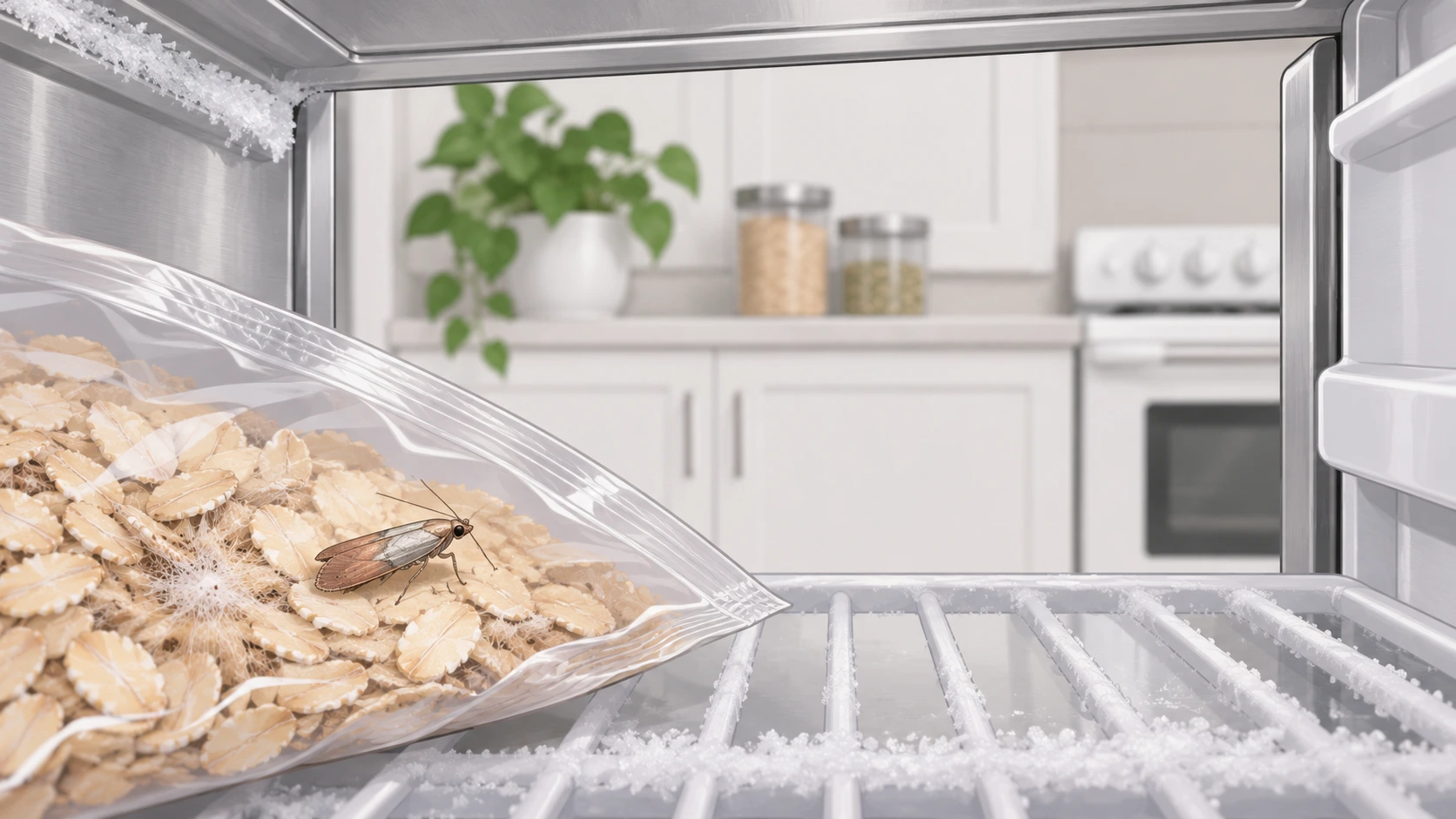
Indian meal moths can be killed by freezing infested material at 0°F (-18°C) for at least four days or by heating suitable materials to approximately 130°F (54°C) for at least 30 minutes. These are established household treatment recommendations, but their effectiveness depends on the insects actually experiencing the required temperature for long enough.
A bag of flour placed in a freezer does not instantly become -18°C throughout. Likewise, setting an oven to 130°F does not mean the center of a tray of grain immediately reaches that temperature. The clock, the temperature, and the location of the insects all matter.
Indian meal moths (Plodia interpunctella) also differ in their vulnerability to heat and cold depending on whether they are eggs, feeding larvae, mature larvae, pupae, or adults. Scientific studies show that some stages withstand particular exposures better than others.
For most households, freezing is the more practical thermal treatment for small quantities of dry stored products. Oven heating can work, but temperature control, product thickness, material safety, and food quality make it more demanding. Heavily contaminated food is usually better discarded than treated.
What Temperature Kills Indian Meal Moths?
There is no single temperature that instantly kills every Indian meal moth at every life stage. A temperature becomes lethal through the combination of its intensity and the length of exposure.
As the temperature becomes more extreme, the exposure time needed to kill insects generally decreases. However, individual stages respond differently, and laboratory results cannot automatically be treated as guarantees for a full package of food.
The following benchmarks provide a practical starting point.
| Temperature | Exposure time | What the evidence supports |
|---|---|---|
| 0°F (-18°C) | At least 4 days | Widely recommended household freezing treatment for susceptible stored-food pests |
| 0°F (-18°C) | 7 to 10 days | More conservative household guidance used by some extension programs, particularly useful where cooling time is uncertain |
| 130°F (54°C) | At least 30 minutes | Common extension recommendation for shallow quantities of suitable food |
| 122°F (50°C) | 34 minutes | Approximately 99% mortality of wandering fifth-instar larvae in a controlled study, not a guarantee of complete household treatment |
| 118°F (48°C) | Approximately 34 minutes | Approximately 99% mortality of tested Indian meal moth eggs in a separate controlled study |
| 108°F (42°C) | More than 10 hours | Required to reach approximately 99% mortality across tested egg ages under laboratory conditions |
The household recommendations come from stored-food pest treatment guidance. The stage-specific research figures describe measured experimental results and should not be used interchangeably with the household procedures.
In particular, 99% mortality is not 100% mortality. A laboratory result showing that 99 out of 100 insects would be expected to die under particular conditions does not establish a complete kill of every insect in a real package.
The useful question is therefore not simply how hot or cold the freezer or oven becomes. It is whether every insect in the treated material receives an adequately lethal exposure.
What Freezing Temperature Kills Indian Meal Moths?
A household freezer operating at 0°F (-18°C) or colder can kill Indian meal moth eggs, larvae, pupae, and adults when the exposure is sufficiently long.
For a practical household procedure, keep small, suspect items in the freezer for at least four days. If the product is thick, the freezer is heavily loaded, or its temperature is uncertain, a longer interval is more cautious.
University extension recommendations vary. Four days at 0°F is a commonly published minimum, while other programs recommend as much as seven to ten days for suspect stored products.
Those differences should not be interpreted as proof that the shorter recommendation is ineffective. They reflect different guidance assumptions, safety margins, and circumstances.
Freezing works because sufficiently low temperatures disrupt normal insect function and eventually cause irreversible injury. However, cold injury does not occur at exactly the same rate in every life stage or under every exposure condition.
How Long Should You Freeze Food to Kill Indian Meal Moths?
For a small package that can cool thoroughly, four full days in a freezer reliably maintaining 0°F (-18°C) is a sensible minimum based on standard extension guidance.
Seven days provides a more conservative household margin when you cannot directly confirm how quickly the interior cooled. Some extension recommendations extend that margin to ten days.
The important qualification is that the food must have time to cool before the insects inside receive the intended exposure.
Imagine putting a large container of room-temperature birdseed into an already full freezer on Monday morning. The surrounding freezer air may be at 0°F, but the center of the container will initially be much warmer.
If the package takes many hours to cool, the insects near its center have not received the same cold exposure as insects close to the outer surface.
That is why thinner packages, smaller quantities, and sufficient airflow improve the reliability of freezing. When the center temperature cannot be measured, extending the treatment time is more practical than assuming that the entire package cooled instantly.
Does One Night in the Freezer Kill Indian Meal Moths?
One night in a freezer is not a dependable treatment for every stage of an Indian meal moth infestation.
Some exposed insects may die rapidly at sufficiently low temperatures. Others may survive shorter exposures, particularly if they are protected within a large package or the freezer does not maintain its target temperature.
A night in the freezer also provides little assurance that a thick container cooled completely.
For home treatment, follow the established multi-day recommendations rather than using an overnight exposure as proof that all eggs and larvae have been killed.
Is Refrigeration Cold Enough to Kill Indian Meal Moths?
Ordinary refrigeration is not a reliable rapid-kill treatment.
A refrigerator commonly operates near 35°F to 40°F (approximately 2°C to 4°C). Those temperatures may slow insect development and activity, but they are much warmer than a household freezer.
Controlled research on Indian meal moth eggs found that near-freezing temperatures above 0°C could require lengthy exposures to achieve high mortality. In one study, approximately 19.8 days at 0.5°C were needed for 99% mortality across the tested egg ages.
The results illustrate why placing a suspect food product in the refrigerator for a day or two should not be described as killing every Indian meal moth.
Refrigeration can limit development and help protect food from further insect activity, but it should not be substituted for a verified freezing treatment.
Does Freezing Kill Indian Meal Moth Eggs and Pupae?
Adequate freezing can kill Indian meal moths across their developmental stages, including eggs and pupae. The time required depends on the temperature and on the exposure each stage receives.
Cold tolerance is not identical throughout the life cycle.
Laboratory studies have shown that adult Indian meal moths can be highly susceptible to severe cold, while larvae, pupae, and cold-acclimated individuals respond differently. Some stages suffer lethal injury before their body fluids actually freeze.
That means a freezer treatment cannot be judged simply by whether an insect appears frozen. Nor should a moth that remains motionless immediately after removal be taken as proof that the entire treated population has died.
The most useful stage-inclusive guidance is based on maintaining an adequately low temperature for a sufficiently long period.
The University of Kentucky’s temperature-exposure table for stored-product insects gives Indian meal moth figures ranging from one day at 0°F to 5°F to five days at 10°F to 15°F. These figures come from a historical stored-grain reference and assume exposure at the stated temperatures.
For households, the commonly recommended four-day treatment at 0°F offers a clearer practical benchmark than selecting a shorter exposure from a temperature table without accounting for cooling delays.
Which Indian Meal Moth Stage Is Hardest to Kill With Heat?
Mature wandering larvae can be particularly heat tolerant.
A controlled study exposed Indian meal moth eggs, wandering fifth-instar larvae, pupae, and adults to constant temperatures between 44°C and 52°C.
The mature larvae were generally the most heat-tolerant stage across the temperatures tested. At 50°C, they required at least 34 minutes of exposure to reach 99% mortality.
This stage-specific heat susceptibility research explains why evidence that heat kills exposed adults should not automatically be treated as proof that every larva has also been killed.
The result also has a limitation. The researchers measured mortality under controlled exposure conditions. A larva buried deep in a container of food may take longer to reach the same temperature.
What Heat Temperature Kills Indian Meal Moths?
Indian meal moths can be killed by sustained exposure to temperatures around 120°F to 140°F (49°C to 60°C), provided the combination of temperature and time is sufficient.
For household use, a commonly recommended method is to place a shallow layer of suitable dry food in an oven at approximately 130°F (54°C) for at least 30 minutes.
This guidance is intended for relatively small, shallow quantities. A deep container may need considerably longer to heat through.
It is also important to distinguish the oven setting from the temperature achieved inside the material.
If an oven is set to 130°F, the center of a tray of food will initially be cooler. Starting a timer as soon as the tray enters the oven does not establish that every insect has already received 30 minutes at 130°F.
Where reliable measurement is possible, the conservative approach is to confirm that the coolest part of the product has reached the intended treatment temperature before counting the full exposure interval. Without such confirmation, an exact center-temperature exposure cannot be assumed from the oven dial alone.
Some household ovens cannot accurately maintain temperatures as low as 130°F. If your oven cannot safely and consistently hold the intended temperature, do not improvise with a higher setting and assume the original treatment time still applies.
Will 120°F Kill Indian Meal Moths?
A temperature of 120°F (approximately 49°C) can be lethal to Indian meal moths when exposure is long enough. However, it should not be treated as an instantaneous kill temperature.
Controlled egg experiments demonstrate how sharply mortality changes with both temperature and duration.
For example, the temperature sensitivity of Indian meal moth eggs was tested at several elevated temperatures. Approximately 99% mortality across tested egg ages required more than ten hours at 42°C, compared with roughly 34 minutes at 48°C.
Those findings are informative, but they do not establish that every stage dies after a short exposure at 120°F.
Published household heating recommendations also vary with the amount of material, treatment arrangement, and intended margin of safety.
If you cannot verify that all parts of the material received sufficient heat for sufficient time, the treatment remains uncertain.
Does 140°F Kill Indian Meal Moths Faster?
Higher temperatures generally reduce the time required for lethal exposure, but that does not mean every item can be safely heated to 140°F.
A temperature of 140°F (60°C) is above the range used in some of the Indian meal moth stage-specific laboratory experiments. It is also within the range of several extension heating recommendations for stored products.
However, product properties matter. Heat may change flavors, damage ingredients, affect germination, or make some materials unsuitable for their intended purpose.
A higher oven setting does not eliminate temperature differences within a deep package. It can instead overheat the outside while the center remains cooler.
For households, the objective is a controlled, sufficiently long exposure throughout the material, not simply the hottest possible oven setting.
Why the Temperature at the Center of the Product Matters
A thermometer placed in freezer air tells you the temperature around a package. It does not reveal the temperature at the center of a bag of grain.
The same problem occurs in an oven. The air can reach the selected temperature well before a thick layer of dry food does.
Thermal treatments become less predictable as the material gets thicker, more tightly packed, or more heavily insulated.
Consider two hypothetical containers of the same dry grain. One is a shallow tray with a layer approximately half an inch deep. The other is a tightly packed container several inches deep.
Both may be exposed to the same freezer temperature for the same length of time, but the thin layer will generally cool faster. The same principle works in reverse during heating.
The physics of cooling objects in a freezer is documented in conservation guidance. Larger or insulated objects take longer to reach the surrounding temperature, and reducing thickness can substantially shorten cooling time.
This is the most common limitation overlooked by simple temperature advice. The surrounding air may be lethal while an insect protected deep inside the product has not yet experienced the full exposure.
A Practical Example: Two Bags of Flour
Suppose you have two suspect bags of flour.
The first contains a small quantity spread into a thin, sealed freezer-safe bag. The second contains a much larger quantity packed tightly into a thick container.
Both go into a freezer displaying 0°F. The first bag should cool more quickly because heat can escape from a relatively thin layer. The larger container has more material between its center and the surrounding freezer air.
You cannot assign a precise cooling time to either package from size alone. Freezer performance, container material, starting temperature, airflow, and actual thickness all influence the result.
Therefore, the useful decision is to divide suitable material into smaller portions when possible and use a conservative exposure period. Avoid treating the freezer’s air temperature as proof that every insect has already reached that temperature.
How to Freeze Suspect Stored Food Safely
Freezing is most appropriate when a product is only suspected of harboring insects, has little or no visible contamination, and can tolerate freezing without losing its intended quality.
Place the material in a clean, freezer-safe, tightly sealed bag or suitable container. Smaller, flatter portions generally cool more evenly than a single bulky package.
Use a freezer thermometer to check that the appliance maintains approximately 0°F (-18°C) or colder. Many freezer dials show a numbered setting rather than the actual temperature.
Keep the product frozen for at least four days, with additional time if its interior may have cooled slowly. Do not repeatedly remove it for inspection, because warming interrupts the exposure.
After treatment, allow the sealed package to return toward room temperature before opening it. Keeping it sealed during warming helps limit condensation directly on the food.
Moisture is particularly undesirable in dry products intended for long-term storage because it can promote spoilage or mold.
Freezing also has a quality limitation. It may change the texture of some materials, and seeds intended for planting may require specific handling to protect viability.
For foods with extensive webbing, insect debris, or obvious contamination, discarding the product is usually preferable. Killing insects does not remove the material they have left behind.
How to Heat Suspect Food Without Creating New Risks
Oven treatment is appropriate only for material that can safely tolerate the temperature and can be heated evenly.
The first consideration is the container. Do not put plastic bags, ordinary food packaging, or containers that are not oven-safe into the oven.
For a suitable dry product, a shallow oven-safe tray helps reduce uneven heating. However, a low oven setting is useful only if the appliance can maintain it reliably.
Avoid using oven heating for products that could scorch, melt, become unsafe, or lose essential properties at the treatment temperature. Nuts and other oily foods may change in quality, while chocolate and some prepared foods may melt or degrade.
Do not heat seed intended for planting without understanding the consequences for germination.
Microwave ovens are particularly difficult to use as precise pest-killing tools because they may produce uneven heating. A short microwave interval copied from a general guide cannot establish that every insect inside a product received the same lethal exposure.
Do not place metal packaging in a microwave or attempt to heat a sealed container that could build pressure.
Heating is also unsuitable for treating an entire pantry, kitchen cupboard, or room by improvising with household heaters. Uncontrolled heating can create fire and property-damage hazards.
If the item cannot be safely heated under a verifiable temperature-and-time procedure, choose freezing where suitable or discard it.
Can Hot Water Kill Indian Meal Moths?
Hot water can kill Indian meal moths when insects receive sufficient heat, but it is generally unsuitable for treating dry pantry foods.
Pouring hot water into flour, cereal, grain, or powdered products changes the material and can make it unusable. It also provides no assurance that all insects receive the same exposure.
A study of Indian meal moth eggs used carefully controlled hot-water treatments to measure mortality at particular temperatures. Those experimental conditions should not be translated into advice to pour boiling water over household food packages.
For a dry stored product, controlled dry heat or freezing offers a more appropriate thermal approach when treatment is justified.
Can Sunlight or a Hot Car Kill Indian Meal Moths?
A hot car or a sunny windowsill may reach temperatures that are lethal to exposed Indian meal moths, but neither provides a dependable treatment without controlled measurement.
The air inside a parked vehicle can become very hot. Yet shaded parts of the vehicle, the center of a bulky package, and insulated containers may remain cooler than surrounding surfaces.
Sunlight introduces the same uncertainty. A dark package in direct sun can warm much more than a light-colored package in shade, while temperatures fluctuate with clouds, wind, and time of day.
Without verifying both the material’s internal temperature and its exposure duration, there is no basis for declaring every life stage dead.
Leaving food in a hot car can also damage its quality. Household treatment should not depend on guessing whether the weather was hot enough.
Does Freezing or Heating Make Contaminated Food Safe to Eat?
Killing Indian meal moths does not remove insect contamination.
Larvae can leave silk, droppings, shed skins, and other material in stored food. Thermal treatment may kill the insects while leaving those residues exactly where they were.
This distinction matters when deciding whether a product is worth treating at all.
A sealed package with no visible contamination that you are treating as a precaution presents a different situation from a bag containing numerous larvae and clumps of silk-bound food.
The first may be a reasonable candidate for freezing. The second is generally best discarded.
Thermal treatment also does not reverse mold growth, bacterial spoilage, rancidity, or contamination from other sources. A lethal insect exposure is not a food-safety sterilization process.
For additional information about the condition of affected materials, see the damage Indian meal moth infestations cause to food.
Why Indian Meal Moths Can Reappear After Freezing or Heating
Successful treatment of one package does not establish that every Indian meal moth in the home has been killed.
A larva may have already left its food source before the package was placed in the freezer. Mature Indian meal moth larvae can travel away from feeding material and pupate in sheltered locations.
That individual would not be exposed to the cold treatment applied to the package.
Another package may also contain developing insects that were never treated. Consequently, adults can emerge even after a correctly frozen bag has been returned to storage.
This does not necessarily mean the freezing temperature was insufficient.
The reason Indian meal moth larvae and cocoons appear on walls or ceilings helps explain why thermal treatment of a single food item cannot address every insect that may already have left it.
Similarly, a newly appearing adult does not identify which package supported its development. Continued activity calls for checking the remaining evidence rather than automatically repeating heat treatment on the same item.
The broader process of locating an Indian meal moth infestation source is separate from choosing a lethal temperature for an individual product.
Freezing or Heating: Which Is Better for Household Use?
Freezing is generally the more forgiving option for small quantities of dry, temperature-tolerant material. It does not require holding an oven at an unusually low baking temperature, and it avoids the risk of scorching.
Heat can work, but it requires greater attention to the container, product thickness, and the ability to maintain the intended temperature.
| Consideration | Freezing | Oven heating |
|---|---|---|
| Practical household target | 0°F (-18°C) | Around 130°F (54°C) |
| Typical guidance | At least 4 days, with longer margins in some recommendations | At least 30 minutes for suitable shallow material |
| Main uncertainty | How quickly the product’s center cools | How quickly the product’s center heats |
| Packaging | Freezer-safe sealed bags or containers | Oven-safe trays or cookware only |
| Possible quality effects | Condensation after thawing, changes in some foods | Scorching, melting, flavor changes, reduced seed viability |
| Best suited to | Small packages that tolerate freezing | Small, shallow amounts that tolerate controlled heating |
| Inappropriate expectation | That one night guarantees a complete kill | That the oven setting equals the product’s core temperature |
This comparison is a practical synthesis of extension recommendations and thermal-transfer principles, not a laboratory comparison showing one method has a universally higher kill rate.
In either case, there is little benefit in treating heavily infested food that should already be discarded.
For a wider overview of the methods that can affect different life stages, see what kills Indian meal moths. Temperature treatment is most useful when applied to a clearly identified item under conditions that can be controlled.
Common Questions About Lethal Temperatures
Will 32°F (0°C) Kill Indian Meal Moths?
An exposure at 32°F may slow activity, and sufficiently prolonged exposure near freezing can kill some stages. However, 32°F is not a dependable rapid-kill temperature. Research on Indian meal moth eggs shows that near-freezing exposures may require many days to achieve high mortality. Use an actual freezer rather than relying on refrigeration or temperatures near the freezing point of water.
Does Freezing Kill Indian Meal Moth Larvae Instantly?
No. Larval mortality depends on the temperature and duration of exposure, as well as the insect’s physiological condition. A larva inside a large package also takes time to cool. A multi-day treatment at 0°F is more dependable than assuming instant death.
Will 100°F (38°C) Kill Indian Meal Moths?
A temperature of 100°F is not an established rapid-kill household treatment for Indian meal moths. Warm conditions can affect development and survival, but a reliably lethal exposure requires an adequately high temperature sustained long enough. Do not use a warm room or a low-temperature warming device as a substitute for the published heat-treatment recommendations.
Can Indian Meal Moths Survive Being Frozen and Thawed?
Some insects can survive particular short or insufficient cold exposures, especially when their internal temperature never reaches the intended extreme. Visible immobility after freezing or thawing is not a reliable test of mortality. Use a sustained, verified treatment instead of checking whether an individual appears motionless.
Should You Freeze a Whole 20-Pound Bag of Birdseed?
A large bag presents greater uncertainty because the center may take much longer to cool than the outside. Divide material into smaller freezer-safe portions if feasible, and use a conservative treatment interval. If the birdseed is heavily infested, disposal is often more practical. For product-specific considerations, see Indian meal moths in birdseed.
Can You Use the Oven’s Self-Cleaning Cycle to Kill Indian Meal Moths?
No. Self-cleaning cycles reach extremely high temperatures intended to clean the oven, not treat stored food. They can damage materials and create significant fire and smoke hazards. They are inappropriate for insect treatment of food products.
The Bottom Line
Indian meal moths can be killed through sustained freezing or heating, but successful treatment requires the correct temperature for long enough to reach the insects.
For household use, 0°F (-18°C) for at least four days is a widely recommended freezing benchmark, with longer periods offering a useful margin for uncertain cooling conditions. Heating suitable shallow products to approximately 130°F (54°C) for at least 30 minutes is another established recommendation, provided the material actually receives adequate heat.
Eggs, larvae, pupae, and adults do not have identical temperature tolerances. Mature larvae can be especially heat tolerant, and controlled laboratory findings should not be mistaken for guarantees involving deeply packed food.
The most dependable choice for a small, lightly suspect dry product is usually proper freezing. Heavily infested products are better discarded because thermal treatment kills insects without removing their contamination. Once treated, keep suitable materials in tightly sealed containers to prevent new exposure.
Temperature controls the insects that actually receive the treatment. It cannot kill Indian meal moths sheltered elsewhere in the home.
One thought on “What Temperature Kills Indian Meal Moths? Freezing and Heat Explained”