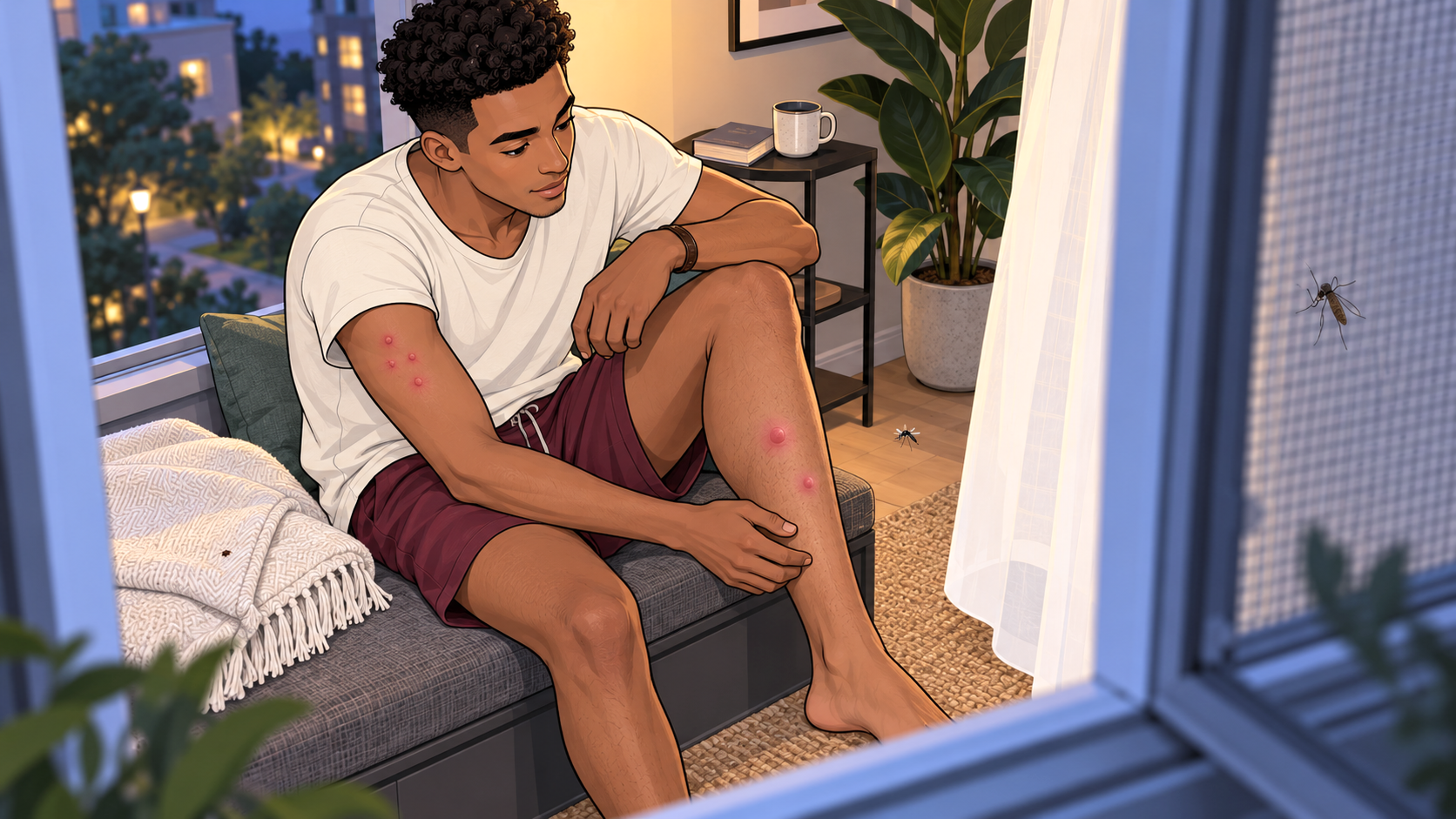
Mosquito bites are familiar enough that most of us think we recognize one instantly. Then several itchy bumps appear after a night’s sleep and that confidence disappears. Maybe a mosquito got into the bedroom. Maybe the marks were already developing from bed bug bites. Looking at the bumps alone often cannot settle it.
When comparing bed bug bites vs. mosquito bites, the circumstances surrounding the bites usually reveal more than their shape. Both can produce itchy, swollen bumps that look remarkably similar. A mosquito may bite while you are awake or asleep, while bed bug reactions commonly appear after exposure around a sleeping or resting area and may not become visible until days later.
The useful investigation therefore runs backward. Instead of asking only, “What does this bump look like?” ask where you were, when the itching began, whether new marks keep appearing, and whether an insect problem can actually be found.
Start With the Moment You Could Have Been Bitten
A mosquito gives you an advantage that bed bugs often do not. Sometimes you know exactly when the exposure happened.
You may spend an evening on a patio, hear mosquitoes buzzing around your legs, feel an insect land, and notice an itchy bump afterward. Mosquitoes can bite during the day or night, depending on the species, and itching and swelling are common reactions to their bites. When that sequence is clear, there is little reason to invent a more complicated explanation.
Bed bugs create a less obvious event. They commonly feed while people sleep, and their feeding can go unnoticed at the time. Salivary substances introduced during feeding help prevent a person from immediately feeling the bite. The resulting marks may not appear until one to several days after the feeding occurred.
That delay breaks the connection between cause and effect. A bump first noticed Tuesday morning might tempt you to blame Monday night, even though the relevant bed bug exposure could have happened earlier. For this reason, the time you noticed a bed bug reaction is not necessarily the time you were bitten.
Mosquito exposure is not always obvious either, especially when someone is asleep. Still, a known period around active mosquitoes provides a piece of evidence that the appearance of the bump cannot.
A Mosquito Can Visit the Bedroom Without Living in the Bed
Waking with bites does not automatically shift the answer toward bed bugs. Mosquitoes can enter homes, and some species feed indoors. One mosquito in a bedroom can therefore create an overnight mystery without there being anything wrong with the mattress.
This distinction changes the type of evidence worth searching for. A mosquito is a flying insect that may have entered through an open door, damaged screen, or another opening. Mosquitoes can bite during both day and night, so the fact that a mark appeared after sleep is not enough to identify the insect.
Bed bugs operate from a much closer base. They hide in protected spaces around places where hosts sleep and rest. Mattress seams, box springs, bed frames, headboards, nearby furniture, and cracks can all provide harborages. Repeated unexplained marks associated with the same sleeping area therefore make a careful inspection for bed bugs much more informative than examining the bumps again.
That difference is easy to miss. The mosquito question is often, “Could one have gotten into this room?” The bed bug question is, “Is there a population hiding close to where I sleep?”
Those are two completely different investigations.
The Shape of the Bump Is Surprisingly Weak Evidence
Mosquito and bed bug reactions overlap enough that there is no dependable visual dividing line between them.
Both can produce itchy, raised, swollen areas. In fact, bed bug bites are specifically described as looking similar to mosquito and flea bites. Broader clinical guidance on arthropod bites also notes that many biting insects produce itchy swollen papules because the visible lesion largely reflects the body’s reaction to substances introduced during feeding.
The size of the bump does not rescue the comparison. People react differently to both insects. One mosquito bite can become a large swollen welt in a sensitive person, while another produces little more than a small itchy bump. Bed bug reactions likewise range from no visible sign to pronounced inflammatory or allergic responses.
A central dot is not a reliable shortcut either. Arthropod bites can sometimes show a small point where mouthparts entered the skin, but that feature is neither exclusive to mosquitoes nor exclusive to bed bugs.
This is why we would not compare the diameter of two welts and declare the larger one a mosquito bite. Skin measures your immune response better than it measures the species of insect.
For the same reason, our broader guide to raised, flat, and swollen bed bug bites treats appearance as a range rather than a fixed template.
The “Bed Bugs Bite in Threes” Rule Creates More Confusion Than It Solves
Pattern recognition becomes especially tempting when several bumps appear together.
Bed bug reactions can occur in clusters or lines. Repeated feeding by a single bed bug can even be associated with a cluster of itchy papules or wheals. That gives the familiar line or group of bites some basis in real observations.
It does not create a three-bite rule.
Mosquito bites can also occur close together. If exposed skin is available and mosquitoes are active, several bites can accumulate on one arm, ankle, or leg. Nothing requires them to be perfectly scattered.
Therefore, three marks in a line cannot identify bed bugs, just as three randomly spaced bumps cannot identify mosquitoes. Our article on bed bug bite clusters goes further into why counting marks produces false certainty.
The better question is whether the pattern accompanies another meaningful clue. A line of bumps plus confirmed bed bugs in a mattress seam matters. The same line after an evening beside a mosquito-filled lake tells a very different story.
Exposed Skin Tells You Less Than You Might Expect
Both insects need access to skin, so body location creates another area of overlap.
Bed bug reactions are often found on uncovered areas such as the face, neck, arms, hands, and legs. That makes sense because those areas may remain accessible while someone sleeps. Where bed bugs bite on the body can also be affected by clothing, blankets, sleeping position, and where the insects are approaching from.
Mosquitoes can likewise feed on exposed skin. Wearing long sleeves and pants is one of the measures used to reduce mosquito bites, which tells us something important about this comparison: an exposed forearm is useful to both insects.
As a result, bites on your arms do not meaningfully distinguish them. Neither do bites on the legs.
Location becomes more informative when combined with the circumstances. A bare calf covered in bumps after sitting outdoors at dusk has one history. An exposed shoulder developing repeated marks after several nights in the same hotel bed has another.
The skin location stayed similar. The exposure story changed completely.
New Marks Every Morning Deserve a Bedroom Investigation
Repeated timing can eventually become more important than the appearance of any individual bite.
One unexplained bump after one night leaves many possibilities open. New marks repeatedly noticed after sleeping in the same room create a pattern worth investigating. Even then, the marks themselves still do not diagnose bed bugs, because delayed reactions complicate the timeline.
This is the point where physical evidence becomes valuable. Bed bug bites are not considered diagnostic on their own, and confirmation is better achieved by identifying adult or immature bed bugs near the area where exposure occurred.
A mattress inspection should therefore focus on the insects and what they leave behind. Look along seams, labels, folds, the box spring, headboard, frame joints, and nearby protected spaces. Live bugs, eggs, shed bed bug skins, fecal spotting, and characteristic stains provide much stronger evidence than another photograph of your arm.
Meanwhile, consider the room itself for mosquitoes. Are windows screened properly? Has a mosquito actually been seen or heard indoors? Are doors being left open in an area with active mosquitoes?
You are no longer comparing two bumps. You are comparing two possible sources.
A Bite You Felt Happen Changes the Odds, but Not Every Bite Is Felt
Mosquitoes are often blamed correctly because people catch them in the act. A mosquito lands, a person swats it, and an itchy reaction develops at the same location. That sequence provides direct context.
Bed bug bites usually lack that obvious moment because feeding often occurs during sleep without immediate awareness. Our guide to whether you can feel bed bugs biting explains why the feeding event and the later skin reaction can feel disconnected.
However, absence of a remembered mosquito bite proves nothing. A person can be bitten without noticing it, particularly while sleeping or when attention is elsewhere.
Likewise, suddenly feeling an itch does not necessarily identify the exact moment an insect fed. The inflammatory response itself can become noticeable after the feeding event.
This distinction prevents another common mistake. “I never felt a mosquito bite me” is not evidence of bed bugs. “I felt something bite me” is not automatically evidence of mosquitoes.
Actually seeing the insect feed is far more useful than recalling when the itch began.
The Biggest Biological Difference Is Not Visible on Your Skin
There is one major distinction between these insects that a bite photograph cannot capture.
Bed bugs are not known to transmit disease to people. Their medical importance comes primarily from bite reactions, itching, sleep disruption, allergic responses, and skin damage or secondary infection associated with scratching.
Mosquitoes are different. Some mosquito species can transmit pathogens that cause diseases such as West Nile virus, dengue, malaria, and several forms of encephalitis. At the same time, many mosquito bites are simply nuisance bites, and not every mosquito transmits germs.
The difference matters because illness following mosquito exposure should not be judged as merely a skin problem. Fever, severe headache, neurologic symptoms, or other significant illness after potential mosquito exposure warrants medical assessment, particularly when travel or local mosquito-borne disease activity makes infection plausible.
A bed bug infestation needs pest identification and environmental control. A suspected mosquito-borne illness is a medical question. The bump may look similar while the implications are completely different.
Use Two Investigations Instead of Trying to Make the Skin Decide
When you genuinely cannot tell bed bug bites from mosquito bites, separate the problem into two searches.
First, investigate where the exposure could have happened. Outdoor time, unscreened windows, a mosquito seen indoors, or known mosquito activity strengthens that side of the explanation. Repeated unexplained marks associated with one sleeping location make the bed and surrounding furniture worth inspecting.
Second, follow the physical evidence. Do not promote bed bugs to the leading explanation simply because you cannot find a mosquito. Likewise, do not blame mosquitoes simply because a quick glance at the mattress revealed nothing. Small bed bug infestations can be difficult to locate, which is why bites without obvious bed bug signs require careful interpretation.
If you capture an insect, identification can end much of the speculation. An adult mosquito and an adult bed bug are unmistakably different insects. One flies on narrow wings. The other is a small, flattened, wingless insect that crawls.
Once physical evidence enters the picture, the argument over whether one bump looks “more mosquito-like” becomes much less important.
Other Questions About Bed Bug and Mosquito Bites
Can a mosquito bite you several times in one night?
A person can receive multiple mosquito bites during one period of exposure, whether from one or more mosquitoes. The number of bumps therefore cannot tell you how many mosquitoes were present, just as bite count cannot reliably tell you the number of bed bugs.
Can mosquitoes bite you under blankets?
A blanket can reduce access to covered skin, but bedding shifts while people sleep and may leave skin exposed. Mosquitoes can also bite uncovered areas such as the face, hands, arms, and feet. Finding a mark beneath where a blanket sits in the morning does not reconstruct exactly how you were covered throughout the night.
Do mosquito bites appear faster than bed bug bites?
Mosquito bite reactions can become noticeable relatively soon after feeding, whereas visible bed bug reactions may not appear until one or several days later. Individual reactions vary, so timing is supporting evidence rather than a stand-alone identification test.
Could I have both mosquitoes and bed bugs in the same bedroom?
Yes. Finding one pest does not make the other impossible. A mosquito may enter a room that also has a bed bug infestation. When different exposures are plausible, identify the insects or their environmental evidence rather than trying to assign every mark from appearance alone.
What should I do if the bites become badly swollen or infected?
Avoid excessive scratching because damaged skin can develop secondary infection. Seek medical care when swelling is severe or worsening, the area becomes increasingly painful or shows signs of infection, or you develop other concerning symptoms. More guidance is available in our article on when to see a doctor for suspected bed bug bites.