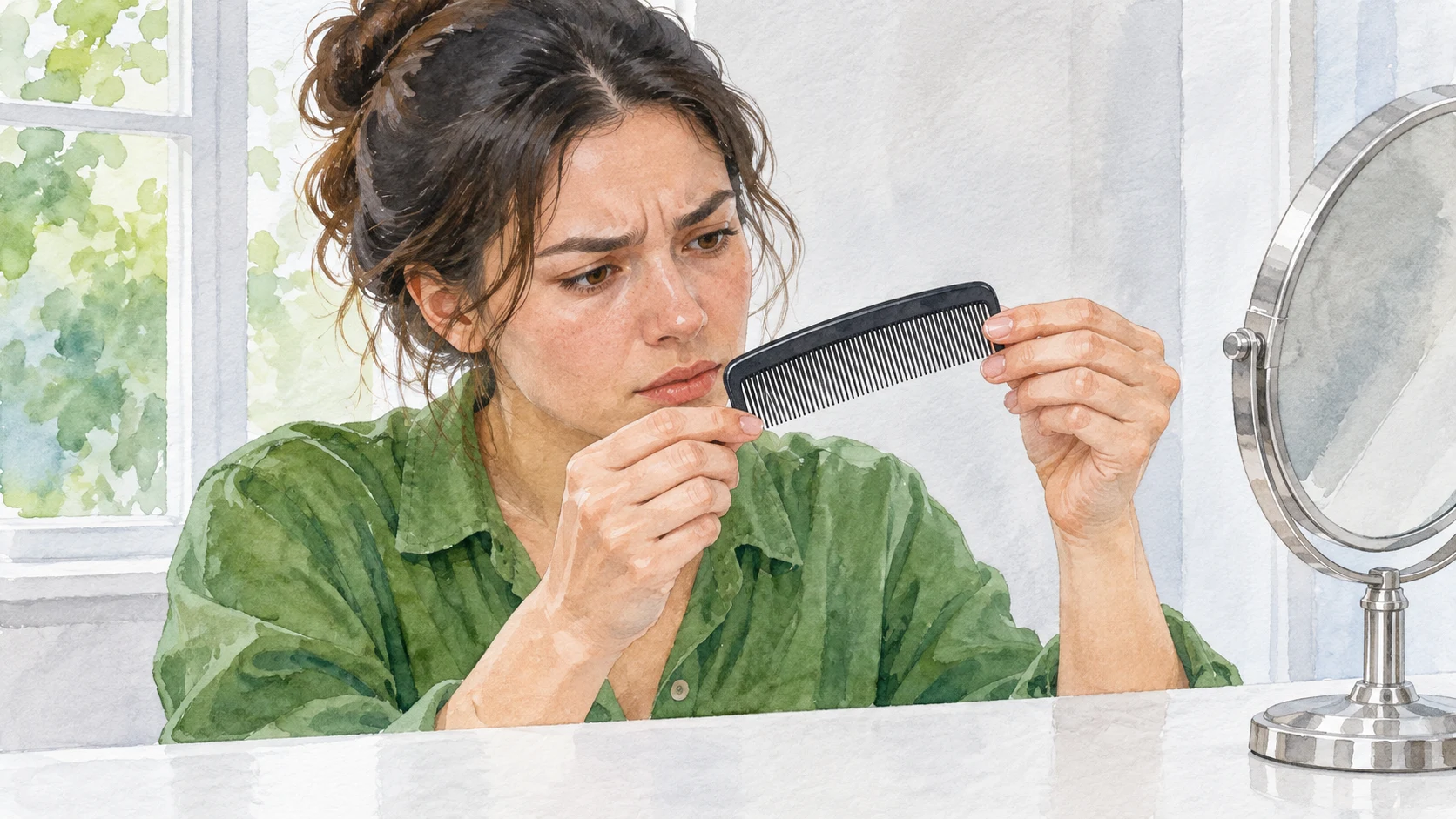
Dandruff, hair casts, dried hair products, lint, dirt, and even small insects can be mistaken for head lice. Some of these materials resemble lice eggs because they appear as tiny white or yellowish specks attached to hair. Others cause confusion because they move, resemble small insects, or appear on the scalp alongside itching.
One of the most misleading look-alikes is a hair cast, a tiny sleeve of material surrounding a hair shaft. It can resemble a head lice egg but may slide along the hair, unlike a nit that is firmly cemented in place. The misidentification of head lice and their eggs is common enough that the appearance of an unfamiliar speck should not automatically be interpreted as an infestation.
Understanding what an object is likely to be starts with separating three observations: whether it is a living insect, whether it is attached to a hair shaft, and whether its shape is consistent with a louse or nit.
Hair Casts: One of the Most Convincing Head Lice Look-Alikes
Hair casts are small, whitish or yellowish sleeves that surround individual hair shafts. They are sometimes called pseudonits because they can closely resemble head lice eggs when viewed without magnification.
A hair cast is generally cylindrical rather than oval. It forms a narrow tube around the hair, sometimes looking like a tiny white bead or short piece of thread. Multiple casts may appear along the same strand, creating the impression of several attached nits.
Unlike a genuine nit, a hair cast is not permanently cemented to the hair shaft. It may slide along the strand, although the amount of movement varies. This mobility is an important distinguishing feature.
The tubular shape and mobility of hair casts have been documented in clinical descriptions of pseudonits. Under magnification, a cast appears to encircle the hair, whereas a lice egg is a separate oval structure attached alongside it.
Hair casts can occur without a head lice infestation. They may be associated with accumulated keratin around hair shafts or certain scalp and hair conditions. Their presence does not establish a particular medical diagnosis.
A person who notices numerous small white structures arranged along individual hairs may therefore be seeing hair casts rather than lice eggs. The distinction is especially relevant when the particles look unusually uniform or appear to surround the hair instead of sitting against one side.
Dandruff and Loose Scalp Flakes
Dandruff is another common source of confusion because its flakes can resemble the pale appearance of empty lice egg cases. Both may be noticed near the scalp, particularly when the hair is separated or viewed under bright light.
Dandruff flakes are generally irregular and relatively flat. Their size varies, and they may rest on the scalp, become trapped between hairs, or fall onto clothing. Nits have a more consistent oval shape and are attached to individual hair shafts.
The distinction is not always obvious from color. A small white flake and a translucent nit may look nearly identical at a glance. Their relationship to the hair provides more useful information.
The differences between head lice nits and dandruff include attachment, movement, and shape. Those characteristics are more dependable than assuming that every white particle is dandruff or every pale speck near the roots is a nit.
Dandruff can also occur alongside scalp itching, which may increase concern about lice. Itching by itself cannot determine what the visible material represents.
Hair Spray, Gel, and Other Product Residue
Dried styling products can leave small particles on the hair that resemble lice eggs. Hair spray droplets may harden into tiny whitish or translucent deposits, while gel, mousse, wax, and other products can leave uneven flakes or clumps.
These residues are particularly confusing when they collect near the roots or adhere to individual strands. A small dried droplet may appear rounded, making it look more like a nit than ordinary dust.
Product residue does not have the organized structure of a lice egg. Under magnification, it may appear irregular, amorphous, or unevenly distributed along the hair. Its apparent shape depends on how the product dried.
The confusion between nits and hair-product deposits is recognized in dermatological examinations. Hair spray and gel residues are among the materials described as pseudonits.
A useful contextual clue is whether similar particles are distributed through areas where styling products were applied. However, the presence of product residue does not rule out head lice, and the absence of recent styling products does not prove that a particle is a nit.
Lint, Dust, Dirt, and Sand in Hair
Ordinary environmental debris can become trapped in hair, particularly after outdoor activities, wearing certain fabrics, or contact with dusty surfaces. Small pieces of lint, dust, dirt, and sand may resemble lice-related material when viewed against the scalp.
Lint often has an irregular or fibrous appearance. Dirt particles can be brown, gray, or black, while sand grains may be pale or translucent. Their colors overlap with the normal appearance of head lice eggs, making color an unreliable distinguishing feature.
Most loose debris is not attached to a particular hair shaft by a specialized adhesive. It may become caught among strands, but its position can change as the hair moves.
The presence of sand, dirt, lint, and other harmless particles in hair is a recognized reason for mistaken lice identification.
Debris can also become mixed with natural scalp oils or styling products, making it cling more firmly than expected. Resistance to movement therefore deserves interpretation alongside the object’s shape and whether it is actually bonded to one strand.
Scabs and Dried Skin Material
Small scabs or fragments of dried skin can be mistaken for lice-related particles, particularly when they are brownish, yellowish, or located close to the hair roots.
A scab may have an irregular, crust-like appearance and remain attached to the scalp rather than to a hair shaft. Detached fragments can become caught in surrounding hair, where they may resemble tiny dark specks.
This distinction matters because head lice eggs are attached to hair, not embedded in scalp skin. A particle arising from the skin’s surface is physically different from a structure cemented to an individual strand.
Scabs can have several causes, including scratching or minor skin injuries. Their appearance alone does not establish why they developed, and this article does not attempt to identify underlying scalp conditions.
Persistent sores, bleeding, pain, or signs of infection warrant medical assessment rather than assumptions about head lice.
Mites and Other Tiny Arthropods
Small arthropods occasionally found on a person’s hair, clothing, or skin may be mistaken for head lice. The confusion is more likely when someone sees a moving speck but cannot examine its anatomical features.
Mites are arachnids rather than insects. Adult mites generally have eight legs, while adult head lice have six. However, mite larvae may have six legs, and many mites are too small for their legs to be counted reliably without magnification.
Bird mites are one example of tiny mites that can enter living spaces, particularly where birds or their nests are present. They may crawl onto people, but they do not establish the same type of scalp infestation as head lice.
The presence of a moving speck on the head therefore does not automatically identify it as a louse. Its body proportions, legs, and circumstances matter, although precise identification may require magnification or expert examination.
Microscopic follicle-associated mites, such as Demodex, are a different situation. They are not ordinarily recognizable as individual crawling insects during a routine visual examination of hair. A person should not assume that an unexplained visible speck is a follicle mite.
Fleas, Bed Bugs, and Other Insects Found Near Hair
Occasionally, a small insect encountered near someone’s head is mistaken for a head louse simply because of its location. However, being found in hair does not establish that an insect normally lives there.
Fleas may move through hair temporarily, particularly after contact with an infested animal or environment. Their powerful jumping ability differs from the crawling movement of head lice. The differences between head lice and fleas involve more than size and color.
Bed bugs can also be confused with lice when someone finds a small, brownish insect near bedding or clothing. Unlike head lice, bed bugs do not normally remain attached to scalp hair. They typically hide in surrounding areas between blood meals.
The distinction between head lice and bed bugs is particularly relevant when an insect is discovered on a pillow or near a sleeping area rather than actually gripping a hair shaft.
Other small insects can occasionally become caught in hair by chance. Aphids, for example, have been documented among insects mistakenly submitted as suspected head lice. Their accidental presence does not mean they are adapted to living on the human scalp.
A small insect should therefore be considered in the context of where it was found and how it moves, rather than identified solely by the fact that it was near someone’s head.
Fungal Deposits and Hair Shaft Abnormalities That Resemble Nits
Some less common hair shaft findings can closely resemble lice eggs. These include certain fungal deposits and structural changes affecting individual hairs.
White piedra, for example, can produce pale nodules along hair shafts. These nodules may resemble nits, especially when they are small and distributed along individual strands.
Other hair shaft abnormalities can produce localized thickening, irregularities, or small structures that appear attached to hair. Such findings are not necessarily insects or eggs.
A clinical comparison of pseudonits and genuine lice eggs documented several alternatives, including hair casts, white piedra, and hair shaft abnormalities. Magnified examination helped distinguish these structures when ordinary visual inspection was insufficient.
These findings are less familiar than dandruff or styling residue, but they demonstrate why the presence of an attached particle is not always enough to establish that it is a nit.
Their medical causes and treatment are outside the scope of identifying head lice look-alikes. Persistent or unusual hair shaft deposits are better assessed by a qualified healthcare professional than classified from appearance alone.
How to Narrow Down What You Are Seeing
Different look-alikes produce different kinds of visual evidence. Rather than treating every speck as a possible louse, it helps to first determine whether the object is moving independently, resting loosely in the hair, or fixed to a strand.
| What you notice | Possible explanation | Most useful distinguishing clue |
|---|---|---|
| Loose white or yellow flakes | Dandruff or shed skin | Irregular shape and loose position |
| Tiny white tubes surrounding hairs | Hair casts | Sleeve-like structure that may slide along the shaft |
| Small hardened droplets or clumps | Hair-product residue | Uneven deposits without a consistent egg structure |
| Irregular pale or dark particles | Dust, lint, dirt, or sand | Loose environmental material |
| Brownish crusts near the roots | Scabs or dried skin | Association with the scalp surface |
| Small moving arthropod | Head louse, mite, or another insect | Body structure and movement |
| Firm pale nodules along hair | Nits or certain hair shaft deposits | Attachment structure and magnified appearance |
The table is a way to organize observations, not a substitute for identifying a specimen. Several different materials can share the same color, size, or apparent attachment.
The most important distinction is between something that merely resembles lice-related material and a living head louse. A suspicious speck does not become a confirmed infestation simply because it is difficult to identify.
Which Clues Are Useful, and Which Can Mislead You?
Three observations are particularly useful: whether the object moves on its own, whether it is attached to a single hair shaft, and whether it has a recognizable anatomical structure.
A living head louse is an insect capable of crawling. A nit is an egg structure fixed to hair. Dandruff, hair casts, and product deposits are not living insects, even when they resemble lice-related material.
However, each clue has limitations. Hair casts can surround individual strands and appear firmly positioned. Product deposits may cling to hair. Loose particles can move when disturbed without being alive, while a living insect may remain motionless during observation.
The appearance of adult head lice and the appearance of their eggs and nits provide two different visual reference points. Confusing an egg-like particle with a living insect can make the identification process unnecessarily difficult.
A fourth consideration is the quality of the observation. If an object is too small or obscured to reveal meaningful detail, guessing from its color or location is unlikely to improve accuracy.
Why Mistaken Identification Matters
Misidentifying harmless debris as head lice can create unnecessary concern and lead to inappropriate use of lice treatments. Some products contain insecticidal ingredients and should not be used simply because an unidentified particle was found in the hair.
Misidentification can also work in the opposite direction. A genuine louse may be dismissed as an ordinary insect or piece of debris when its features are not clearly observed.
Finding a living nymph or adult louse provides stronger evidence of an active infestation than finding an unidentified white particle. The importance of distinguishing live lice from suspected nits is central to avoiding unnecessary treatment.
The signs of a head lice infestation should be considered separately from the appearance of individual look-alikes. Itching, flakes, and unfamiliar specks are not interchangeable forms of evidence.
When the object remains uncertain, identification by a healthcare professional or another qualified person is preferable to repeatedly treating the hair without confirming what is present.
Common Questions About Things Mistaken for Head Lice
What is most commonly mistaken for head lice eggs?
Dandruff, hair casts, dried styling products, lint, and dirt are common look-alikes. Hair casts are particularly convincing because they can resemble small white structures attached to individual strands.
Can hair casts look exactly like nits?
They can look very similar without magnification. Hair casts generally form tubular sleeves around hair shafts and may slide along them, while genuine nits have an oval egg structure cemented to the strand.
Can tiny mites be mistaken for head lice?
Yes. Some mites are small enough to be confused with lice when viewed briefly. However, their anatomy and usual relationship with people differ, and many are too small to identify reliably without magnification.
Can dried hair spray look like lice eggs?
Yes. Dried hair spray droplets can form small, pale deposits that resemble nits. Their irregular structure and lack of a genuine egg attachment can help distinguish them under closer examination.
Can dirt or lint look like living lice?
Small dark particles may be mistaken for insects, especially when hair movement makes them appear to shift. Dirt and lint do not crawl independently or possess insect anatomy.
Does finding a white speck mean someone has head lice?
No. Many harmless materials can produce white specks in hair. Even a genuine nit does not, by itself, confirm that living head lice are currently present.
2 thoughts on “What Can Be Mistaken for Head Lice?”