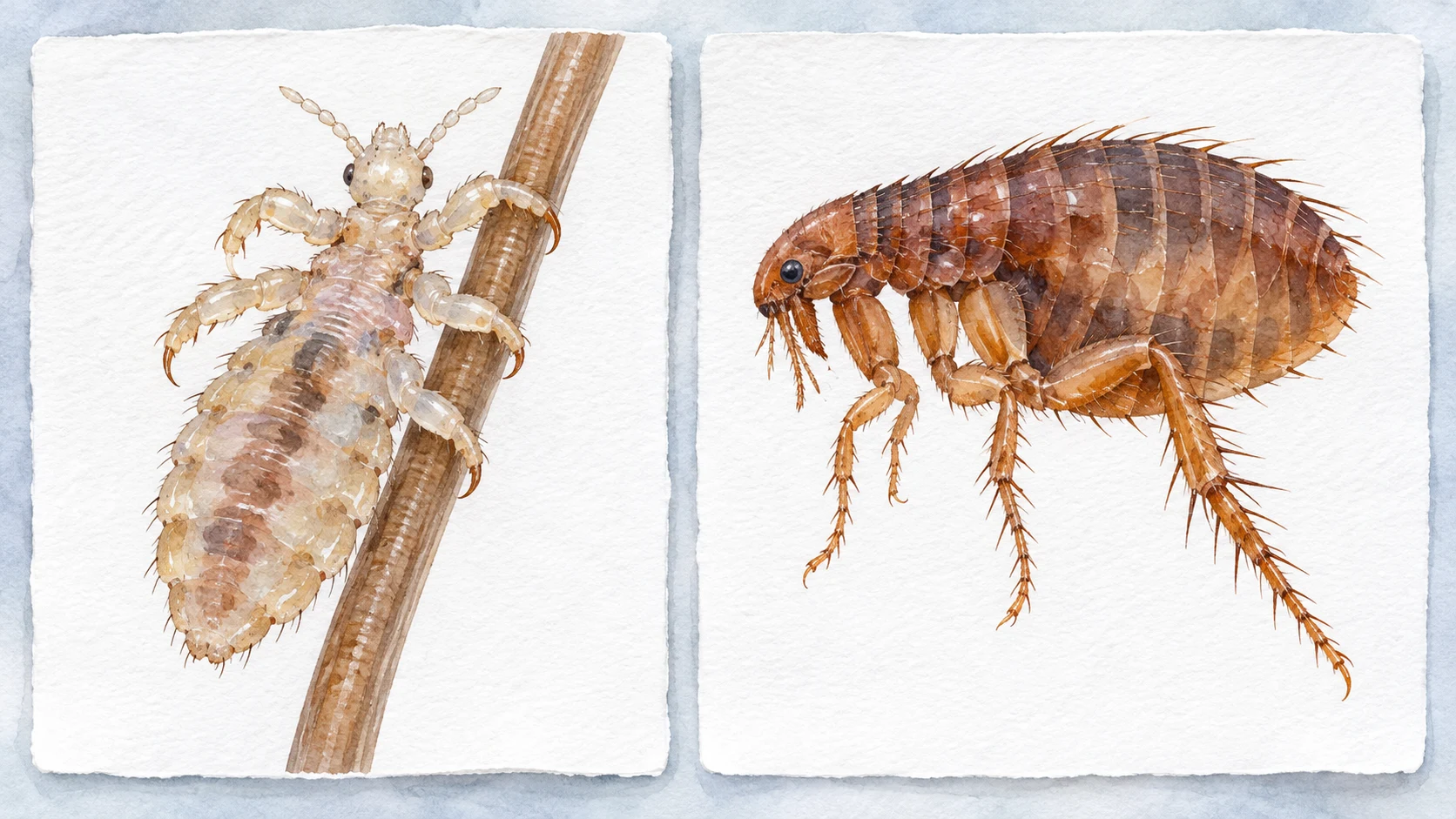
Head lice crawl through human scalp hair, while fleas can jump using their powerful hind legs. That is the quickest way to tell them apart when you can observe a living insect. Head lice remain closely associated with people, but fleas commonly infest dogs, cats, and other mammals and can also be found in carpets, pet bedding, and other parts of a home.
Their bodies look different, too. A head louse is a small, elongated insect with six relatively short legs designed to grip hair. A flea is usually darker, has a narrow body flattened from side to side, and possesses enlarged hind legs that allow it to jump considerable distances relative to its size.
Both insects feed on blood, and both can be difficult to recognize without magnification. However, their movement, anatomy, preferred hosts, and the evidence they leave behind usually provide enough differences to narrow down which insect you are seeing.
Head Lice Crawl, but Fleas Can Jump
Movement is one of the most useful differences between head lice and fleas. A head louse moves by crawling along hair shafts, gripping them with specialized claws. It cannot jump or fly, even when disturbed.
Fleas also crawl, but they possess powerful hind legs that allow them to leap away from danger or onto a passing host. A flea resting on clothing or skin may suddenly disappear with a quick jump, sometimes covering several inches in a single movement.
This ability is particularly noticeable when fleas are disturbed. Someone attempting to catch a small dark insect on a sock may see it spring away before they can touch it. A head louse cannot escape in that manner. It must crawl to another position or remain attached to a hair.
The crawling behavior of head lice is closely connected to their dependence on human scalp hair. Their legs are adapted for gripping rather than launching their bodies into the air.
Fleas use a different strategy. Their powerful jumping legs allow them to move between environmental resting places and suitable hosts.
However, an insect that does not jump during a brief observation is not automatically a head louse. Fleas can remain still or crawl without jumping. Movement is most informative when a jump is actually observed, rather than when one is absent.
A small insect moving steadily along a scalp hair is more consistent with a head louse, particularly when it grips the strand as it travels. A dark insect that leaps from the carpet onto a person’s sock is much more consistent with a flea.
How Their Bodies Look Different
Head lice and fleas are both wingless insects, but their body proportions are noticeably different under magnification.
Head lice have elongated, somewhat flattened bodies, with a relatively narrow head, a thorax bearing six legs, and a segmented abdomen. Their overall appearance is often described as oval or elongated rather than sharply compressed.
Fleas have bodies flattened from side to side, a feature known as lateral compression. This makes them appear relatively narrow when viewed from the front or back but more substantial when viewed from the side.
The difference can be compared to two objects flattened in different directions. A head louse has a broad upper and lower surface relative to its thickness, while a flea has a narrow side-to-side profile suited to moving between hairs or fur.
Many common fleas also have stiff bristles and comb-like rows of spines that help them navigate through a host’s coat. These features are not usually visible without magnification.
The body structure of common cat and dog fleas includes lateral compression and distinctive anatomical features used by specialists to distinguish flea species.
Head lice have their own recognizable features, including a comparatively elongated abdomen and claws designed to grasp scalp hairs. The appearance of adult head lice is useful when comparing a specimen against photographs of fleas.
Are Fleas Bigger Than Head Lice?
Size alone is not a reliable distinction because the two insects overlap considerably in length.
Adult head lice are commonly about 2 to 3 millimeters long, roughly the size of a sesame seed. Many fleas measure approximately 1 to 4 millimeters, depending on the species.
A small flea may therefore be shorter than a large head louse, while a larger flea may exceed the length of most head lice. The apparent difference can also be exaggerated by body position or magnification.
The actual size of head lice helps explain why the insects are often confused when seen only as tiny moving specks.
For an unfamiliar specimen, body shape and leg proportions provide more useful evidence than length alone.
Flea Legs vs. Head Lice Legs
Both insects have six legs because both are insects. The important difference is how those legs are built and used.
Head lice have relatively short legs ending in specialized claws. These claws work against structures on the legs to form a gripping mechanism that helps the insect hold individual hair shafts.
The legs are arranged for climbing and maintaining contact with hair. A head louse can move surprisingly quickly through a person’s hair, but it cannot launch itself from one strand to another by jumping.
Fleas have disproportionately developed hind legs. Their rear legs contain structures adapted for powerful jumping, allowing them to propel themselves away from surfaces or toward a host.
Under magnification, a flea’s hind legs are much more conspicuous than those of a head louse. The flea often appears to have long, bent rear appendages, while the head louse’s six legs are more similar in general proportions.
The specialized anatomy of flea jumping and body compression provides an anatomical explanation for the movement difference.
A photograph showing unusually long hind legs is therefore more suggestive of a flea than a head louse. By contrast, an insect gripping a single human hair with short, clawed legs is more consistent with a louse.
What Color Are Head Lice Compared With Fleas?
Head lice are commonly grayish, tan, pale brown, or somewhat translucent. Their appearance can change after feeding because blood may become visible through the body.
Fleas are usually darker. Many common species appear reddish-brown, dark brown, or nearly black, especially when viewed against a pale background.
This can make a flea easier to notice on white socks or light-colored bedding, while a pale head louse may be difficult to see against similarly colored hair.
Color is still a supporting clue rather than a dependable identification method. A recently fed head louse may look darker than usual, and a flea’s appearance can vary with species, lighting, and whether it has recently fed.
The normal color variations of head lice overlap with some of the brown shades seen in fleas.
A dark moving speck is not necessarily a flea, and a pale insect is not necessarily a louse. The shape of the body and the structure of the legs are more informative than color alone.
Do Head Lice and Fleas Live on the Same Hosts?
Head lice are human-specific parasites. They depend on human blood and are adapted to living among human scalp hairs.
Dogs, cats, and other household pets do not carry or spread human head lice. A child cannot acquire head lice from a dog, and a pet cannot maintain a human head lice infestation.
Fleas have a different host relationship. Many flea species feed on mammals and birds, with cat fleas and dog fleas being particularly relevant to households with pets.
Despite their common names, cat fleas can infest dogs as well as cats. They can also bite people, although humans are not their preferred hosts in many household flea situations.
The host preferences and feeding behavior of fleas explain why a flea problem may involve both pets and people in the same home.
A household with a scratching dog and small jumping insects on the floor has evidence pointing toward fleas. Finding insects that grip scalp hair, with eggs attached to individual human hairs, points toward head lice.
This distinction also changes how the insects move between hosts. Head lice mainly spread when human hair comes into direct contact with infested hair. Fleas can jump onto passing animals or people from their surroundings.
Can Fleas Live in Human Hair Like Head Lice?
Fleas can occasionally enter human hair, but they do not normally establish the same kind of persistent scalp infestation as head lice.
A flea may jump onto a person’s head or become temporarily caught in hair. This is possible during close contact with an infested pet or in an environment where fleas are present.
However, human scalp hair is not the characteristic long-term habitat of common household fleas. They are more strongly associated with animal hosts and the surrounding environment.
Head lice behave differently. They are adapted to staying on the human scalp, where they can feed repeatedly and remain close to the hair shafts used for egg attachment.
The areas where head lice commonly remain on the scalp reflect this close association with human hair.
If a small insect is repeatedly found gripping individual scalp hairs, head lice become a more plausible explanation. If a jumping insect is briefly seen in someone’s hair after contact with an infested animal, a flea is possible.
Neither observation alone proves the insect’s identity, but the difference between a persistent scalp association and a temporary encounter is important.
Where Would You Find Evidence of Head Lice or Fleas?
The location of insects and their eggs often provides stronger evidence than a person’s description of itching.
Head lice are primarily found on scalp hair. Their eggs, commonly called nits, are cemented to individual hair shafts, usually close to the scalp when first laid.
Fleas have a different distribution. Adult fleas may be found on pets or jumping through areas where animals spend time. Their eggs are not cemented to human hair. Flea eggs can fall from animal fur into bedding, carpets, and other resting places.
The development of flea eggs and immature stages in the environment explains why flea-related evidence may occur away from the animal itself.
For example, a person might find tiny dark insects jumping near a pet’s sleeping area. That pattern is consistent with fleas because the insects and their immature stages can be associated with the surrounding environment.
A different situation is a child with small oval structures firmly attached to individual scalp hairs. Those structures are more consistent with head lice nits than flea eggs.
The appearance and attachment of head lice eggs help distinguish this evidence from the loose eggs associated with fleas.
What About Flea Dirt?
Flea dirt is the name commonly given to flea feces, which consist largely of digested blood. It often appears as small, dark, pepper-like particles in an animal’s coat or bedding.
This material is different from head lice nits. Nits are attached egg structures, while flea dirt consists of loose fecal particles.
Dark specks found in pet fur can therefore support suspicion of fleas, particularly when living fleas are also present. However, ordinary dirt and other debris can resemble flea dirt, so the appearance of dark particles alone is not conclusive.
A small dark speck on a child’s scalp should not automatically be called flea dirt either. Its location, attachment, and association with a recognizable insect all matter.
Head Lice vs. Fleas: Side-by-Side Comparison
| Feature | Head lice | Fleas |
|---|---|---|
| Movement | Crawl and grip hair | Crawl and jump |
| Ability to jump | Cannot jump | Can jump |
| Wings | None | None |
| Legs | Six short legs with gripping claws | Six legs, with enlarged hind legs |
| Body shape | Elongated and flattened | Narrow and flattened from side to side |
| Typical color | Grayish, tan, or pale brown | Usually reddish-brown to dark brown |
| Typical size | About 2–3 mm as adults | Often about 1–4 mm, depending on species |
| Principal host | Humans | Mammals or birds, depending on flea species |
| Association with pets | Pets do not carry human head lice | Common household fleas often infest pets |
| Where eggs are found | Cemented to human scalp hairs | Often fall into animal bedding and surrounding areas |
| Typical household evidence | Live lice and attached nits in scalp hair | Jumping fleas, pet-associated insects, flea dirt, and environmental stages |
The most decisive observation is an actual jump. Head lice cannot perform one. If the insect clearly leaps from a floor, sock, or pet, it is not a head louse.
When no jump is observed, the combination of body shape, leg structure, host association, and location of eggs provides a stronger basis for comparison.
Can You Tell the Difference From Bites Alone?
Not reliably. Both head lice and fleas feed on blood, and their bites may cause itching or irritated skin. The appearance of a bite is not specific enough to identify which insect caused it.
Head lice usually feed on the scalp, so irritation is commonly associated with the head and areas near the hairline. Flea bites may occur on exposed skin, including the lower legs and ankles, particularly when fleas are encountered in the home.
However, these patterns are not absolute. Fleas can bite other body areas, and not everyone reacts to insect bites in the same way.
A person with an itchy scalp does not necessarily have head lice, just as someone with itchy ankles does not necessarily have fleas.
The signs of an active head lice infestation depend more heavily on finding living lice than on interpreting skin irritation alone.
If a household also has pets scratching and jumping insects appearing in living areas, those observations provide much stronger support for fleas than the appearance of the skin marks.
What If You Find a Small Insect in Your Hair or Home?
The first useful question is whether the insect was actually living among scalp hairs or was simply found near someone’s head.
An insect firmly gripping a hair shaft is more consistent with head lice, especially if additional lice or attached nits are present. A small insect jumping from clothing, carpeting, or pet bedding is more consistent with a flea.
A specimen found on a pillow presents a less certain situation. A head louse may occasionally become detached from the scalp, while a flea can also be present in bedding. The location alone does not establish which insect it is.
Photographs can help when they show the insect’s body outline and legs clearly. A side view may reveal a flea’s compressed body and enlarged hind legs, while a magnified view of a head louse may show its elongated body and gripping claws.
The visibility of head lice without magnification has limits, and the same applies to identifying small fleas from a brief sighting.
We would not identify an insect as a flea simply because a pet lives in the home, or call it a head louse because it was found on a child’s pillow. The insect’s observable features should support the identification.
If the specimen remains uncertain, a clear photograph or a safely contained specimen can be shown to a qualified pest identification service or healthcare professional, depending on where it was found and the concern involved.
Common Questions About Head Lice and Fleas
Can head lice jump like fleas?
No. Head lice move only by crawling. Fleas can crawl and jump, using their enlarged hind legs to propel themselves away from surfaces or onto hosts.
Can a dog or cat give someone head lice?
No. Human head lice are adapted to humans and are not carried or spread by dogs or cats. Pets can carry fleas, which may also bite people.
Can fleas lay eggs in human hair?
A flea may temporarily enter human hair, but common household fleas do not normally maintain an infestation there like head lice. Flea eggs are not cemented to human scalp hairs and often fall into the surrounding environment.
Are fleas darker than head lice?
Usually. Common fleas are often reddish-brown or dark brown, while head lice may appear grayish, tan, or pale brown. Color overlaps, however, so it is not a reliable identification method by itself.
Can head lice live in carpets like fleas?
Head lice do not establish breeding populations in carpets. They depend on the human scalp and generally die within about two days after becoming detached if they cannot feed. Fleas have immature stages that develop in the environment, including areas around animal resting places.
If an insect jumps out of someone’s hair, is it a head louse?
No. A genuine jump rules out head lice because they cannot jump. A flea is one possibility, although the insect’s anatomy is still needed to establish its identity.