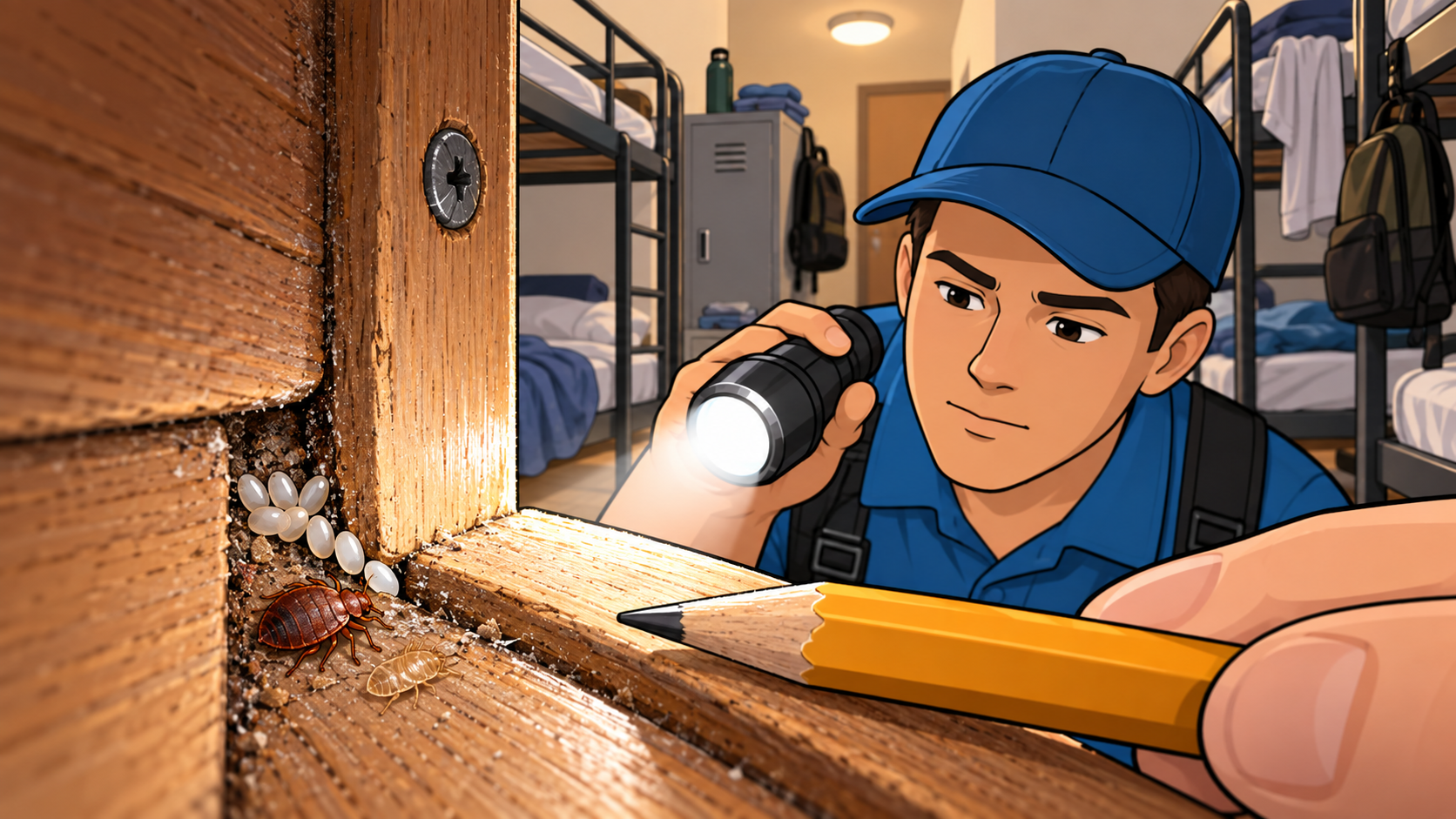
Bed bug eggs are tiny, pearly white to translucent, and roughly 1 millimeter long. They have an elongated oval shape and are easily overlooked without close inspection, especially when tucked into mattress seams, furniture joints, cracks, and other protected hiding places.
Females attach individual eggs to surfaces with an adhesive secretion. Several eggs may be deposited near one another, but bed bugs don’t produce a true egg sac. What looks like a cluster is still a collection of separate eggs, as explained in whether bed bugs have egg sacs.
What a Bed Bug Egg Looks Like Up Close
Under magnification, a bed bug egg is considerably more complex than a smooth white oval. The outer shell is called the chorion, and one end contains a cap-like structure called the operculum through which the nymph eventually emerges.
A detailed electron-microscope study found polygonal projections covering the chorion, along with a complex collar surrounding the operculum. These microscopic features aren’t something you’re likely to distinguish during an ordinary home inspection, but the operculum itself may be visible under sufficient magnification.
Fresh eggs are pale and can be difficult to distinguish against light-colored fabric. After hatching, the empty shell can remain behind.
Bed Bug Eggs Are Glued to Surfaces
Bed bug eggs don’t simply rest loosely wherever the female drops them. They’re secured to the substrate with egg glue. Researchers studying the proteins involved in bed bug reproduction identified a probable egg-glue protein and demonstrated through gene-silencing experiments that it plays an important role in attachment. The same research also characterized a protein involved in the eggshell itself.
This attachment helps explain why eggs can remain fixed inside cracks and seams instead of rolling around like grains of sand. It doesn’t make them impossible to remove physically, but their tiny size and attachment can make thorough removal difficult.
How to Tell Bed Bug Eggs From Debris
Size, shape, attachment, and location are more useful together than any single characteristic. Bed bug eggs are consistently small, elongated, pale, and usually attached to a surface. Lint and dandruff have irregular shapes and generally move easily, while grains of salt or sand aren’t cemented to furniture or fabric.
Location provides another clue. Females commonly deposit eggs in protected harborages where bed bugs already hide, rather than scattering them randomly across open surfaces. Knowing where bed bugs lay their eggs can make an inspection much more focused.
Don’t identify an infestation from a tiny white object alone. Look for accompanying evidence such as live bugs, shed skins, dark fecal spotting, or additional eggs.
When Do Bed Bug Eggs Hatch?
Hatching time depends strongly on temperature. Under favorable indoor conditions, eggs can hatch in roughly a week, although development isn’t governed by one fixed number of days under every condition.
The newly emerged first-stage nymph is extremely small and pale before feeding. You can see how the egg stage fits into the bed bug life cycle and what baby bed bugs look like after hatching.
Finding Bed Bug Eggs During an Inspection
Use a bright flashlight and inspect seams, folds, cracks, joints, screw holes, and other narrow spaces around sleeping areas. Magnification can help when you’re examining something close to 1 millimeter long.
Finding eggs is strong evidence of an active or recently active infestation, but don’t assume every egg is viable. Hatched shells and nonviable eggs can remain behind, so eggs should be interpreted alongside the other evidence present.
Questions About Bed Bug Eggs
Are bed bug eggs visible to the naked eye?
Yes, but barely. At roughly 1 millimeter long, they’re visible without magnification if you have good lighting and know what you’re looking for. Magnification makes identification considerably easier.
Can bed bug eggs be vacuumed up?
Accessible eggs can sometimes be physically removed by vacuuming or other mechanical cleaning, but their adhesive attachment and protected locations make it easy to miss some. Vacuuming shouldn’t be relied upon as the only treatment.
Do bed bug eggs change color before hatching?
The developing embryo can become more visible as the egg matures, so older viable eggs may look different from newly laid pearly-white eggs. Color alone isn’t a reliable way to determine exactly when an egg will hatch.
How are bed bug eggs different from head lice nits?
Head lice attach their eggs to human hair shafts close to the scalp. Bed bugs normally attach eggs to environmental surfaces in their harborages, not to human hair.
6 thoughts on “What Do Bed Bug Eggs Look Like, and How Big Are They?”