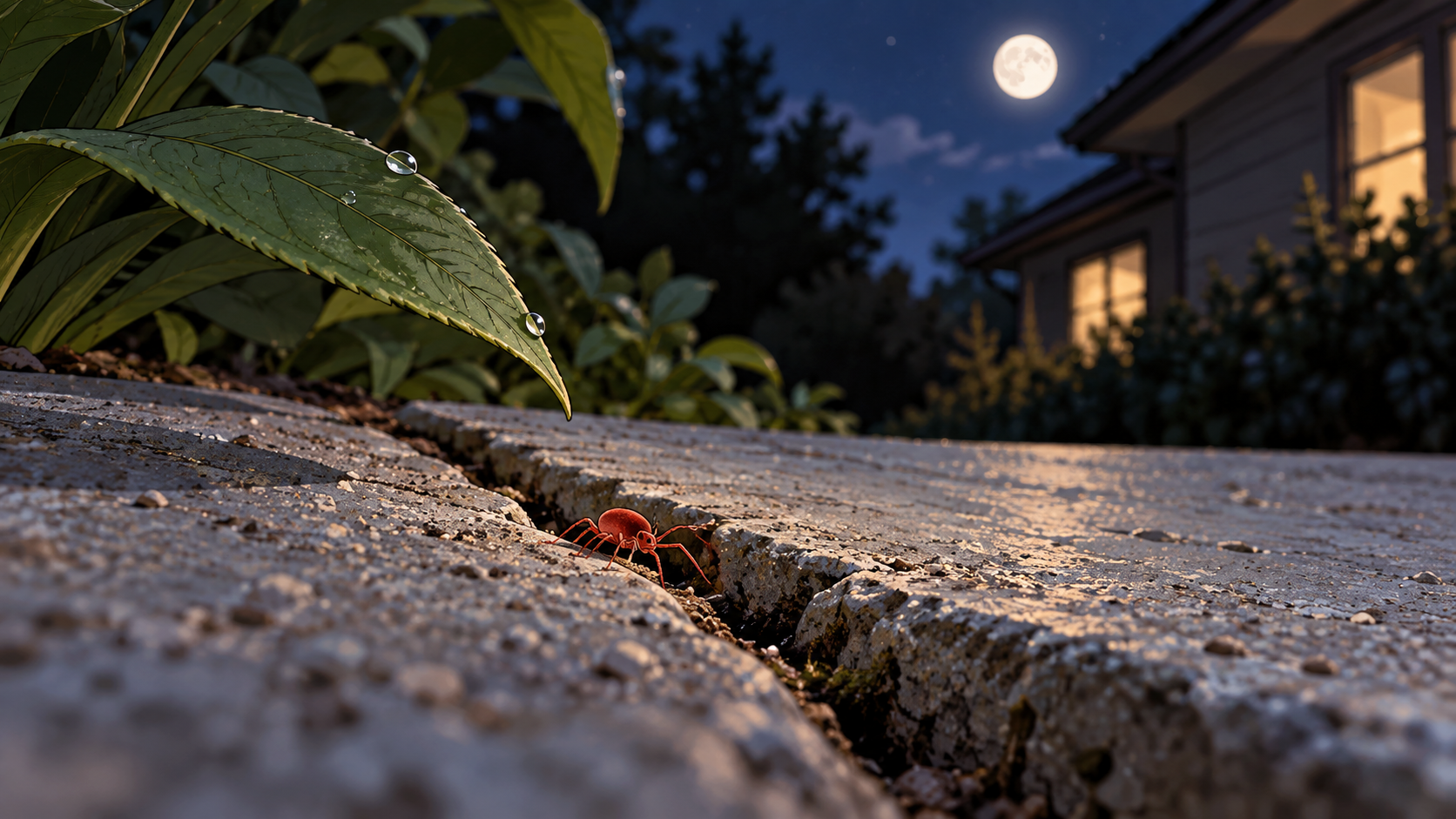
Clover mites can be active at night, but they are not best described as strictly nocturnal. Their activity depends heavily on temperature and weather conditions. They can feed during nighttime hours, while the conspicuous crawling homeowners see on walls and foundations is especially common during mild, sunny periods. When temperatures drop enough in the evening, wandering clover mites stop moving and remain where they are until conditions warm again. That means nighttime activity can vary considerably from one evening to another.
Clover Mites Are Not Strictly Daytime or Nighttime Mites
Clover mites do not follow a simple schedule in which they become active at sunset and hide at sunrise. Temperature has a strong influence on when they move, and their cool-season biology allows activity under conditions that would slow many warm-season mites.
Agricultural observations have documented clover mites feeding at night and on cloudy days. That establishes an important point: darkness itself does not make clover mites inactive. They can remain active after sunset when other conditions are suitable.
At the same time, nighttime does not guarantee activity. A cold evening can bring movement to a halt. For that reason, we would not use the presence or absence of nighttime activity as an identification test for clover mites.
Temperature Often Matters More Than Darkness
The clearest pattern around homes occurs as temperatures change through the day. Clover mites commonly crawl across lawns and onto sun-warmed building surfaces during mild weather. When the temperature falls toward the end of the day, they can stop where they are and remain motionless until it warms again.
That behavior can leave large numbers sitting beneath shingles, windowsills, siding edges, and other protected spots overnight. They may look completely inactive even though they were crawling across the same area only hours earlier. Once temperatures rise the following day, movement can resume.
This is why describing clover mites simply as “day-active” misses the mechanism. Daylight often coincides with warmer surfaces, particularly on sunny walls, so the mites become conspicuous during the day. The warmth is doing much of the work.
Cloudy Conditions Can Change the Pattern
Direct sunshine is not required for clover mite activity. They can feed during cloudy conditions as well as at night, and their seasonal activity generally favors relatively cool weather. Clover mites are cool-season mites rather than pests that require hot summer conditions.
Weather can therefore blur any apparent day-night pattern. A mild night may permit activity, while a cold evening may stop it. Likewise, a suitable cloudy day can support activity without the bright sunshine often associated with mites crawling over exterior walls.
The same temperature sensitivity helps explain why clover mites are not equally active throughout the year. Their seasonal activity rises and falls with suitable weather, rather than following the same daily schedule in every season.
Why You May See More Clover Mites During the Day
Around buildings, daytime sightings are often easier to notice because clover mites commonly move onto surfaces warmed by the sun. Sunny sides of foundations and walls can attract large numbers of crawling mites, particularly during their cooler periods of seasonal activity.
Visibility plays a role too. A tiny mite crossing a pale windowsill or exterior wall in daylight is far easier to spot than the same animal moving through vegetation after dark. Seeing most of your clover mites during the day therefore does not prove that the population becomes inactive at night.
What matters more is the combination of temperature, weather, and where the mites happen to be. Clover mites can be active at night, but falling nighttime temperatures often reduce or temporarily stop their movement.
Other Questions About Clover Mite Activity
Do clover mites sleep at night?
There is no useful homeowner-level evidence for describing their nighttime inactivity as sleep. When temperatures fall, clover mites can simply stop moving and remain motionless until conditions warm.
Do clover mites feed at night?
Yes. Nighttime feeding has been documented, so clover mites do not require daylight in order to feed.
Why are clover mites motionless in the evening?
Temperature is a likely reason. Clover mites can stop moving when temperatures fall at the end of the day and resume their activity after conditions become warmer.
Can clover mites be active on cloudy days?
Yes. Clover mite feeding and activity are not restricted to sunny conditions. Cloudy weather can still provide suitable conditions for activity.