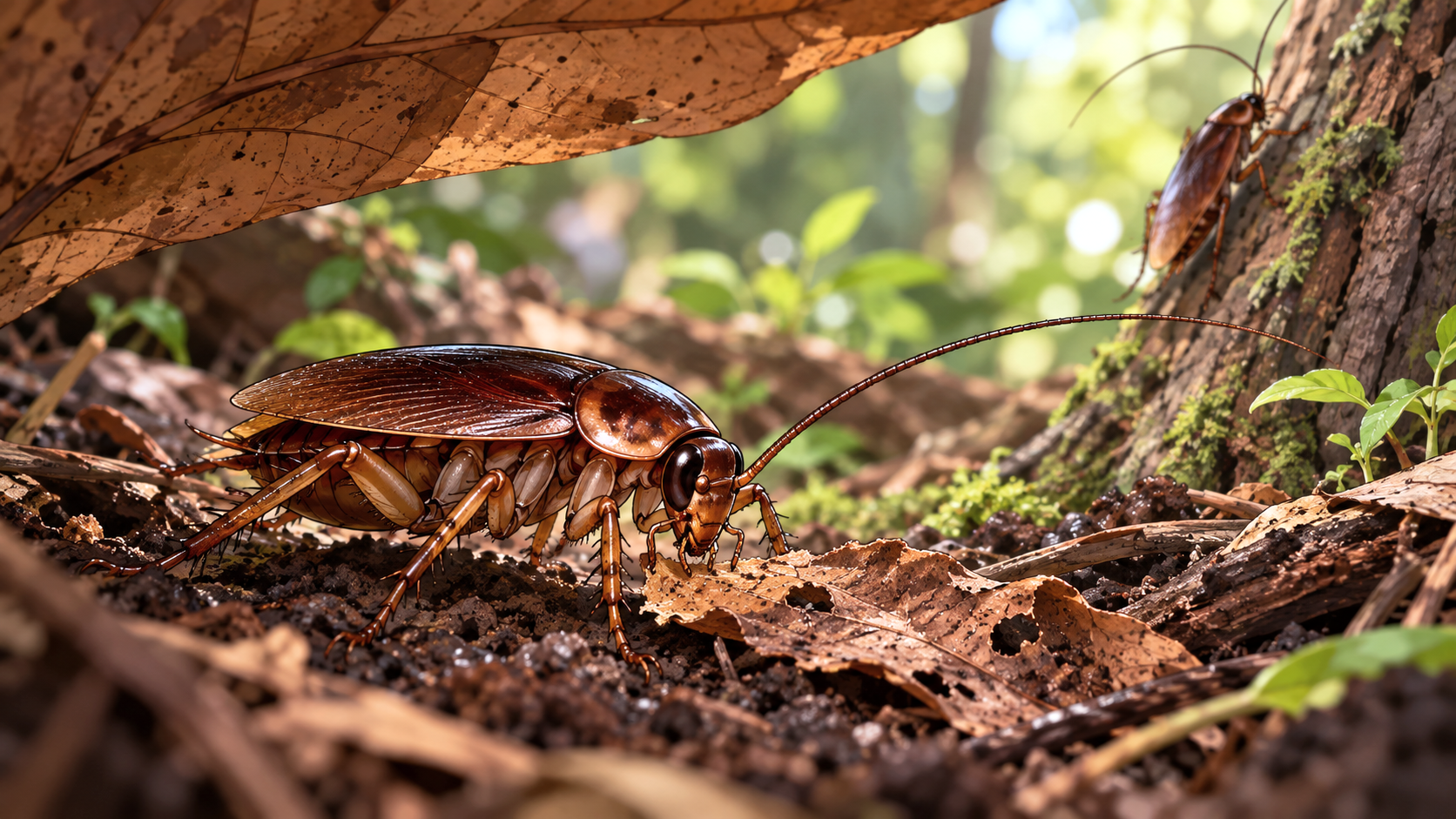
Cockroaches have collected so many exaggerated survival stories that the genuine facts can get lost among the myths. The real animals are interesting enough without embellishment. Some cockroaches give birth to live young, juveniles can regenerate lost legs, individuals can learn tasks, and termites evolved from within the cockroach lineage. Even the familiar household pests represent only a small slice of cockroach diversity.
Here are some of the cockroach facts we find most remarkable, with the legends separated from what research actually supports.
Termites Are Part of the Cockroach Family Tree
Termites were historically placed in their own order, Isoptera. Genetic and phylogenomic evidence now places them within Blattodea, the same order as cockroaches. Research has repeatedly recovered termites alongside the wood-feeding cockroach genus Cryptocercus, confirming that termites evolved from within the cockroach lineage.
This does not make the cockroach under a refrigerator a termite. It means the termite lineage arose from cockroach ancestors and later developed its extraordinary social organization. The relationship is one of the more surprising consequences of modern cockroach classification.
The Oldest “Cockroach” Fossils Are Not Modern Cockroaches
Cockroach-like insects were abundant hundreds of millions of years ago, which is the source of the familiar claim that cockroaches have remained essentially unchanged since the Carboniferous. The fossil story is less tidy. Many ancient insects described as roach-like, or “roachoids,” possessed features not found in modern cockroaches and cannot simply be treated as living cockroaches pushed backward through time.
Estimates of exactly when modern lineages arose vary among evolutionary studies. A large phylogenomic analysis estimated crown Blattodea at about 205 million years old and found that many major modern cockroach groups diversified during the Cretaceous. Cockroaches are unquestionably an ancient lineage, but “unchanged for 300 million years” oversimplifies a long evolutionary history.
One Cockroach Gives Birth and Feeds Its Developing Young
Most people associate cockroach reproduction with egg cases called oothecae, and that is appropriate for many species. Diploptera punctata, the Pacific beetle cockroach, takes reproduction in a very different direction. It is viviparous, retaining developing embryos inside a brood sac and eventually producing live young.
The mother does more than carry the embryos. She supplies them with a nutrient-rich secretion containing milk proteins. Research describes the brood sac as functioning in ways analogous to a uterus and placenta, with maternal secretions nourishing embryos during cockroach pregnancy. It is an unusual reproductive strategy within a group whose reproduction varies considerably among cockroaches.
Cockroaches Can Learn
A cockroach is not simply running on a fixed collection of reflexes. Experiments have demonstrated learning in both classical and operant conditioning tasks. In one study, cockroaches learned associations involving odors and also navigated a forced-choice T-maze, with measurable differences in learning performance among individual cockroaches.
Their sensory equipment supports a surprisingly information-rich view of the immediate environment. Antennae collect chemical and mechanical information, while rear appendages called cerci detect disturbances in the surrounding air. Those structures are part of a much more elaborate cockroach sensory system and anatomy than a quick glimpse of a fleeing roach suggests.
Cockroaches Can Have Individual Behavioral Tendencies
Put several cockroaches together and group behavior can conceal how differently the individuals behave. Experiments with American cockroaches found individual variation in shelter use and behavioral plasticity. Social interaction changed the group’s aggregation dynamics, but individual shelter preferences remained related to behavior expressed in groups.
Cockroaches are therefore not necessarily interchangeable units behaving identically whenever they encounter the same environment. Individual variation can exist even when the insects ultimately gather together under the same shelter.
A Young Cockroach Can Regenerate a Lost Leg
Losing a leg is not necessarily permanent for a cockroach that still has molts ahead of it. Nymphs can regenerate damaged or missing appendages as they develop. Experiments with American cockroaches have shown substantial regeneration of amputated legs during subsequent development.
The result depends partly on where and how the limb was lost. In experiments with discoid cockroaches, legs detached at a natural autotomy joint regenerated sooner than legs severed through the coxa, and the replacement limbs increased in size through later molts. Regeneration therefore occurs through the developmental process rather than a full-sized leg simply appearing after an injury. The relationship between growth and cockroach molting is crucial because an adult that has completed its molts does not have the same opportunity to replace a missing appendage.
A Headless Cockroach Can Remain Alive for a While, but It Cannot Live Normally
The famous headless-cockroach story has a factual core. Carefully decapitated cockroaches have survived for days or even weeks under experimental conditions. Insects do not depend on the head for breathing in the way mammals do, and cockroaches have nerve centers distributed through the body that can continue controlling some basic functions after the brain is gone. Documented experiments found that headless American cockroaches could remain alive for several weeks.
Survival is not recovery. A headless cockroach cannot drink or feed normally and eventually dies. The fact is impressive precisely because it demonstrates how differently an insect body operates, not because decapitation somehow fails to affect the animal.
Most Cockroaches Are Not Household Pests
The handful of species familiar from kitchens and apartment buildings distort our perception of the entire group. Cockroaches occupy forests, caves, leaf litter, rotting wood, and many other habitats, and numerous species have no meaningful association with human buildings. The different cockroach types encountered around structures represent only part of their broader diversity.
Even a cockroach found indoors is not automatically a species capable of establishing there. Wood cockroaches, for example, primarily live outdoors, and flying males may accidentally enter homes after being attracted to lights. Context therefore changes how finding a single cockroach should be interpreted.
Cockroaches Do Not All Look Brown
Tan, reddish brown, dark brown, and nearly black cover many of the pest species people encounter, but cockroach coloration extends beyond that familiar palette. Some species are green, while others carry striking bands, spots, or contrasting patterns.
Size varies just as dramatically. A small indoor pest and a large tropical cockroach can look so different that someone unfamiliar with the group might not immediately recognize both as cockroaches. The broad range of cockroach appearance is another reason the stereotypical brown kitchen roach is a poor model for the entire order.
The Nuclear-War Story Needs a Major Qualification
Cockroaches are often described as creatures that would inevitably survive a nuclear war. Some insects can tolerate considerably more ionizing radiation than humans, but radiation resistance does not make an animal immune to a nuclear explosion. Heat, blast pressure, fire, habitat destruction, food loss, and radiation would all affect survival.
Radiation tolerance also varies among species and life stages, so there is no scientific basis for treating every cockroach as an indestructible post-nuclear survivor. Their reputation for toughness is better supported by specific biological abilities, such as regeneration and physiological resilience, than by the sweeping claim that nuclear war could not eliminate them.
A Few Cockroach Facts That Raise More Questions
Can cockroaches reproduce without males?
Some can under certain circumstances. Facultative parthenogenesis has been documented in species including the American cockroach, allowing females to produce offspring without mating when males are unavailable. It is not a universal cockroach ability.
Do cockroaches have blood?
They have hemolymph, the circulating fluid of their open circulatory system. It does not perform oxygen transport in the same way human blood does because insects deliver oxygen primarily through their tracheal respiratory system.
Can cockroaches recognize individual humans?
Research supports learning, memory, sensory discrimination, and individual variation in cockroaches, but that does not establish the much stronger claim that household cockroaches recognize particular people as individual humans. We would not infer that ability from their demonstrated learning skills.
Why can cockroaches be difficult to catch?
Rapid locomotion combines with sensory systems that can detect approaching disturbances. Their body form also lets them disappear into narrow shelter quickly. Speed alone is therefore only part of what makes a fleeing cockroach frustrating to capture.
If a surprising cockroach fact comes from a pest sighting in your home, identify the insect before drawing conclusions from its reputation. Cockroach lookalikes are common enough that a clear photograph or specimen can prevent a completely unrelated insect from inheriting all of the cockroach myths along with the name.