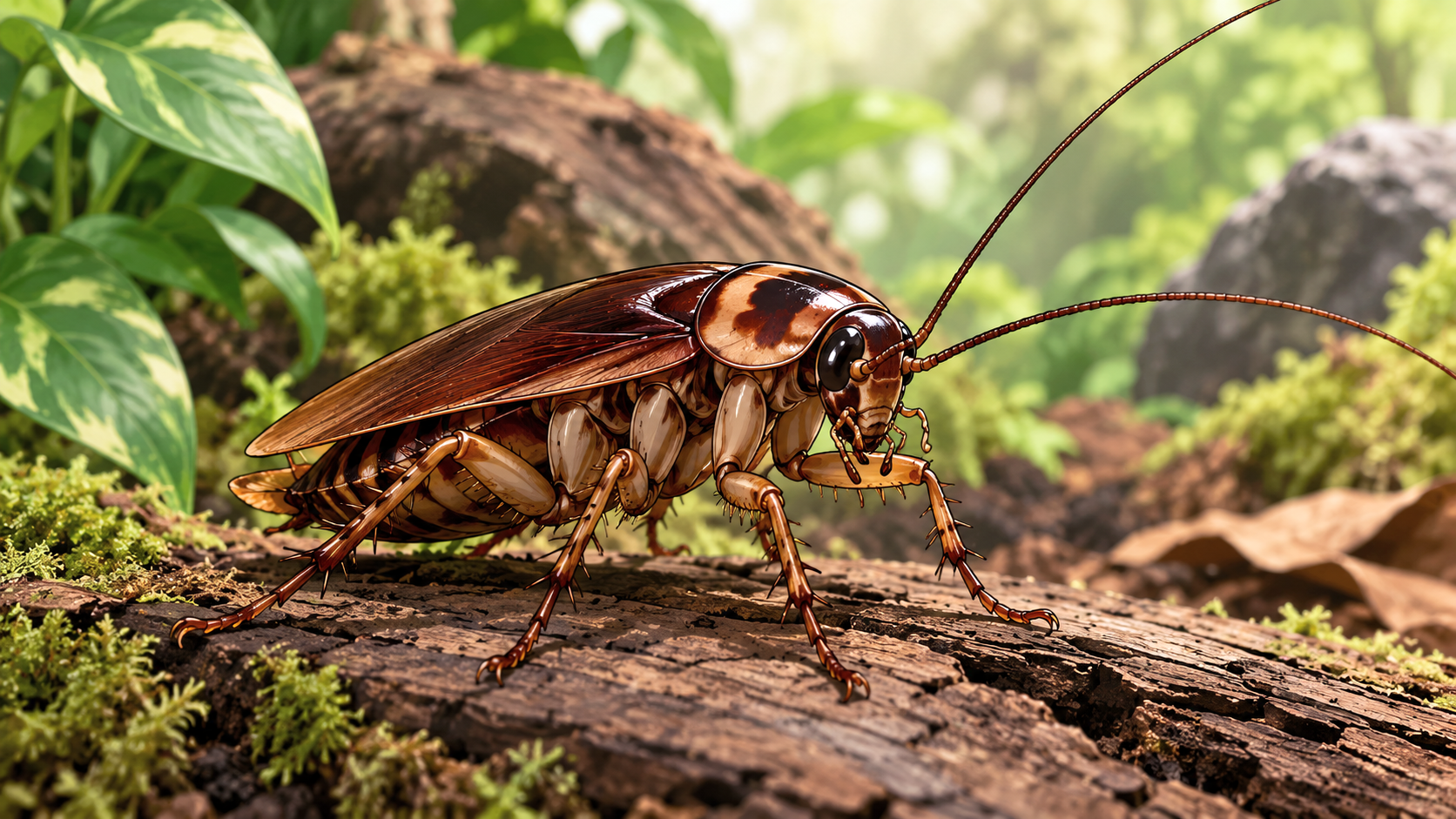
Cockroaches are insects. They belong to the class Insecta and the order Blattodea. They have the defining insect body plan of a head, thorax, and abdomen, with three pairs of legs attached to the thorax. Their closest major relatives include termites and praying mantises, although their modern classification contains a surprising complication: termites are now placed within the cockroach lineage. The confusion usually comes from everyday language. People often use “bug,” “roach,” and “insect” as though they describe separate categories. A cockroach can be called a roach or bug informally, but biologically it remains an insect.
Where Cockroaches Fit in the Insect Family Tree
A useful simplified classification places cockroaches within Animalia → Arthropoda → Insecta → Blattodea. Arthropoda is the much larger group containing insects, spiders, mites, centipedes, crustaceans, and numerous other animals. Insecta narrows that group considerably, while Blattodea narrows it again to the evolutionary branch containing cockroaches and termites.
Cockroaches also belong to a larger lineage called Dictyoptera, which contains Blattodea and Mantodea, the praying mantises. Molecular studies support the close evolutionary relationship among cockroaches, termites, and mantises. A cockroach is consequently much more closely related to a praying mantis than to a superficially similar beetle.
Classification at this level answers what a cockroach is without identifying which particular cockroach you found. The broader definition of a cockroach includes its basic biology and ecological role, while species diversity belongs to the different types of cockroaches.
Six Legs Put Cockroaches Firmly Among the Insects
Adult insects have three principal body regions and three pairs of legs. Cockroaches follow that arrangement. Their head carries major sensory and feeding structures, the thorax consists of three segments supporting the legs and, in winged adults, the wings, and the abdomen forms the rear body region. The six cockroach legs are therefore not simply a convenient identification clue. Their placement reflects the underlying insect body plan.
Cockroaches also have one pair of antennae and an external skeleton rather than bones. Many adults have wings, although wing development and flight ability vary. Those characteristics are shared in different combinations across insects, so none makes an animal a cockroach by itself. The complete arrangement of cockroach body structures reflects specialization within the much larger insect lineage.
This also explains why spiders, ticks, and mites are not insects despite often being grouped with them casually. They are arthropods, but arachnids have four pairs of walking legs as adults rather than three. A clover mite is an arachnid rather than an insect, making leg number one of the simplest visible differences between the two groups.
Termites Changed the Way Cockroaches Are Classified
Older classifications commonly treated termites as the separate insect order Isoptera. Modern evolutionary research changed that arrangement. Multiple lines of molecular evidence show that termites arose from within the cockroach lineage rather than forming a separate lineage alongside it. A major molecular analysis found termites nested within cockroaches, with the wood-feeding genus Cryptocercus representing their closest living cockroach relatives.
Later phylogenetic work continued to support that placement. Research using a larger set of cockroach lineages recovered termites within Blattodea alongside the major cockroach groups, while a subsequent phylogenomic analysis again found strong support for the termite-Cryptocercus relationship and treated cockroaches and termites together as Blattodea.
Calling termites part of Blattodea does not mean a German cockroach and a termite are interchangeable animals. Termites evolved distinctive social colonies and other biological specializations. The classification describes ancestry. Their very different lifestyles developed after their lineage diverged from other cockroaches.
A Cockroach Is Not a Beetle or a “True Bug”
Every cockroach is an insect, but not every insect belongs to the same order. Beetles belong to Coleoptera, flies to Diptera, butterflies and moths to Lepidoptera, and the insects formally known as true bugs belong to Hemiptera. Cockroaches occupy Blattodea.
The word bug creates an especially easy misunderstanding. In ordinary speech, virtually any small crawling insect may be called a bug. Entomologically, “true bug” has a narrower meaning associated with Hemiptera. Cockroaches are therefore bugs in the casual sense but are not true bugs in the taxonomic sense.
Beetles provide another useful example because dark beetles are sometimes mistaken for roaches indoors. Both animals have six legs because both are insects, yet they belong to separate orders with different body structures. Identification therefore requires more than confirming insect status, and a cockroach-versus-beetle comparison becomes useful when the specimen could reasonably be either one. A similar issue occurs with earwigs mistaken for cockroaches, since earwigs are also six-legged insects.
Taxonomy Questions That Come Up With Cockroaches
Are cockroaches arthropods?
Yes. Insects form one major branch of Arthropoda, so a cockroach is both an arthropod and an insect. Calling it an arthropod is correct but less specific, much as calling a dog a mammal is correct without identifying it as a dog.
Are cockroaches related to grasshoppers?
Both are insects within the broader polyneopteran radiation, but grasshoppers belong to Orthoptera rather than Blattodea. They do not share the particularly close relationship that cockroaches have with termites and mantises.
Were prehistoric cockroaches insects too?
Fossil insects resembling cockroaches occur deep in the Paleozoic record, although many early “roach-like” fossils were not members of the modern cockroach crown group. Research on Blattodea indicates that many major living lineages diversified considerably later than the oldest superficially cockroach-like fossils.
Does identifying something as an insect prove it is a cockroach?
No. Six legs and the standard insect body plan only narrow the possibilities to Insecta. Shape, coloration, markings, antennae, wings, and other features are needed to determine whether an insect actually looks like a cockroach rather than another household insect.
2 thoughts on “Are Cockroaches Insects?”