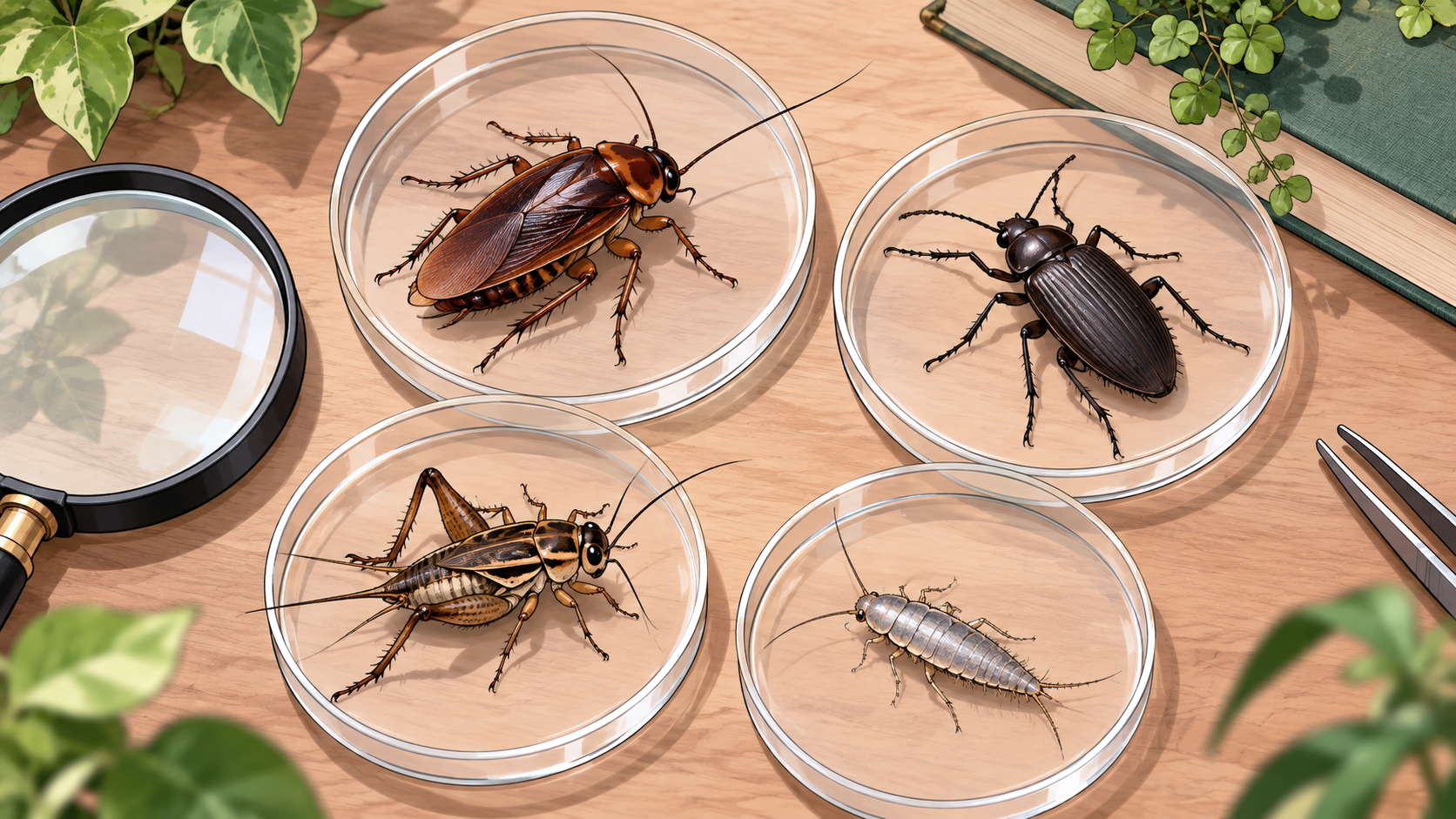
Dark color and fast movement are enough to make almost any unfamiliar insect on the floor look like a cockroach for a few seconds. Beetles, crickets, earwigs, silverfish, termites, bed bugs, and even aquatic insects can trigger the same suspicion, especially when the sighting is brief.
The quickest way to identify a cockroach lookalike is to stop relying on color and check its structure. Cockroaches typically have a flattened oval body, very long threadlike antennae, six spiny legs, a head partly covered from above by the pronotum, and two small cerci at the rear. Adult wing structure varies among the different types of cockroaches, so no single feature should carry the entire identification.
Ground Beetles Can Look Remarkably Roach-Like on the Floor
A dark ground beetle running across a basement or garage can make a convincing cockroach at a distance. Many are black or brown, somewhat flattened, nocturnal, and quick on their feet. Their hard backs provide the easiest correction. Beetles have rigid forewings called elytra, which meet along a lengthwise seam over the abdomen. A cockroach does not have this hard beetle shell, and its head is usually less exposed from above.
Ground beetles are primarily outdoor insects, with many species living in soil, leaf litter, beneath stones, and around vegetation. Some occasionally wander into buildings. Finding one indoors therefore has different implications from finding an established household cockroach. The combination of a clearly visible head and hard wing covers is much more useful than comparing shades of brown, while a full cockroach-versus-beetle identification can resolve specimens where those characters are difficult to see.
Crickets Give Themselves Away at the Hind Legs
Crickets and cockroaches can both have long antennae, dark bodies, and nocturnal habits. The silhouette changes dramatically at the rear. Crickets possess enlarged hind legs adapted for jumping, whereas a cockroach has three pairs of running legs without a cricket’s oversized jumping pair.
Movement can expose the difference before small anatomical details are visible. A cricket may make powerful jumps when disturbed. Cockroaches run rapidly and can climb, while some species also fly, but their normal escape does not involve cricket-style jumping. An insect with extremely long antennae should therefore not be called a cockroach until the hind legs have been checked.
Earwigs Have Pincers Where Cockroaches Have Small Cerci
Both cockroaches and earwigs carry paired appendages at the rear, but they look nothing alike when seen clearly. An earwig has prominent forceps-like cerci, often described as pincers. Adult males can have strongly curved forceps, while female forceps are generally straighter. Earwigs also have a narrower, more elongated body than the typical broad oval cockroach. Their rear pincers are one of their most conspicuous identifying features.
Cockroach cerci are much smaller sensory appendages rather than large forceps. Their position can still help confirm an identification when combined with the other external structures of a cockroach. Poor lighting can hide the difference, so the rear end is worth photographing when the insect has a generally roach-like color.
Silverfish Have Three Long Tail Filaments
Silverfish share several superficial traits with cockroaches. Both are wingless in some visible life stages, have long antennae, move quickly, and hide in cracks or sheltered spaces. The rear of a silverfish is unmistakably different once it is visible. Its tapered abdomen ends in three long filaments, while a cockroach has two much shorter cerci.
The overall outline also diverges. Silverfish narrow progressively toward the rear, producing a carrot-like or fish-like profile, and their bodies are covered with scales. Their two long antennae and three long rear filaments give them a shape that a cockroach does not have. A clear view from above should separate the two without relying on how quickly either insect runs.
Termite Swarmers Can Be Mistaken for Winged Cockroaches
A winged insect appearing suddenly indoors can cause confusion when its body is partly hidden beneath its wings. Termite swarmers have two pairs of wings that are roughly equal in length, and their antennae are relatively straight. Cockroaches have a different body construction, and the relationship between termites and cockroaches does not make the two interchangeable for household identification.
A termite swarmer also carries wings that extend conspicuously beyond its body. Shed wings accumulating around windows or other emergence points can provide additional evidence of termite activity. Because termites can damage structural wood, suspected termite evidence deserves proper identification rather than being dismissed as an odd-looking roach. Equal-length wings and straight antennae are useful termite characters, although species-level identification may require closer examination.
Bed Bugs Are Much Smaller and Wingless
An adult bed bug is flat and reddish brown, two characteristics that can sound cockroach-like when described without scale. Size changes the comparison immediately. Adult bed bugs are only about 5 to 7 mm long, lack functional wings, and have relatively short antennae. Their broadly oval bodies also lack the long-legged appearance associated with cockroaches. Adult bed bugs are small, flattened, reddish-brown insects adapted for blood feeding.
Confusion is most plausible with a small cockroach nymph rather than a large adult roach. Even then, body proportions and antenna length differ, and the circumstances of the discovery provide useful supporting evidence. Bed bugs are strongly associated with sleeping and resting areas, whereas cockroach habitat depends on species and available food, moisture, warmth, and shelter. A direct cockroach and bed bug comparison is more appropriate when the specimen is tiny and found near a bed or upholstered furniture.
Giant Water Bugs Resemble Large Cockroaches From a Distance
A giant water bug can be broad, flattened, brown, and large enough to invite comparison with an American cockroach. Its front legs quickly break the resemblance. Giant water bugs are aquatic predators with thick raptorial forelegs designed to seize prey, along with short antennae that are much less conspicuous than a cockroach’s long feelers.
Adults can fly and may be attracted to lights, which occasionally puts them on dry ground far from the water where someone expects to find them. They remain aquatic true bugs rather than cockroaches. Confusion is amplified because “water bug” is also used informally for certain roaches, so cockroach and water bug identification requires knowing whether the name refers to a nickname or an actual aquatic insect.
A Few Other Insects Can Create a False Alarm
Some longhorn beetles can look roach-like because their antennae are exceptionally long, but their hardened beetle wing covers remain a strong separator. Darkling beetles may have a dark brown or black body that produces the same problem in dim light. June beetles are usually more robust and convex, with hard elytra rather than the flatter outline associated with a cockroach.
Outdoor cockroaches create a different identification trap because they really are cockroaches. Wood cockroaches, for example, may enter buildings accidentally without behaving like the familiar indoor pest species. A genuine cockroach therefore does not automatically mean that the building contains a reproducing infestation. Repeated sightings and physical signs of cockroach activity provide far more context than appearance alone.
Questions That Can Narrow Down an Uncertain ID
What if the insect has very long antennae?
Long antennae support a cockroach identification but do not prove it. Crickets and some beetles also have exceptionally long antennae, so check the legs, wings, head, and rear appendages before deciding.
What if the insect has no visible wings?
It could still be a cockroach. Young cockroaches do not have fully developed adult wings, and adult wing development also differs among cockroach species and sexes. Other body features become more useful when wings are absent.
Can a cockroach look black rather than brown?
Yes. Some cockroaches are very dark. Oriental cockroaches, for example, can appear dark brown to nearly black. A black insect should not automatically be classified as a beetle.
What should I photograph for identification?
Get an overhead image showing the entire body, then a closer image that preserves the antennae, back, legs, and rear of the abdomen. Include an object for scale without placing it over the insect. Those views preserve far more identifying information than a blurry side photograph.
If the insect cannot be confidently identified, avoid treating the room solely on the assumption that it is a cockroach. Capture the specimen or preserve clear photographs first. Correct identification determines whether you are dealing with an indoor pest, an outdoor insect that wandered inside, or something that requires an entirely different response.
3 thoughts on “Bugs That Look Like Cockroaches: A Quick ID Guide”