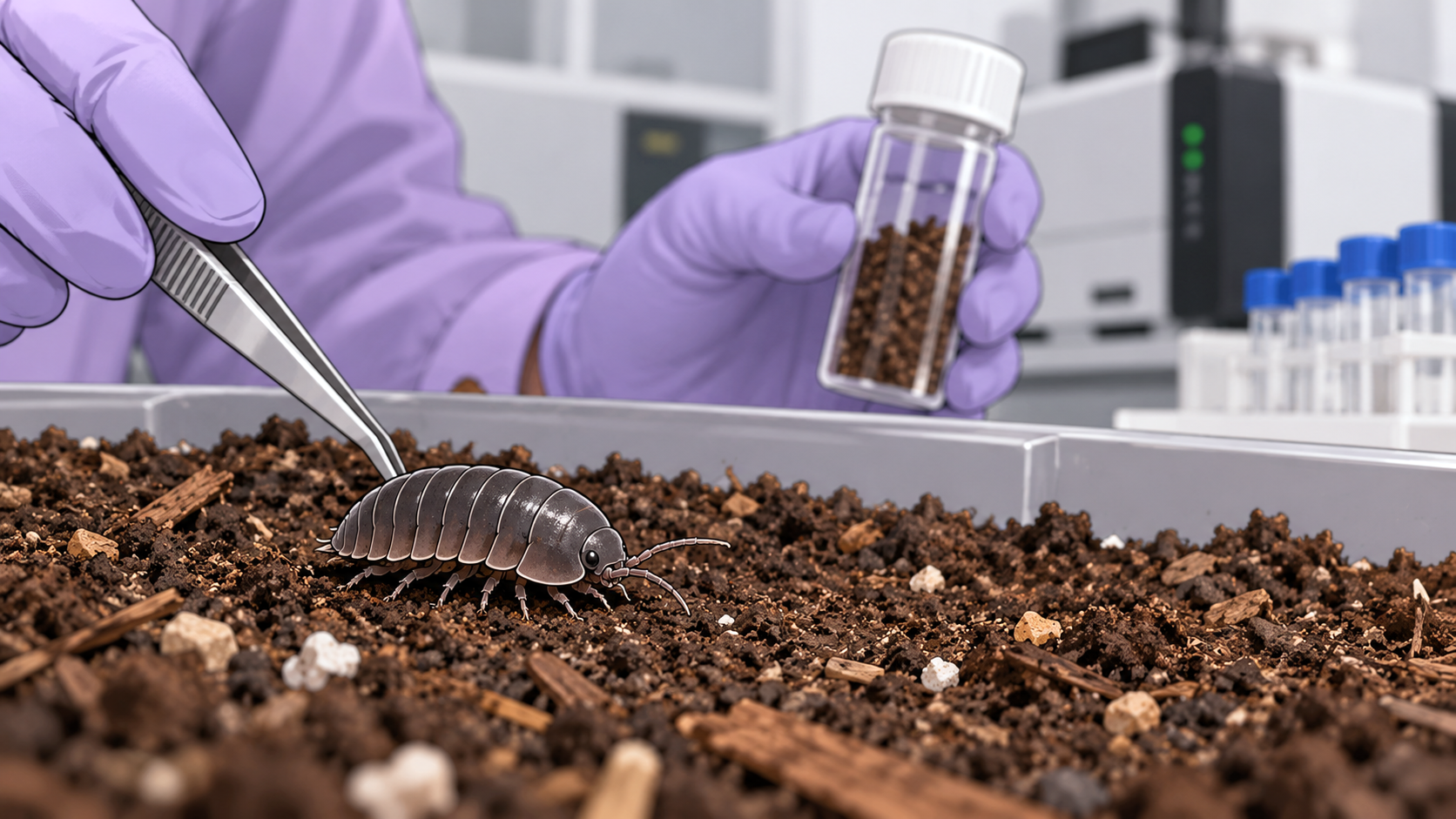
Roly-polies should not be considered a proven way to remove heavy metals from contaminated soil. They can absorb and store metals such as cadmium, copper, lead and zinc in their bodies, especially the hepatopancreas. That is bioaccumulation. Actual remediation requires reducing, removing, immobilizing or otherwise controlling contamination at the site. The idea that roly-polies “clean” soil comes from a real biological ability that has been stretched beyond what the evidence demonstrates. Terrestrial isopods can tolerate and concentrate some metals remarkably well, which makes them useful to scientists studying pollution. Concentrating a contaminant inside a small animal is not equivalent to removing enough of it from an area to make the soil safe.
The Metal Goes Into the Roly-Poly, but It Has Not Necessarily Left the Site
Roly-polies encounter metals through contaminated food, soil and other environmental material. Their digestive system can take up some of those elements and store substantial amounts internally. A recent synthesis of terrestrial-isopod research found particularly strong accumulation of several metals and identified the hepatopancreas as the principal organ for metal sequestration and detoxification.
Common pillbugs have demonstrated this capacity experimentally. When Armadillidium vulgare was fed leaves contaminated with cadmium and lead, the animals accumulated both metals, although cadmium accumulated much more strongly relative to its concentration in the food. The metals were detected in hepatopancreatic tissue, and increasing exposure produced cellular responses associated with metal stress. Another comparison involving A. vulgare and two related terrestrial isopods found that accumulation depended on both the metal involved and the isopod species.
None of this makes the contaminant disappear. Unless contaminated animals are physically removed from the site and their metal burden represents a meaningful fraction of the total contamination, the metal remains within the local ecosystem. An isopod may die, be eaten or eventually return material to the detrital system. The predators that consume roly-polies also create a possible route by which accumulated material can move through a food web rather than leave it.
Scientists Often Use Isopods to Measure Contamination, Not to Extract It
The ability to accumulate metals gives terrestrial isopods considerable value as biomonitors. Researchers can collect animals from different locations, measure the substances in their tissues and compare those results with environmental conditions. A. vulgare collected at varying distances from a landfill, for example, accumulated several heavy elements in patterns that made the animals useful for detecting low and intermittent environmental contamination.
Porcellio scaber has been used differently but for the same underlying reason. In contaminated soil, its body burden can provide information about the fraction of a metal that is biologically available. Researchers evaluating lead, zinc and cadmium stabilization found that an isopod bioaccumulation test could detect changes in metal bioavailability after the soil itself had been treated with stabilizing materials.
In another remediation experiment, EDTA treatment reduced several measures of contamination in polluted soil. The researchers then exposed P. scaber to the treated and untreated soil and measured accumulated lead, zinc and cadmium. The isopods served as an in vivo test of remediation effectiveness; they were not the remediation treatment. Confusing those two roles is one source of the claim that pillbugs themselves clean contaminated ground.
Storage Inside the Hepatopancreas Helps Explain Their Unusual Tolerance
A terrestrial isopod can survive metal exposure that would be difficult for some other soil invertebrates because its tissues can sequester certain elements. The hepatopancreas, a major digestive and storage organ, is central to this process. A broad ecotoxicology review describes an exceptional capacity for storing metals in hepatopancreatic tissue, with copper and cadmium among the elements studied extensively.
Sequestration reduces the amount of a metal freely interacting with sensitive cellular processes, but tolerance has limits. High exposure can alter feeding, growth and tissue condition and can eventually increase mortality. Recent work with A. vulgare collected from environmentally disturbed sites found cadmium and lead accumulation alongside cellular stress and damage.
Metal handling also differs by element. Copper is biologically required in crustaceans and can be strongly regulated, while cadmium, lead and other contaminants follow different uptake, storage and elimination patterns. A statement such as “roly-polies absorb heavy metals” is therefore only a starting point. It cannot predict how much of a particular contaminant an animal will contain after living in a particular soil.
Bioaccumulation Does Not Tell You How Much Metal Was Removed From the Soil
Suppose laboratory analysis finds a high concentration of cadmium in pillbug tissue. That measurement tells us the animal accumulated cadmium. It does not reveal, by itself, what percentage of the site’s total cadmium inventory has been transferred into pillbugs.
A remediation method has to be assessed at the scale of the contaminated material. Soil mass, contaminant concentration, depth, spatial distribution, chemical form and bioavailability all matter. Roly-poly abundance and individual body mass are tiny by comparison with the quantity of soil on even a modest property. Research using isopods therefore commonly treats their accumulation as an indicator of exposure rather than evidence of large-scale contaminant extraction.
The animals’ feeding on decomposing organic material can bring them into contact with contaminated litter, and their broader role in decomposition and nutrient cycling continually moves material through the detrital food web. Neither process demonstrates a net removal of heavy metals from the property.
Metal Levels in a Roly-Poly Do Not Provide a Simple Home Soil Test
Finding many roly-polies in a yard cannot tell you whether the soil contains dangerous metal concentrations. Even laboratory measurements of the animals require interpretation because accumulation varies with species, metal, exposure duration, food, environmental concentration and physiological regulation. A 2026 review found that nonlinear relationships between environmental concentrations and isopod body burdens can limit their quantitative use as bioindicators.
Visual appearance is even less informative. The normal colors and patterns seen in roly-polies cannot reveal cadmium, lead, copper or zinc exposure. Unusual blue coloration has a separate biological explanation and should not be interpreted as evidence of metal contamination.
If contamination is suspected, soil testing provides measurements that can be compared with applicable environmental or health guidance. A population of apparently healthy pillbugs cannot establish that the soil is clean, and sick or dead pillbugs cannot identify which contaminant is present.
Deliberately Adding Roly-Polies Is Not a Soil-Remediation Plan
There is no established household remediation protocol in which releasing pillbugs into contaminated ground and allowing them to accumulate metals makes the site safe. The research instead supports their use in ecotoxicology, biomonitoring and tests of how available contaminants are to organisms.
Their ordinary biology also makes deliberate extraction difficult. Roly-polies occupy moist shelters near the soil surface, move through litter, reproduce and interact with other organisms. Recovering enough individuals to remove a meaningful contaminant mass would require demonstrating both substantial uptake and reliable collection, followed by appropriate handling of the contaminated biomass. The available evidence does not establish that sequence as a practical remediation method.
Suspected lead, cadmium, arsenic or other hazardous soil contamination warrants proper testing and remediation advice appropriate to the contaminant and site. Roly-polies can tell researchers a great deal about pollution, but they should not be relied upon to remove it.
Questions About Roly-Polies and Contaminated Soil
Can heavy metals hurt roly-polies even though they can store them?
Yes. Sequestration provides tolerance, not immunity. High metal exposure has been associated with altered feeding and growth, tissue damage and mortality in terrestrial isopods.
Could removing contaminated roly-polies remove at least some metal?
Physically removing an animal also removes whatever metals are contained in its body. That alone does not establish a useful remediation method because the amount extracted must be meaningful relative to the contaminant mass remaining in the soil.
Do all roly-poly species accumulate metals equally?
No. Experimental comparisons show species-specific differences in accumulation. The species found among terrestrial roly-polies therefore cannot be treated as identical metal accumulators.
Does seeing roly-polies mean contaminated soil is safe for a garden?
No. Their ability to survive in an area is not a soil-safety test. Some terrestrial isopods tolerate and sequester substantial metal burdens, so their presence cannot substitute for laboratory analysis when contamination is suspected.