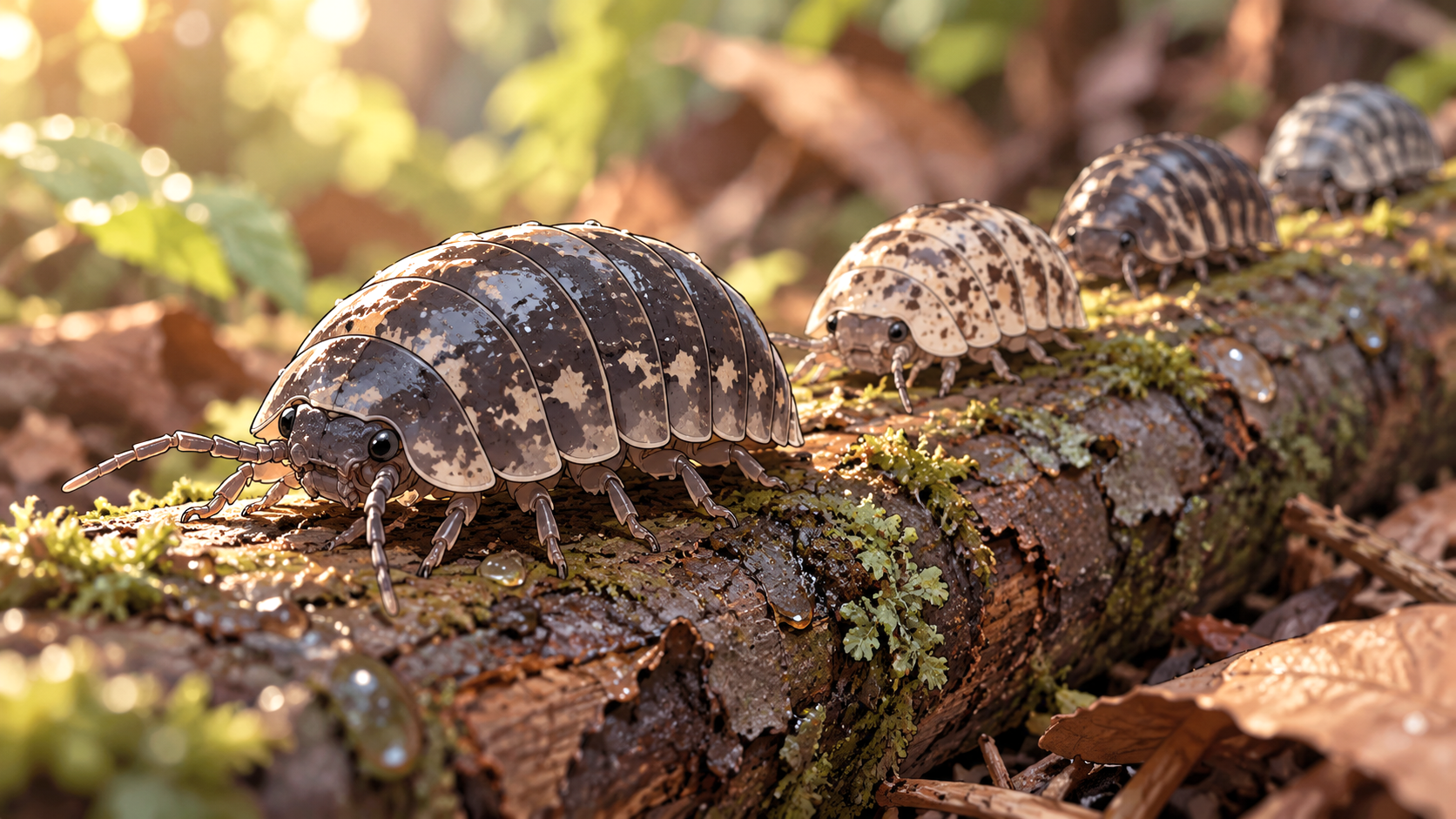
Roly-polies are commonly gray, charcoal, brownish or nearly black, but natural variation can also produce reddish, pale, mottled, spotted or patterned individuals. Young roly-polies may be lighter than mature animals, and molting can temporarily leave part of the body much paler than the rest. Color alone is therefore unreliable for identifying a species.
Some variation is inherited, some reflects age or sex, and some is temporary. An unusually colored roly-poly is not automatically a different species, and there is no good basis for assuming that a particular food caused its color simply because the animal was found eating it.
Gray Is Common, but It Is Not the Only Normal Color
The familiar common pillbug, Armadillidium vulgare, is often dark gray or gray-black. Its outer covering contains different pigment systems: ommochrome contributes much of the dark body coloration, while pteridine pigments contribute to lighter colored markings. The amount and distribution of these pigments can vary, producing individuals that do not match a single standard shade.
Red and reddish-brown forms are genuine examples of pigmentation variation rather than evidence that an animal has recently eaten something red. Research on A. vulgare has documented red, white and wild-type black-gray phenotypes, with differences associated with pigment formation in the integument. Earlier breeding work also found that red body coloration can be inherited. A red or unusually pale pillbug can consequently belong to the same species as a much darker individual.
Color ranges also differ among species. The visual features separating different types of roly-polies can include markings and pigmentation, but those traits need to be considered alongside body structure and geographic range. Two animals with different colors are not necessarily different species, while two similarly gray animals can be.
Spots and Mottling Can Be Part of the Animal’s Pigmentation
A roly-poly does not have to be uniformly colored from head to rear. Common pillbugs can carry lighter marks along the back, and some females of A. vulgare display cream-colored dorsal markings. Microscopic examination has shown that these cream markings contain specialized pigment cells with pteridine granules, including the yellow pigment sepiapterin.
Sex can affect how those markings appear. In the same species, pigment cells associated with cream markings occur in both sexes, but darker ommochrome-containing cells can obscure them externally in males. A visibly spotted female and a comparatively plain male can therefore belong to the same species rather than representing separate varieties.
Patterns also have limits as identification tools. The general shape and segmented appearance of a roly-poly remain important when deciding what kind of animal you have found, while finer structural features become necessary for species-level identification. Pigmentation can support an identification, but a photograph showing only color may not settle it.
Very Young Roly-Polies Can Look Pale or Nearly Translucent
Newly released terrestrial isopods do not necessarily display the dark, opaque appearance associated with mature pillbugs. Pigmentation develops as the animal grows, so a tiny pale individual beside darker adults may simply be young.
The effect can be pronounced enough to complicate color-based identification. Historical work on inherited coloration in A. vulgare noted that young animals from a red form initially lacked the obvious red or brown coloration later used to distinguish that phenotype. Research on pteridine pigmentation has likewise found age-related changes in pigment content.
A small whitish roly-poly therefore does not automatically represent an albino animal. Size, developmental condition and the degree of pigmentation need to be considered together. The appearance of newborn and juvenile roly-polies changes as they develop, whereas true inherited pigment reduction persists beyond a brief juvenile stage.
A Half-White Roly-Poly May Be in the Middle of Molting
One of the strangest normal appearances occurs during a molt. Terrestrial isopods do not shed their entire exoskeleton in one piece. They use a biphasic process in which the posterior half is shed first and the anterior half follows later. During the interval, the two halves of the same animal can look noticeably different.
Freshly exposed cuticle has not yet reached the appearance and hardness of the older exoskeleton. A roly-poly can consequently look pale, whitish or visually divided across the middle during part of the process. The temporary contrast is particularly striking because the boundary between the two molting regions lies between the fourth and fifth pereon segments.
That appearance should resolve as the roly-poly completes its two-stage molt and the new cuticle develops. A lasting pale phenotype is a different phenomenon. Laboratory work has identified genetically inherited albino strains of A. vulgare, demonstrating that permanent pigment reduction and temporary post-molt paleness should not be treated as the same condition.
Color Morphs Do Not Automatically Represent Separate Species
Captive isopod keepers selectively maintain animals with unusual colors and patterns, producing lines commonly called morphs. Morph labels can describe visually distinctive populations, but a breeding name does not by itself establish a separate species. Species identity depends on taxonomy, not the commercial or hobby name assigned to a color form.
Natural populations already demonstrate how misleading appearance can be. A. vulgare includes genetically influenced red and pale phenotypes as well as the common dark form. Research has traced red coloration to differences involving ommochrome production and metabolism, while other work has identified inherited mechanisms associated with albinism. Substantial color differences can therefore exist within one species.
The reverse is equally important: matching colors do not prove two roly-polies are the same species. Structural characters and distribution are needed when the goal is to determine which roly-poly species is present.
Questions About Roly-Poly Color
Can a roly-poly be completely white?
Very pale or white individuals can occur for more than one reason. A newly molted animal may be temporarily pale, young individuals may have less developed pigmentation, and inherited pigment-reducing mutations have been documented in A. vulgare. The duration and context of the appearance help distinguish these possibilities.
Do female roly-polies have different markings from males?
They can. In A. vulgare, cream dorsal markings can be more externally apparent in females because the corresponding pigment cells in males may be obscured by darker pigmentation. Sex cannot reliably be determined from color alone, however; male and female roly-polies have more useful anatomical differences.
Does a roly-poly’s food determine its body color?
Ordinary pigmentation should not be attributed to diet without evidence. Genetic differences, pigment chemistry, age, sex and molting can all affect appearance. Finding a colored roly-poly eating a particular material does not establish that the food produced the color.
What about a bright blue or violet roly-poly?
Blue or violet discoloration is different from the ordinary gray, red, pale and patterned variation discussed here. It has a documented association with iridovirus infection, so an intensely blue roly-poly warrants a different explanation rather than being treated as a routine color morph.