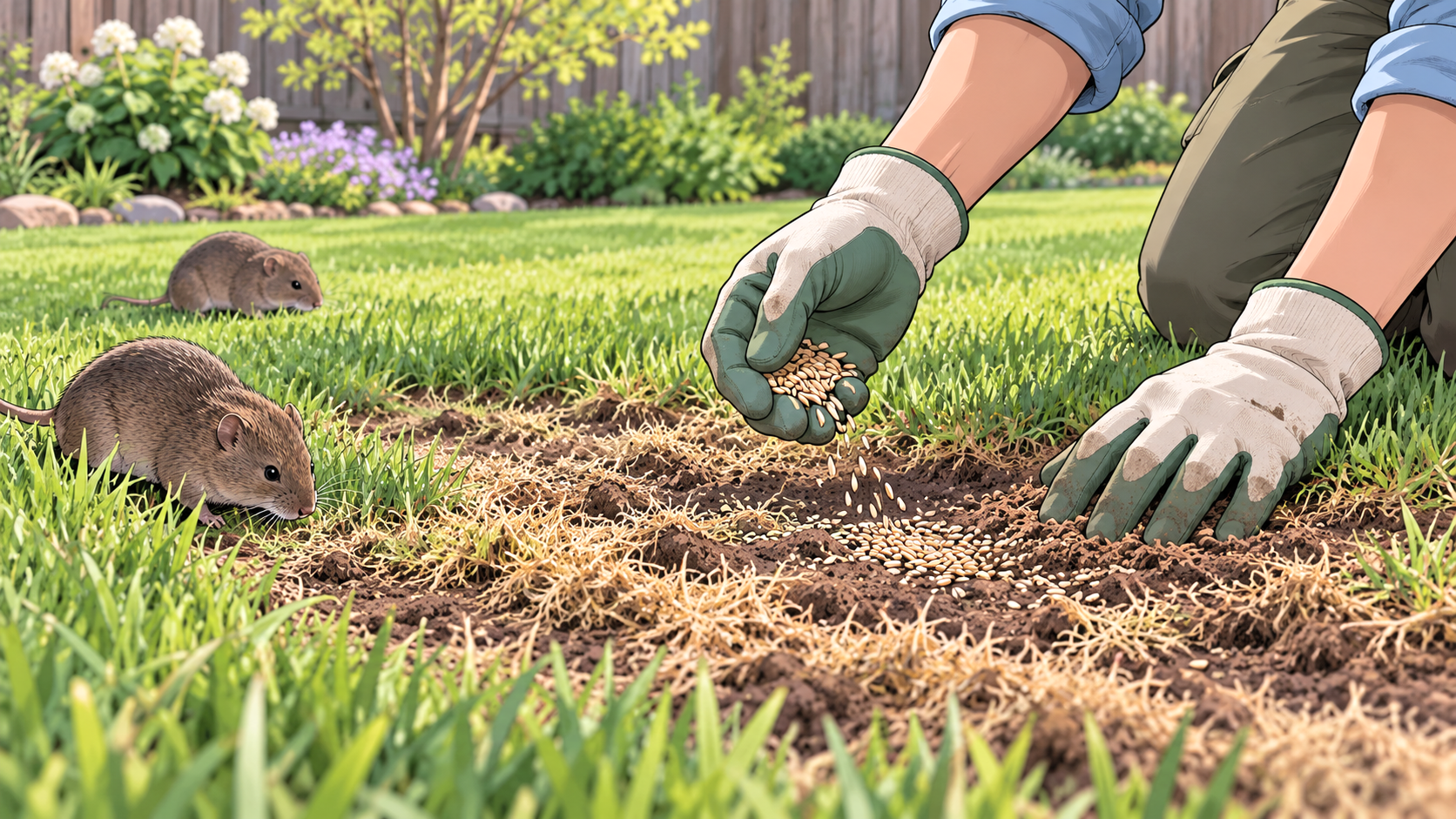
To repair lawn damage from voles, gently rake away dead grass and debris, allow surviving turf to regrow, and reseed any bare patches that fail to recover. Most shallow vole runways improve naturally once the grass begins actively growing, provided the crowns and roots remain healthy. Severely worn areas may need fresh seed, a small amount of topsoil, or replacement sod.
A lawn covered in winding brown trails after snowmelt can look considerably worse than its actual condition. Voles often clip grass blades close to the ground without destroying the growing points. Repairing every visible track immediately may waste seed and disturb turf that would have recovered on its own.
Start by Separating Recoverable Grass From Bare Soil
The first repair decision is whether living grass remains in the damaged tracks. Voles commonly wear down or feed on turfgrass shoots while leaving the crowns and roots intact. When those growing tissues survive, grass along vole runways can recover as temperatures rise.
Look closely at the base of the grass rather than judging the area entirely by its brown appearance. Green shoots emerging among the damaged material indicate that recovery has begun. A patch with surviving grass plants requires less intervention than exposed soil where vegetation has disappeared.
The condition becomes easier to assess after several days of suitable growing weather. Dormant grass may not immediately show new growth, particularly during a cold spring. Avoid declaring an entire strip dead while nearby undamaged turf is also dormant.
A practical repair decision follows the remaining vegetation:
| Lawn condition | Appropriate repair |
|---|---|
| Flattened grass with intact growing points | Gentle raking and time for regrowth |
| Thin grass with scattered bare areas | Raking followed by overseeding |
| Completely bare soil | Prepare the surface and reseed |
| Uneven ground with missing turf | Correct the surface level before seeding or laying sod |
| Extensive dead turf | Consider partial renovation or sod replacement |
Damaged turf often recovers rapidly in spring, although overseeding can help fill remaining gaps. The objective is to restore coverage without removing healthy grass unnecessarily.
Rake Out the Damaged Grass Without Tearing Up the Lawn
Once the lawn surface has thawed and is firm enough to walk on without leaving impressions, use a leaf rake or flexible garden rake to lift matted material from the tracks. Remove loose clippings, accumulated thatch, and visible debris while leaving rooted grass in place.
Vole pathways can contain chewed vegetation and droppings, so wear gloves, avoid handling waste directly, and keep pets away during cleanup. Work in a manner that minimizes dust and avoid dry sweeping, blowing, or aggressively disturbing concentrated rodent waste. Where substantial droppings are present, rodent-cleanup precautions take priority over ordinary lawn maintenance.
Raking helps expose surviving shoots to light and air while improving contact between the soil and any seed added later. Removing matted dead grass before repairing turf also prevents loose vegetation from separating new seed from the growing medium.
Use enough pressure to dislodge debris, not enough to strip the lawn down to mineral soil. Repeated aggressive raking can uproot recovering plants and turn a narrow damaged trail into a wider bare patch.
If the lawn is waterlogged from melting snow, postpone the work until the surface firms up. Working wet soil can create additional compaction and damage the remaining turf.
Overseed the Areas That Do Not Fill In
Bare sections need direct seed-to-soil contact for successful establishment. After clearing away dead vegetation, lightly loosen the exposed soil surface with a rake. Add suitable grass seed at the package’s recommended repair rate, then rake it lightly into the surface or press it down to establish contact.
Choose seed compatible with the existing lawn and its growing conditions. A sunny Kentucky bluegrass lawn has different requirements from a shaded planting beneath mature trees. Matching the mixture helps the repaired area blend with the surrounding turf as it matures.
The basic requirements for lawn overseeding include suitable seed selection, soil contact, and adequate moisture. Simply scattering seed over a thick layer of dead grass produces poor contact and inconsistent germination.
Apply only enough seed to establish a reasonable stand at the manufacturer’s stated rate. Heavy seeding does not guarantee a thicker lawn because overcrowded seedlings compete for moisture, light, and nutrients.
A thin topdressing of screened soil or finished compost may help where the existing surface is uneven or poor. Avoid burying surviving grass under a thick layer of material. The repaired area should remain level with the surrounding lawn rather than developing a raised strip along every former runway.
Water New Seed Without Saturating the Ground
Newly seeded patches require consistent surface moisture while the grass germinates. Water gently enough that seeds remain in place, and adjust frequency according to temperature, rainfall, soil type, and exposure.
During establishment, the soil surface should remain moist rather than alternating between prolonged dryness and standing water. Frequent light irrigation supports germination, while excessive watering can wash seed away and create poor soil conditions.
Once the seedlings are established, gradually move toward deeper, less frequent watering appropriate for the grass species and local conditions. Maintaining constantly saturated soil is not necessary for mature turf.
Keep heavy foot traffic, pets, and equipment off the repaired strips while seedlings are vulnerable. Narrow vole trails are particularly easy to disturb because their small width can make them appear insignificant during ordinary lawn use.
When Should You Repair Vole Damage?
For cool-season lawns, early spring is useful for cleanup and assessing natural recovery, but late summer to early fall generally provides more favorable conditions for establishing new grass.
Spring offers the advantage of repairing winter damage soon after discovery. The soil must be workable, and seed needs sufficient warmth and moisture to germinate. Rapid weed growth, inconsistent rainfall, and summer heat can interfere with spring establishment.
Late summer and early fall often provide warm soil, cooler air temperatures, and reduced competition from many summer weeds. These conditions favor successful cool-season lawn renovation, particularly when substantial reseeding is necessary.
For a lawn damaged after snowmelt, the timing decision can be simple. Rake and monitor the surviving grass in spring, repair isolated bare patches when growing conditions are suitable, and reserve extensive reseeding for the more favorable establishment period if necessary.
Dormant seeding is another option in certain cold climates, but it requires appropriate timing and local knowledge. Seed distributed too early during fluctuating winter temperatures may germinate before conditions are suitable for survival.
Do Vole Trails Need Topsoil or New Sod?
Most shallow trails do not need substantial quantities of topsoil. Where the surface remains level and grass crowns survive, adding soil can bury recovering vegetation and create an unnecessary raised area.
Topsoil is more useful where erosion, displaced material, or localized wear has left a genuine depression. Apply enough screened soil to restore a reasonably even surface, then establish grass on the repaired patch. Soil should not be added merely because a runway remains visibly brown.
For larger areas with no viable grass, sod can provide faster surface coverage than seed. Remove the damaged turf, prepare and level the soil, lay fresh sod with good soil contact, and water until the roots establish. Sod replacement requires firm contact with prepared soil, otherwise the replacement can dry out or root unevenly.
A narrow trail surrounded by healthy grass rarely justifies cutting out a long strip and installing sod. Small irregular patches are generally easier to blend through overseeding, while sod replacement is more practical when an entire section requires reconstruction.
Should You Fertilize the Damaged Lawn?
A modest fertilizer application can support recovery when the lawn needs nutrients, but heavy fertilization is not a substitute for living grass crowns or successful reseeding.
The recovery of vole-damaged turf can be encouraged through raking and appropriate fertilization. However, the amount needed depends on the existing soil fertility, grass type, and season.
If the lawn already receives regular fertilizer and remains healthy outside the damaged tracks, avoid automatically adding extra nitrogen. Excessive applications can stimulate weak, rapid growth and increase maintenance demands without improving bare-soil establishment.
Use soil-test recommendations where available, especially before renovating a large section. Newly seeded turf may have different nutrient requirements from an established lawn, so choose the fertilizer program appropriate for the repair.
How Long Does It Take for a Vole-Damaged Lawn to Recover?
Light damage can become noticeably less visible within several weeks of active spring growth. Completely bare areas take longer because new seedlings must germinate, develop roots, and produce enough foliage to cover the exposed soil.
Recovery also depends on the existing grass. Kentucky bluegrass can spread through underground rhizomes and gradually occupy nearby bare areas, while perennial ryegrass generally relies more heavily on its existing plants and new seeding to restore coverage.
Do not judge the result solely by how quickly the first green shoots appear. Seedlings need additional time to form a durable stand, and recovering turf may remain thinner than the surrounding lawn for part of the growing season.
If previously healthy grass does not begin recovering despite suitable temperatures and moisture, reassess the area before adding more seed. Compaction, shade, drainage problems, disease, and other lawn stresses may prevent recovery even after vole activity has ended.
Avoid Repairing the Same Damage Repeatedly
Reseeding will not reliably restore a lawn while animals continue wearing down or feeding on the same paths. Before beginning substantial repairs, establish that the damaging activity has stopped or is being effectively managed.
An old trail may remain visible after voles have left, so its appearance alone does not justify further treatment. Freshly clipped grass, newly disturbed vegetation, and repeated injury to recovering turf provide more useful evidence of continued activity.
Where the lawn remains stable, focus on turf establishment rather than repeatedly disturbing the ground. The maintenance of healthy lawn conditions supports recovery once the original damage is no longer occurring.
For a typical lawn with shallow spring runways, we would rake first, give the surviving grass an opportunity to recover, and seed only the sections that remain thin or bare. Large-scale renovation is justified when meaningful areas of turf have actually been lost, not simply because the tracks looked extensive immediately after snowmelt.