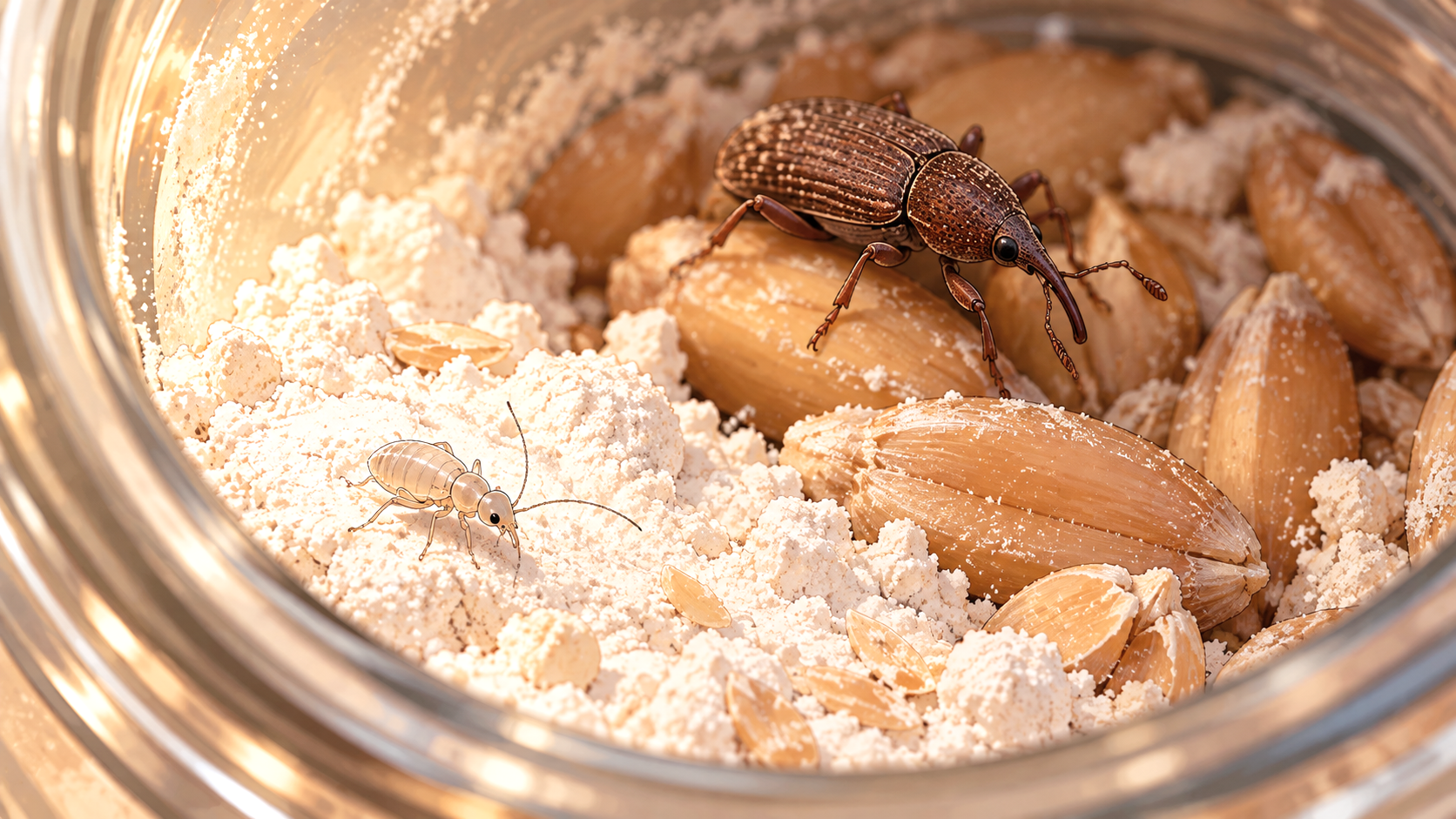
Booklice and weevils can turn up in the same pantry or grain-storage area, but they are not difficult to separate once the insect is viewed closely. Booklice are tiny, soft-bodied insects with long threadlike antennae and a broad head. True grain weevils are hard-bodied beetles with a distinct snout and elbowed antennae.
A Snout Points Strongly Toward a Weevil
True weevils in the genus Sitophilus, including rice, granary, and maize weevils, have a prolonged head forming a noticeable snout. Their antennae are elbowed and arise from the snout rather than extending as long straight threads from a broad head. The Canadian Grain Commission uses the combination of a prolonged snout and elbowed antennae as a defining route in its stored-grain identification key.
Booklice have the opposite appearance. Their head is broad rather than extended forward into a rostrum, and the antennae are long, slender, and threadlike. The typical body shape of a booklouse is soft and delicate, without the hardened wing covers that make a weevil clearly recognizable as a beetle under magnification.
A blurry photograph can hide the snout and create confusion, particularly when the insect is only a few millimeters long. A sharp side or three-quarter view of the head usually resolves the comparison more quickly than color.
Weevils Usually Look Like Small Beetles Rather Than Moving Specks
Many indoor booklice measure around 1 to 2 millimeters, and some stored-product psocids are 1 millimeter or less. Canadian grain guidance describes psocids as very small soft-bodied insects, with larger pale individuals reaching about 2 millimeters. Their small scale explains why booklice can be difficult to examine without magnification.
Stored-grain weevils tend to be larger and more substantial. Rice weevils are approximately 2.5 to 4 millimeters long, while granary weevils can reach about 5 millimeters. They have a rigid beetle body with hardened forewings covering the abdomen.
There is enough overlap at the lower end that measurement alone should not decide the identification. A small rice weevil may still look tiny in a pantry, but its snout, compact beetle shape, and hardened body separate it from a similarly small psocid.
Whole Grain Damage Favors Weevils
The strongest evidence may be inside the food rather than on the insect. Rice, maize, and granary weevils are primary stored-grain pests capable of attacking intact kernels. Female Sitophilus weevils bore into grain, deposit an egg, and seal the opening. The larva then develops inside the kernel before the adult eventually emerges through a hole. Canadian grain guidance describes primary stored-product pests as insects capable of attacking sound grain.
Round or ragged emergence holes in rice, wheat, corn, barley, or other susceptible grain therefore support a weevil infestation. Granary weevil larvae can consume the interior of kernels, while adults also feed on grain. Heavy populations may leave obvious damaged seeds and debris.
Booklice interact with stored food differently. Their diet can include fungi, damaged grain, starches, and exposed food material, but common psocids are generally classified as secondary pests rather than primary grain borers. The Canadian Grain Commission specifically notes that booklice do not damage sound grain and instead tend to exploit broken kernels, exposed endosperm, fungal growth, and other available material.
A bag containing intact grain with neat exit holes therefore presents a different pattern from a humid package containing numerous minute psocids but no internal kernel damage.
The Larvae Barely Resemble Each Other
Weevils undergo complete metamorphosis. Their eggs produce pale, legless grubs that develop before reaching the pupal and adult beetle stages. Rice and granary weevil larvae normally remain concealed within kernels, which is why an infested grain package can contain developing insects even when no larvae are visible. The granary weevil life cycle occurs largely inside grain kernels.
Booklice never produce a grub. Eggs hatch into nymphs with legs and antennae that already resemble small adults. Their development from egg through nymph to adult does not include a larval or pupal stage.
Finding a legless grub inside a grain kernel consequently rules out booklice. Conversely, a cluster containing tiny pale insects that resemble progressively smaller versions of the adults is consistent with psocid development.
Damp Food Can Attract Booklice Without Being Weevil-Infested
Both pests can appear in pantries, warehouses, grain stores, and packaged foods, so location by itself is weak evidence. The environmental conditions surrounding them differ considerably.
Booklice respond strongly to moisture. They flourish where humidity allows fungi and molds to develop, and stored grain with excessive moisture can support large psocid populations. Canadian conservation guidance describes indoor psocids as strong indicators of damp conditions. Persistent booklice activity in a cupboard may therefore accompany damp packaging, condensation, mold, or another humidity problem. Their relationship with moisture also explains why humidity has such a strong effect on booklice populations.
Weevils are associated more directly with susceptible stored commodities. A rice weevil infestation can develop inside rice, wheat, barley, and certain cereal products, while maize and granary weevils attack related grains. Moisture and temperature influence their development, but an infested grain kernel itself supplies the breeding site and larval food.
This creates an important diagnostic contrast in a pantry. Numerous tiny insects scattered across damp cardboard and mold-prone packages favor booklice. Beetles emerging directly from whole grain and leaving damaged kernels favor weevils.
Rice, Maize, and Granary Weevils Do Not All Look Identical
The name “weevil” covers many beetles, and even the common grain weevils vary. Rice weevils are dark brown and typically have four reddish or yellowish patches on the wing covers. Maize weevils have a very similar external appearance, and the Canadian Grain Commission notes that rice and maize weevils cannot be reliably separated by external appearance alone.
Granary weevils are uniformly dark brown and lack the colored wing-cover spots seen on rice and maize weevils. They are also unable to fly, whereas rice and maize weevils can. None of those differences changes the comparison with booklice because all three retain the characteristic weevil snout and beetle body.
Color should therefore remain secondary. Booklice themselves can range from nearly translucent to tan, brown, or darker shades, so matching a tiny brown insect to an online photograph is less dependable than checking its head and antennae.
Other Questions About Booklice and Weevils
Can booklice and weevils infest the same bag of food?
Yes. A damaged or moisture-affected grain product could potentially support more than one stored-product pest. One specimen should not be assumed to represent every insect in the package if visibly different body shapes are present.
Are all pantry beetles weevils?
No. Flour beetles, sawtoothed grain beetles, grain borers, and several other beetles infest stored foods without having the characteristic weevil snout. A pantry insect lacking a snout may still be a stored-product beetle rather than a booklouse.
Can booklice make holes in rice or wheat kernels?
Booklice are not primary internal grain borers. Their feeding is associated more with damaged grain, exposed material, fungi, and other available foods. Distinct emergence holes from intact kernels fit grain weevils much better.
Can adult weevils fly?
Some can. Rice and maize weevils are capable of flight, while granary weevils cannot fly. Common indoor booklice are generally wingless, although the broader psocid group includes winged species.
What should you photograph when the insect is too small to identify?
Get a close image of the head from the side and above, ideally beside a scale. A long snout with elbowed antennae supports a true weevil, while a broad head with long threadlike antennae supports booklice. If neither shape is present, compare the specimen with other small pests that resemble booklice rather than forcing it into either category.