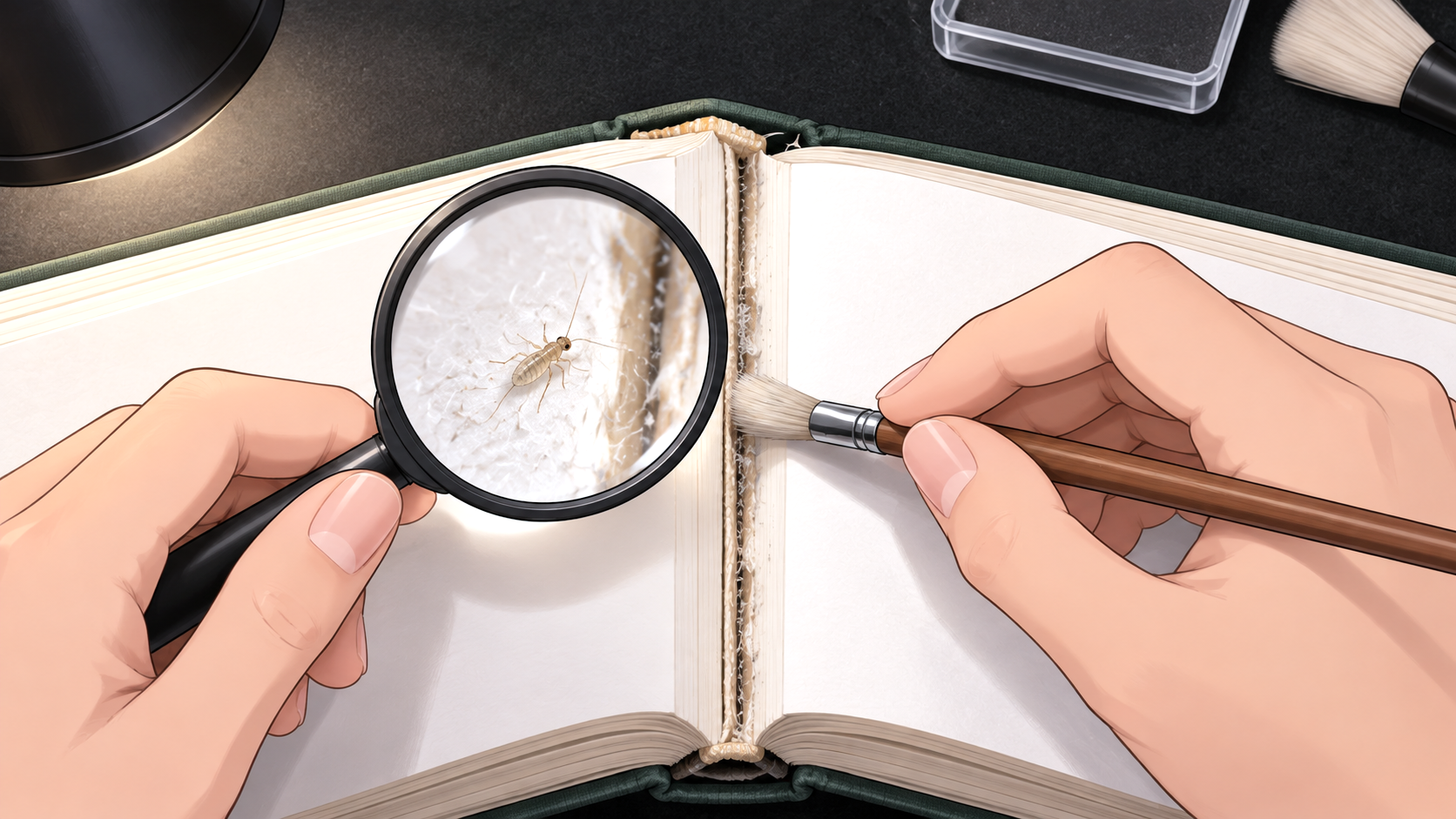
To check a book for booklice, inspect it under bright light over a clean, pale surface and focus on the spine, cover joints, page edges, endpapers, binding gaps, and damp or mold-prone areas. Live moving insects are much more useful for identification than random specks, stains, or isolated white particles.
Begin With the Closed Book
Set the book on white paper, a pale tray, or another plain surface where anything crawling away will be easy to spot. Examine the fore-edge, top edge, bottom edge, corners, spine, hinges, and the space beneath a removable dust jacket before opening the cover. Common household booklice are extremely small, often around 1 to 2 millimeters long, and their soft body, long antennae, and relatively broad head can be difficult to resolve without magnification. Slow movement is often easier to notice than body details.
Books provide several protected recesses that can conceal insects even when the visible cover appears clean. Psocids associated with collections are known to exploit books, manuscripts, paper products, cardboard, and similar organic materials, particularly where moisture and fungal growth are present. If the volume arrived inside a cardboard box, inspect the box separately because the container may be the source.
Inspect the Hinges, Endpapers, and Spine Gaps
Open the front and rear covers carefully and inspect the endpapers, inner hinges, pastedowns, and any accessible gap between the text block and the spine. These areas stay relatively undisturbed and can collect dust, fungal material, and residues from adhesives. Booklice can feed on mold and starch-containing binding glue, so the binding structure is more informative than the middle of a random clean page.
Use a hand lens or phone macro camera if available. Do not pry open a tight spine, pull apart glued components, or flatten an old binding to see deeper. Conservation guidance for handling and caring for books favors careful support rather than forcing fragile structures. Rare, brittle, or valuable volumes should be inspected only as far as they open naturally.
Fan the Page Edges and Watch for Movement
For a sound modern book, gently fan small groups of pages while holding the volume over the pale inspection surface. Watch the inner gutters as well as the exposed page edges. A concealed booklouse may begin moving when its hiding place is disturbed, making it easier to recognize than when it remains still among dust and paper fibers.
There is usually little benefit in turning every page individually unless insects or damage seem concentrated deeper in the book. Ordinary debris can easily be mistaken for a pest when magnified. Booklice may appear translucent, whitish, gray, tan, or brown, so matching a speck by color is not enough. A suspected specimen should show movement and insect anatomy rather than simply resembling a tiny dot.
Use the Damage Pattern to Rule Out Other Pests
A book with insects and visible damage needs two separate questions answered: what is the insect, and what caused the damage? Booklice normally graze surfaces rather than excavating deeply through a text block. Conservation guidance describes psocid feeding as superficial rather than hole-boring damage.
Large holes passing through many pages, tunnels, heavy edge loss, or substantial missing paper are therefore poor matches for ordinary booklice activity. The damage booklice can cause to books is generally subtler and may involve susceptible starches, contamination, or staining rather than extensive removal of paper.
Check the Book for Moisture Clues at the Same Time
Inspection should include the condition of the book itself. Look for water staining, rippled pages, softened boards, swollen text blocks, visible mold, or evidence that the volume has been stored somewhere damp. Mold examination procedures for collections specifically emphasize covers, spines, and the text block, which are also useful places to look for booklice.
A musty odor can justify closer examination but is not proof of insects. Booklice can consume microscopic fungal material that may not yet be visibly obvious, so a book can support them without showing a large fuzzy mold patch. A history of basement storage, water damage, high humidity, or prolonged contact with damp cardboard increases the relevance of these clues.
Do Not Rely on Eggs as Your Main Evidence
Booklice eggs are difficult to use during a routine book inspection. They are extremely small, pale, and generally laid individually rather than in a conspicuous mass. Some can also be obscured by debris. The appearance of booklice eggs overlaps too much with ordinary particles for an isolated white speck to confirm an infestation.
Adult and nymph movement is far more informative. Finding insects of noticeably different sizes can suggest that more than one life stage is present, especially when very small booklice nymphs occur alongside larger individuals in the same binding or storage area.
Do Not Use Droppings as a Diagnostic Shortcut
Booklice do produce waste, but their feces are not a practical household identification sign. Tiny dark or pale particles in an old book may be dust, mold, degraded adhesive, paper fragments, material from another insect, or ordinary dirt. Their droppings do not have a dependable visual pattern that identifies booklice.
A live specimen is more useful than debris. If possible, collect the insect intact in a small container or with a fine brush. Avoid crushing it onto the page because smearing a tiny insect removes many of the features needed for identification.
Inspect the Shelf, Box, and Adjacent Books
One booklouse on a book does not prove that the book itself is the breeding source. Check the shelf beneath and behind it, adjoining books, nearby cardboard, the wall behind the collection, and any location affected by condensation or leakage. The insects may be moving onto the volume from a damp surface nearby.
Several neighboring books containing adults and nymphs provide stronger evidence of a local population than one wandering individual. The broader signs of a booklice infestation become more useful once activity extends beyond one isolated specimen.
This wider check is particularly relevant for newly acquired collections. Library and used books can occasionally transport booklice when insects or eggs are concealed in bindings, boxes, or associated paper materials, but a single transported insect may never establish if the new environment is dry.
Keep a Suspect Book Separate Until You Know What You Found
If you confirm booklice in an ordinary book, temporarily keeping it away from the rest of the collection can make further inspection easier and reduce immediate dispersal. Do not spray the pages or binding with household insecticide, bleach, rubbing alcohol, essential oils, or similar liquids. Such treatments may stain, weaken, or chemically alter paper, inks, leather, and adhesives.
The surrounding environment deserves equal attention because booklice depend heavily on moisture. For collections, relatively dry storage reduces both the insects and the fungal growth they use as food. Library of Congress guidance recommends cool, clean book storage with controlled relative humidity.
The broader measures for preventing booklice around stored books are most relevant when several volumes share the same humid shelving or storage area.
Questions About Inspecting Books for Booklice
Can you see booklice without magnification?
Often yes, especially when they are moving against a contrasting surface, but their small size makes detailed identification easier with a hand lens or macro camera.
Can booklice hide inside the spine?
They can occupy narrow binding gaps and protected joints if the environment is suitable, although forcing a spine apart to inspect it can damage the book.
Should you shake a book over white paper?
Gentle handling may dislodge mobile insects, but forceful shaking is unnecessary and can damage weak bindings. Slow fanning and visual inspection are safer.
Can booklice hide under a dust jacket?
Yes. A dust jacket creates a sheltered gap where insects, dust, and fungal material can accumulate, so it should be removed and inspected separately when possible.
Does one booklouse mean the book is infested?
No. One insect may have wandered onto the book or arrived with another object. Repeated sightings, multiple life stages, and favorable moisture conditions provide stronger evidence of reproduction.
Can a clean-looking book still contain booklice?
Yes. Booklice and their fungal food can be extremely inconspicuous. A clean exterior does not rule out insects hidden in the binding or a history of humid storage.
Should you inspect the cardboard box the books came in?
Yes. Damp cardboard can support booklice independently of the books and may be the actual source of insects found on newly unpacked volumes.