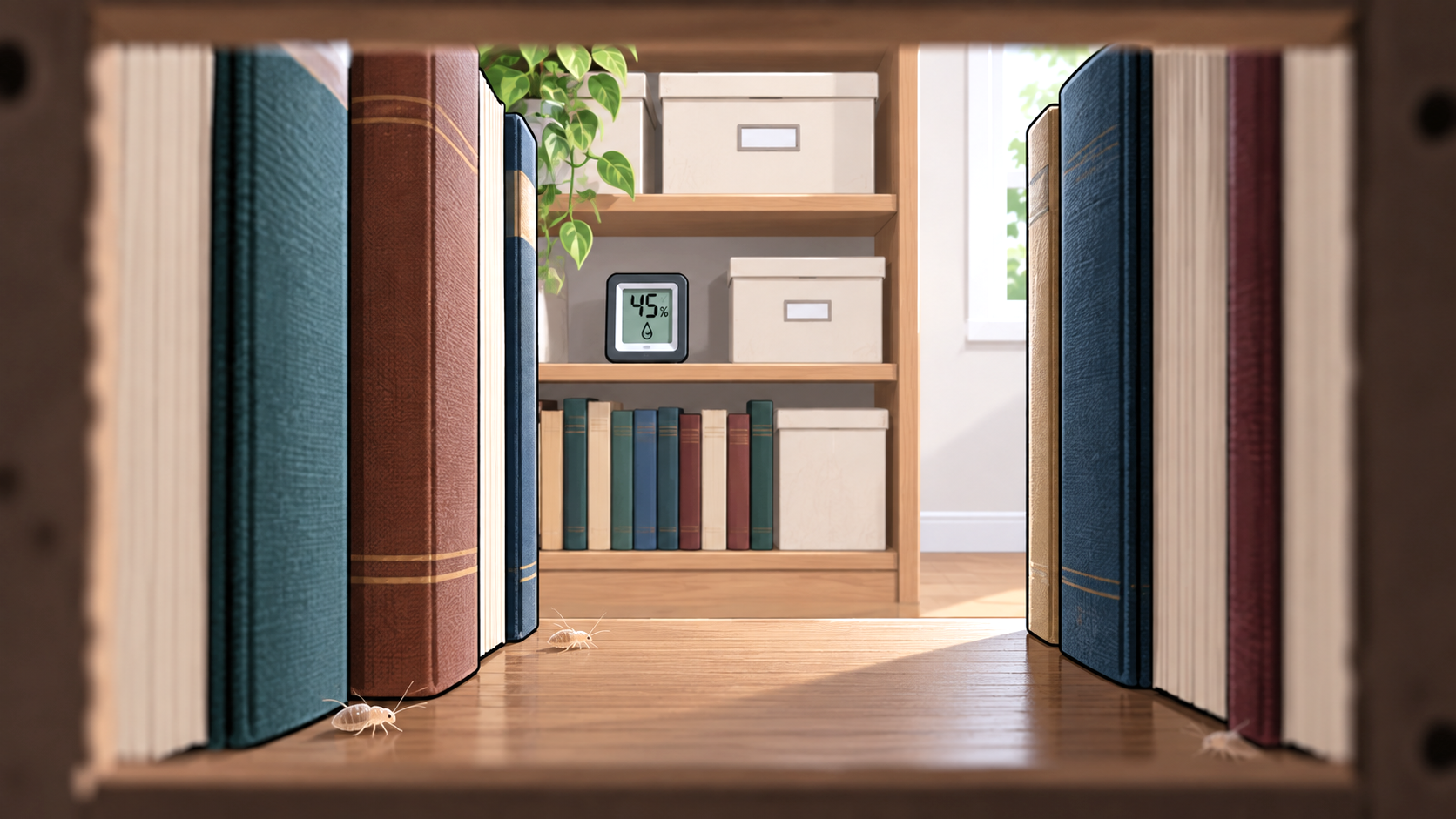
Booklice have an unfortunate name because it makes books sound like the source of the problem. Usually, they are not. A bookshelf becomes attractive to booklice when the surrounding environment provides enough moisture and suitable food, particularly microscopic fungi.
To prevent booklice from getting into your books, keep the collection dry, provide airflow around shelves, avoid storing books against damp walls or floors, and inspect incoming used books and boxes. Indoor booklice struggle under sustained dry conditions, so controlling humidity is considerably more effective than spraying books with pesticides or household remedies.
Start With the Humidity Around Your Books
The most useful booklice prevention tool is a hygrometer.
Booklice are strongly associated with humid environments. They commonly feed on molds and fungi, which is one reason damp books and paper storage can become favorable habitat. Household guidance recommends reducing moisture because psocids do not survive when relative humidity remains below roughly 45% to 50%. Penn State similarly recommends keeping relative humidity below 50% to prevent mold growth and booklouse development.
For an ordinary household collection, however, we would not chase the lowest possible humidity just to deter an insect. Books contain paper, adhesives, leather, cloth, and other materials that respond to changes in moisture. Conservation guidance recommends a stable environment and identifies approximately 45% to 55% RH as suitable for leather-bound books.
That gives you a practical target. Keeping a book collection around 45% to 50% RH, without large swings, creates poor conditions for booklice while remaining reasonable for many books.
If humidity repeatedly rises above that range, investigate why. A dehumidifier can help with booklice when the problem is humid indoor air, but it cannot repair a plumbing leak or water entering through a wall.
Your Books Need Air Around Them
Where you put a bookshelf matters almost as much as the room’s overall humidity.
A shelf pushed tightly against a cold or damp exterior wall can develop a different microclimate from the rest of the room. Poor airflow makes it harder for moisture to dissipate, particularly behind tightly packed books. Condensation or an unnoticed leak can make that hidden area even more suitable for fungi and booklice.
Leave some breathing room where practical. Conservation guidance recommends not storing books directly against the back of a bookshelf, partly because doing so reduces low-airflow microclimates. Books also should not be packed so tightly that removing or inspecting them becomes difficult.
This does not mean every book needs a large gap around it. The goal is simply to avoid creating stagnant, damp pockets that go unnoticed for months.
If you find booklice repeatedly concentrated behind one shelf, check the wall itself. The insects may be revealing a moisture problem rather than a problem with the books.
Keep Books Off Damp Floors
Floor-level storage creates another preventable risk.
Boxes of books placed directly on basement, garage, or other potentially damp floors can encounter moisture from condensation, seepage, minor flooding, or the floor itself. Cardboard can absorb that moisture and hold it around the books.
Booklice can become a problem when stored cardboard gets wet, and the same guidance recommends storing books, papers, boxes, and bags off the floor.
Shelving provides separation and makes inspection easier. It also prevents a small water event from immediately soaking the bottom layer of a collection.
We would be particularly cautious with long-term book storage in basements, attics, sheds, and garages. These spaces can experience larger temperature and humidity fluctuations than the occupied parts of a home. Conservation guidance specifically warns that basements, attics, and garages can be poor environments for books.
Do Not Put Damp Books Back on the Shelf
A book does not have to arrive with booklice to create favorable conditions for them later.
Books can become damp through flooding, leaks, condensation, spills, or storage in humid conditions. Putting a damp book into a tightly packed shelf traps that problem beside other books.
Dry an accidentally wet book promptly and appropriately before returning it to the collection. For a relatively minor wetting event, conservation guidance recommends increasing air circulation while keeping heat low. More serious water damage requires greater care because mold can begin developing rapidly on wet books.
Large, valuable, rare, or extensively wet collections are different from an ordinary paperback that received a small splash. Professional conservation assistance is appropriate when drying the material incorrectly could cause substantial damage.
Preventing persistent dampness matters because booklice and mold are closely connected. A wet book should therefore be treated as a moisture problem before it becomes a pest problem.
Inspect Used Books Before Adding Them to Your Collection
Secondhand books deserve a quick inspection before they disappear into a crowded shelf.
Look along the covers, spine, page edges, endpapers, and protected gaps around the binding. You are not only looking for booklice. Mold, water staining, active insects, insect debris, and a musty condition can all justify keeping the book separate until you understand what is happening.
Booklice are tiny. Common indoor forms are often only about 1 to 2 millimeters long, so good lighting helps. Knowing what booklice actually look like also reduces the chance of confusing them with mites, springtails, or other tiny arthropods.
Pay attention to the box or bag carrying the books as well. Damp cardboard can harbor booklice, and bringing an old moving box straight into a humid storage room creates an avoidable opportunity for introduction.
You do not need to treat every secondhand book as contaminated. A brief inspection and sensible separation when something looks suspicious are enough for routine purchases.
Be More Careful With Books Coming From Damp Storage
A clean-looking book can still deserve extra attention when you know its history.
Books from a dry, climate-controlled home present a different situation from boxes that have spent years in a damp basement, garage, shed, storage locker, or poorly ventilated warehouse. Booklice can arrive with belongings, while suitable humidity determines whether they can persist after arrival.
If a batch comes from questionable storage, inspect it before combining it with the main collection. Keep suspicious material separate while you determine whether insects are active.
For genuinely infested books, isolation also prevents insects from dispersing immediately into surrounding material. Conservation pest-management guidance includes bagging or otherwise isolating infested objects as part of managing collection pests.
Do not permanently seal a damp book in plastic as a preventive measure. Trapping moisture with the object can create exactly the humid microenvironment you are trying to avoid.
Clean Shelves Without Turning Books Into a Chemistry Experiment
Dust and debris should not be allowed to accumulate indefinitely behind a collection.
Periodically remove enough books to inspect the shelf, corners, wall, and surrounding area. Look for moisture staining, mold, condensation, insects, and leaks. Conservation guidance recommends good housekeeping and regular inspection and dust removal from shelving.
Vacuuming accessible insects is also an established physical control for psocids. If you find only a few, physical removal combined with drying may be all that is required.
What we would not do is routinely spray shelves and books with vinegar, bleach, rubbing alcohol, essential oils, or insecticide as preventive maintenance. Those treatments are unnecessary in a dry collection, and applying liquids to books introduces its own material risks.
The same applies to scattering powders between pages. Diatomaceous earth can kill booklice, but that does not make coating books in fine dust a sensible preventive strategy.
Books Do Not Need to Be Sterilized
Trying to make every incoming book completely insect-free can lead to more aggressive treatment than the risk justifies.
Booklice do not need books specifically. They can occur around paper, cardboard, stored foods, walls, cabinets, and numerous other locations where moisture and suitable food exist. Their name reflects where people commonly encounter them rather than a biological dependence on books.
They also do not normally chew large holes through pages. Their feeding on collection materials is generally described as surface grazing rather than boring holes. Large populations can still be undesirable, and the damp conditions accompanying them pose a separate threat to books.
Prevention therefore works better when the collection is treated as an environment rather than every book as a potential infestation.
Keep that environment dry, stable, clean, and inspectable.
Watch the Books You Rarely Touch
The forgotten end of a bookshelf deserves more attention than the novel beside your bed.
Booklice favor damp, warm, undisturbed places. Books that remain untouched for years can hide activity simply because nobody looks behind or beneath them.
Occasionally inspect long-term storage and rarely handled shelves. You do not need to pull apart the entire collection every week. Periodic checks are enough to reveal moisture staining, mold, insects, or a deteriorating storage environment before the problem becomes extensive.
Protective enclosures can be appropriate for valuable or fragile material. Properly designed enclosures can buffer books from environmental fluctuations, but they do not replace humidity control in the room.
If booklice suddenly appear in a collection that has been trouble-free for years, look for what changed. A plumbing leak, unusually humid season, failed dehumidifier, new batch of stored books, wet cardboard, or altered ventilation can matter more than the bookshelf itself.
A Simple Prevention Routine Is Usually Enough
You do not need pesticide-treated shelves or elaborate traps to keep booklice away from books.
Monitor the humidity where the books actually sit rather than relying on how the room feels. Keep the collection off potentially damp floors, avoid stagnant storage against damp surfaces, and correct leaks or condensation quickly. Inspect secondhand books and suspicious boxes before mixing them into the collection, and periodically look behind books that rarely move.
Those habits remove the conditions booklice need without exposing books to unnecessary treatments.
If you already have active insects rather than trying to prevent them, switch from prevention to getting rid of booklice in books. Prevention becomes much easier once the existing population and its moisture source have been dealt with.
Questions About Keeping Booklice Out of Books
Should I keep books in plastic containers to prevent booklice?
A clean, dry container can provide physical protection, but the books must already be dry before storage. Sealing moisture inside with a book can encourage mold and create unfavorable storage conditions. For valuable collections, use storage materials appropriate for book conservation rather than choosing a container solely because it is airtight.
Can booklice get into books stored on a high shelf?
Yes. Raising books off the floor reduces exposure to floor-level dampness and water events, but it does not create an insect barrier. Booklice can occur on elevated shelves when humidity and food conditions are suitable.
Should I put silica gel beside my books?
Silica gel can help control humidity inside appropriately designed enclosed spaces, but a few packets are not a substitute for controlling the humidity of an entire room. For open bookshelves, measure room conditions and address the actual moisture source.
Do booklice mean I need to throw my books away?
Usually not. Finding booklice does not automatically mean a book is ruined. The insects are often more important as a warning of excessive moisture. Isolate genuinely infested material when necessary, correct the environment, and choose a treatment appropriate to the value and condition of the books.