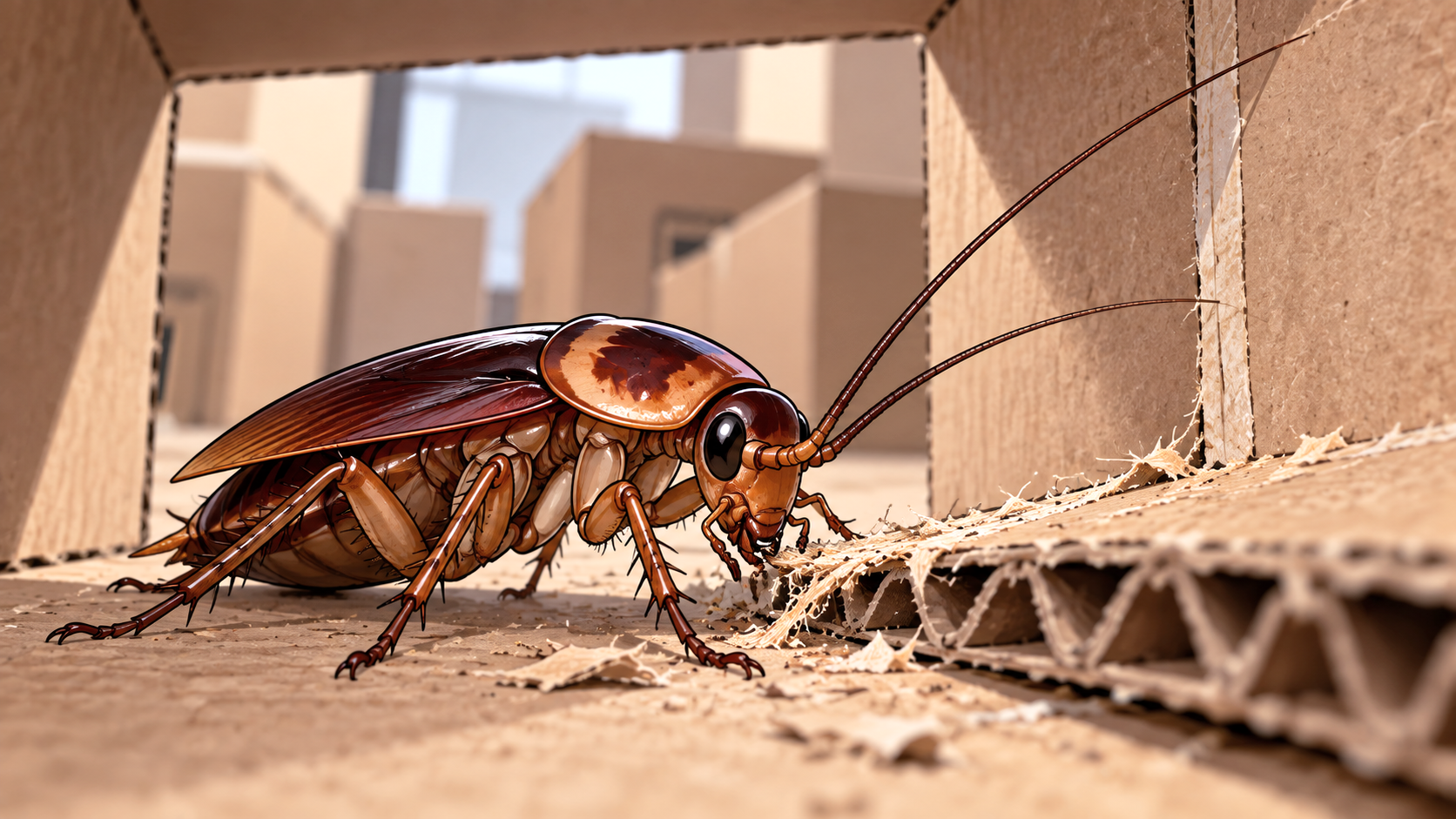
A chewed cardboard box does not necessarily mean cockroaches are living on cardboard. Paper products can offer them several things at once: digestible components, food contamination, and the narrow sheltered spaces many cockroaches readily occupy. Those possibilities need to be separated before blaming the paper itself.
Cockroaches can feed on paper and cardboard, but plain cellulose is not necessarily what attracts them most. Starch sizing, adhesives, paste, grease, food residue, and other organic material can make paper products more useful as food. Corrugated cardboard can also provide excellent shelter even when little or no feeding occurs.
The Edible Part May Not Be the Paper Fiber
Paper and cardboard consist largely of processed plant fibers rich in cellulose. Cockroaches have some capacity to process cellulose, although that ability varies among species and is not equivalent to preferring paper as food. American cockroaches have demonstrated cellulolytic activity within the hindgut, while German cockroach nymphs can obtain some nutritional benefit from cellulose when more readily digestible carbohydrates are limited. Experiments with German cockroaches found cellulose digestion could supplement carbohydrate intake.
Manufactured paper can contain more accessible substances than cellulose alone. Starch has long been used in paper sizing and bookbinding, while glues and pastes may contain materials cockroaches can exploit. American cockroaches are documented feeding on starch in bookbindings, manuscripts, glue, and starch-sized glossy paper. Brown-banded cockroaches may likewise consume starch, paste, and some animal-derived glues, sometimes damaging stamps, envelopes, older bookbindings, wallpaper, and similar materials.
Those examples fit within the unusually broad diet of household cockroaches without making clean paper their preferred food.
Food-Stained Cardboard Is a Different Resource
A pizza box, takeout container, grocery carton, or food-storage box may contain grease, crumbs, sugars, starches, and other residues. A cockroach feeding on that material cannot automatically be described as eating cardboard for its cellulose. It may be exploiting the food embedded in or coating the surface.
This becomes especially relevant in kitchens, restaurants, storerooms, recycling areas, and anywhere boxes are reused for food storage. Cockroaches are generalist feeders capable of adjusting consumption according to available nutrients, and German cockroaches have been shown to regulate protein and carbohydrate intake rather than feed completely indiscriminately. A greasy corrugated box therefore offers a very different feeding opportunity from a clean sheet of untreated paper.
Cardboard Can Be Valuable Without Being Eaten
Corrugated cardboard contains parallel channels, folds, seams, and tight spaces between layers. Those physical features can function as harborages. Cockroaches favor confined spaces where much of the body can contact surrounding surfaces, so stacked boxes and corrugated material can create useful shelter independently of their nutritional value.
The association is strong enough that corrugated cardboard is routinely used as harborage in laboratory cockroach colonies. Published German cockroach experiments have maintained populations in containers with corrugated cardboard rolls serving specifically as harborages, while other controlled colonies similarly use corrugated cardboard alongside separate food and water sources. A cockroach hiding inside a box therefore provides no evidence by itself that it has been feeding on the box.
Cardboard can also create sheltered transport. Boxes moved between warehouses, stores, workplaces, apartments, and homes contain folds where cockroaches or their egg cases can remain concealed. A new appearance of cockroaches inside a home may consequently involve transported packaging rather than insects being drawn to the chemical composition of cardboard from elsewhere.
Books, Wallpaper and Stored Papers Can Show Feeding Damage
Paper-related feeding becomes easier to recognize when the material contains paste, starch, glue, or accumulated organic residue. Damage may appear as irregular scraping, superficial chewing, roughened edges, or small missing areas. It should not automatically be interpreted as proof of cockroaches because silverfish, booklice, termites, and several beetles can also occur around stored paper products.
The surrounding evidence deserves equal weight. Droppings, cast skins, oothecae, live insects, and repeated sightings provide a much stronger basis for attributing damage to cockroaches. The appearance of cockroach shed skins differs from paper fragments, while cockroach egg cases may remain attached to protected surfaces or concealed among stored materials depending on the species.
Paper Feeding Is Not the Same as Wood Destruction
Paper and lumber both originate from plant material, but cockroach interaction with one should not be used to infer what happens to the other. Processed paper may contain starches, adhesives, coatings, food contamination, and exposed fibers that differ considerably from sound structural timber. Although some cockroaches can digest cellulose, common household species are not equivalent to termites or specialized wood-feeding insects. Cockroach activity around structural wood therefore needs a different interpretation from feeding marks on a pasted bookbinding or food-stained carton.
American cockroaches can even survive experimental diets containing substantial lignocellulosic material, and their gut microbial communities change when they are fed cellulose-rich diets. Researchers have demonstrated consumption of crystalline cellulose and sugarcane bagasse by American cockroaches. That physiological flexibility does not turn household cockroaches into structural wood pests.
Questions About Cockroaches and Paper Products
Should I throw away every cardboard box if I find cockroaches?
Not automatically. Boxes containing cockroaches, oothecae, droppings, or heavy contamination should be handled as potentially infested material, while clean boxes elsewhere do not become infested merely because they are cardboard. Reducing unnecessary corrugated packaging can remove convenient hiding spaces.
Can cockroaches damage books?
They can damage paper products when suitable materials such as starch, paste, glue, or other edible residues are present. Older bindings and pasted materials may be more attractive than clean modern paper. Other paper-associated pests can cause similar damage, so chewing alone does not identify the insect responsible.
Can cockroaches hide inside unopened boxes?
They can occupy seams, folds, gaps beneath flaps, and corrugations accessible from outside. Whether they can reach the contents of a particular unopened package depends on how completely it is sealed rather than simply whether the box appears closed.
Does seeing cardboard with cockroach droppings mean they ate it?
No. Droppings show that a cockroach used or passed through the area, not what it consumed there. Combining fecal evidence with other signs of a cockroach infestation gives a more reliable picture than interpreting damage or stains alone.