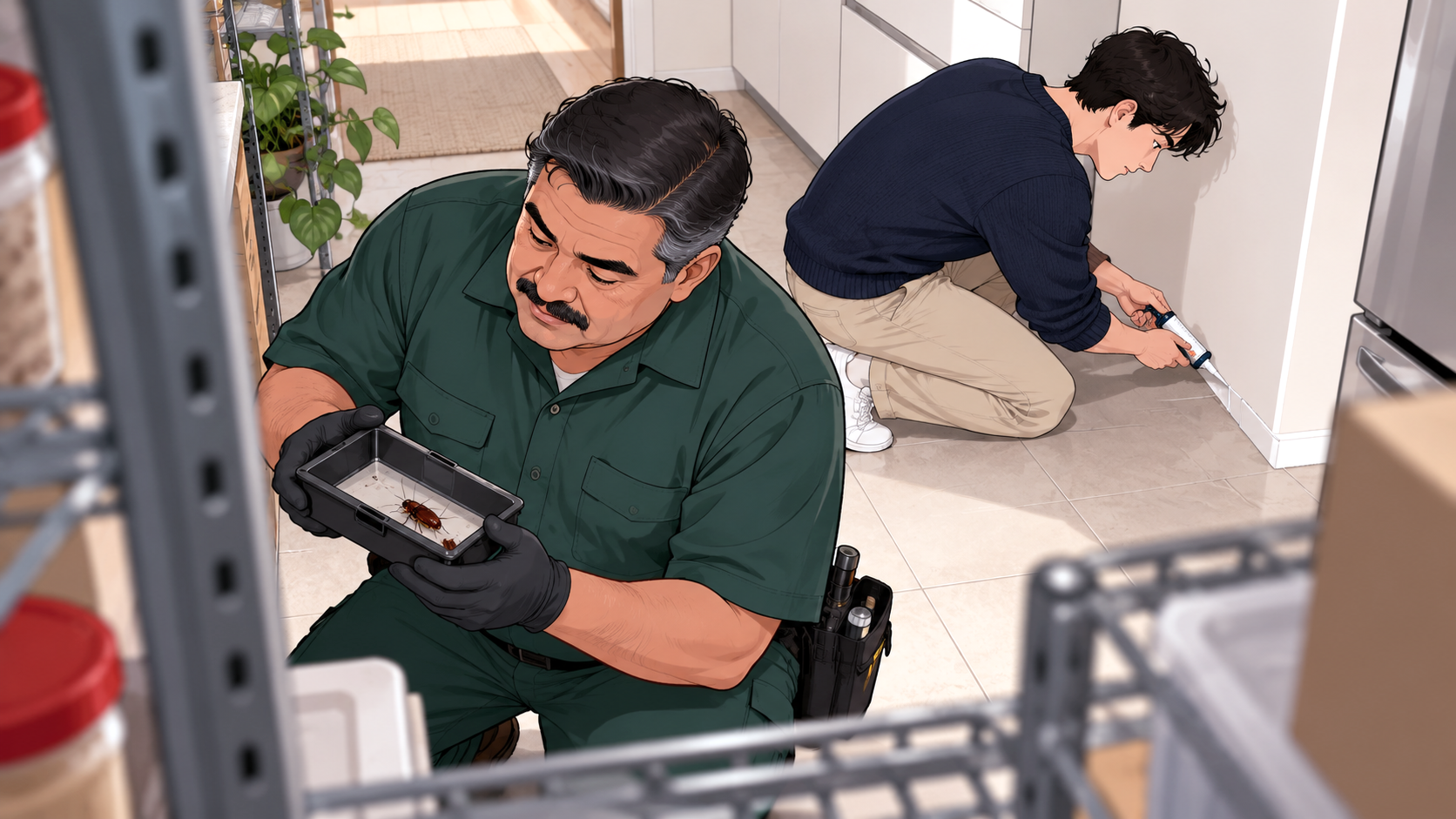
Professional pest control can eliminate a cockroach infestation, including difficult German cockroach populations, but “for good” depends on what happens after elimination. Research in occupied apartments has documented complete elimination in many treated units. A home can still become infested again later if cockroaches are reintroduced or move in from another unit.
A successful service therefore has two separate outcomes to consider. The first is eliminating the population already established in the property. The second is preventing a new population from gaining access after treatment has ended.
Complete Elimination Is Possible, Not Just Population Reduction
Professional cockroach control is sometimes described as though technicians can only suppress an infestation indefinitely. Field evidence shows otherwise. In a 15-month assessment-based pest management program conducted in U.S. public housing, German cockroach populations fell by more than 90% overall and infestations were eliminated from 49 of 65 treated apartments.
Other housing studies have produced similarly large reductions. A community-wide program involving licensed pest-management professionals used monitoring, gel bait, boric acid dust, resident education, and treatment adjustments based on trap catches. After 12 months, average trap counts had fallen by more than 98% in the professionally treated group. A separate seven-month program eliminated 85% of the cockroach infestations identified at the beginning.
Those results also show why elimination cannot be reduced to a single pesticide application. Cockroach control works more reliably when treatment responds to the actual population. Inspection identifies active locations, monitoring measures abundance, targeted products affect the insects, and subsequent checks determine whether further treatment is necessary. The CDC describes this continuing measurement and evaluation as a critical component of integrated pest management.
The First Treatment May Not Be the Last One
A professional visit can produce a steep decline without immediately bringing trap counts to zero. Cockroaches may occupy numerous concealed harborages, and egg cases can complicate the timing of control because the developing nymphs are enclosed until they hatch. Continued captures after the initial service therefore need to be interpreted according to their trend, location, life stage, and the treatment that was applied.
Follow-up allows the technician to treat remaining activity rather than repeating the original service automatically. In a seven-month comparison of building-wide approaches, both bait-only treatment and integrated pest management produced large reductions, but apartments were monitored repeatedly and received additional treatment when necessary. The integrated program ultimately left fewer apartments with high infestation levels.
Monitoring is especially useful because visible sightings alone provide an inconsistent measure of progress. Professionally placed or properly positioned cockroach monitoring traps can show whether catches are declining between visits. A few insects appearing shortly after treatment do not prove failure if the measured population is collapsing, while persistent or rising catches warrant reassessment.
Successful Pest Control Does Not Require Spraying Everything
The strongest professional programs do not depend on coating every accessible surface with insecticide. German cockroach IPM can combine monitoring, sanitation, exclusion, vacuum removal where appropriate, and carefully selected pesticide placements. One year-long apartment study found that an IPM program using gel bait and sticky traps as its primary treatment methods reduced mean indoor insecticide residue concentrations by 74%.
Gel bait is particularly useful because small placements can be positioned near active harborages instead of requiring broad surface treatment. How cockroach bait and gel work also differs from contact treatments because cockroaches must feed on the formulation. Professionals can adjust placement and quantity as monitoring reveals where activity remains.
Room-wide pesticide release is not evidence of a more thorough service. Total-release foggers perform poorly against established German cockroach infestations, despite distributing insecticide over large areas. Precision, access to harborages, appropriate products, and follow-up have greater practical value than simply increasing the amount of pesticide used.
Some Infestations Take Longer Because the Cockroaches Are Harder to Treat
German cockroach populations can differ substantially in their susceptibility to insecticides. Resistance has developed to multiple insecticide classes, so a treatment that performs well against one population may produce weaker results against another. Product labels for professional cockroach baits can consequently include specific insecticide-resistance management instructions, including rotation among appropriate insecticide groups and incorporation into an IPM program.
Behavior can also affect bait performance. A cockroach must encounter and consume enough bait for the treatment to work, and food elsewhere in the property can compete with bait. Heavy populations spread across numerous harborages create another challenge because more locations must be found and treated.
Persistent activity should therefore trigger investigation rather than an assumption that cockroaches are impossible to eliminate. Repeated signs of an active cockroach infestation can help identify areas that need renewed inspection, while continuing captures around appliances that provide protected harborages may reveal activity that an earlier treatment did not fully reach.
Reinfestation Is Different From a Population Surviving Treatment
Suppose monitoring eventually reaches zero and remains there, then cockroaches appear months later. That does not necessarily mean the original population survived unnoticed. Cockroaches can be brought into a property with belongings or goods, and in multi-unit buildings they can disperse between connected residences.
Building-wide research makes the apartment issue particularly clear. Investigators studying a 188-unit high-rise found that German cockroach infestations were spatially associated before treatment. Building-wide IPM reduced infestations and also reduced cockroach dispersal between units. Treating connected infestations therefore accomplished something that repeated treatment of one isolated apartment could not.
Residents dealing with recurring apartment activity need to consider whether cockroaches are originating inside their unit or elsewhere in the building. Sealing suitable penetrations, correcting plumbing and structural defects, monitoring adjoining areas where possible, and coordinating treatment across affected units can be necessary to keep a cleared apartment from being recolonized.
Detached homes remove much of that neighboring-unit pressure, but introductions can still occur. Eliminating an infestation does not create a permanent barrier against every cockroach that may enter the property in the future.
Conditions Inside the Property Affect How Long Control Lasts
Cockroaches need access to food, water, shelter, and suitable hiding places. Pest control can eliminate the insects already present while leaving some of those resources unchanged. Federal IPM guidance recommends sealing food and garbage, correcting water sources such as leaking plumbing, and reducing the conditions that allow household pests to persist.
Professional service is more durable when those environmental conditions are addressed alongside treatment. Grease behind cooking equipment, persistent plumbing leaks, open food, accumulated clutter, damaged seals around pipes, and structural gaps can all make a property easier for a new population to occupy. Preventive work after elimination overlaps with keeping cockroaches from returning rather than extending pesticide applications indefinitely.
Sanitation alone is not proof that a home will never develop cockroaches, and an infestation should not automatically be interpreted as evidence of poor housekeeping. Even well-maintained properties can receive introduced cockroaches. Removing resources simply makes the environment less supportive and improves the effectiveness of an integrated control program.
How Professionals Decide an Infestation Is Under Control
The disappearance of daytime sightings is not enough. Cockroaches are frequently concealed when people are active, so a technician needs more objective evidence before concluding that treatment has succeeded.
Sticky monitors placed in consistent locations can reveal whether activity continues near refrigerators, stoves, sinks, cabinets, bathrooms, and other previously active sites. Assessment-based professional programs have used overnight trap counts both to determine treatment intensity and to verify subsequent population reduction. A sustained absence of catches across previously active monitoring locations provides stronger evidence than simply going several nights without seeing a cockroach.
Physical evidence also needs context. Old droppings and empty egg cases can remain after the insects are gone, so cockroach droppings found in an untreated crevice do not automatically prove current activity. Fresh captures, newly appearing fecal material, live nymphs, and continuing sightings carry more weight when evaluating whether a population remains.
When the Same Cockroaches Keep Appearing After Professional Treatment
Do not immediately add your own sprays, foggers, powders, or repellents between professional visits. Tell the technician what you are seeing, where it occurs, and when it started. Uncoordinated pesticide use can complicate an existing treatment program, especially when bait is part of it.
Record the locations of sightings and monitor catches so the follow-up visit has useful evidence. Activity concentrated in one previously untreated cabinet calls for a different response from cockroaches appearing throughout several rooms. Baby cockroaches appearing repeatedly can also help establish that immature stages remain active rather than every sighting representing an occasional intruder.
If professional treatment continues without measurable improvement, ask how the company is monitoring the infestation, what active ingredients or methods have been used, whether resistance or inaccessible harborages are suspected, and whether adjacent units require inspection. The purpose of follow-up is to change the response when the evidence changes, not to repeat an ineffective procedure indefinitely.
Questions About Keeping a Home Cockroach-Free
Can cockroaches return years after successful extermination?
Yes. A completely new introduction can occur long after the original infestation was eliminated. The length of the cockroach-free interval does not make a property permanently immune to future introductions.
Do you need permanent monthly pest control after cockroaches are gone?
Not every property does. Continued service depends on building conditions, reinfestation pressure, the service agreement, and whether monitoring continues to detect activity. A detached home with a resolved infestation presents a different situation from a large apartment building with recurring infestations in neighboring units.
Can one untreated apartment keep reinfesting treated apartments?
It can contribute to continuing building-wide problems when cockroaches can disperse through connected spaces. Coordinated inspection and treatment become more important when several nearby units are affected.
Should you keep using cockroach bait after professional treatment ends?
Follow the pest-management company’s instructions and the product label rather than adding pesticides indefinitely as insurance. Nonchemical prevention and periodic monitoring can reveal renewed activity without maintaining unnecessary pesticide applications.