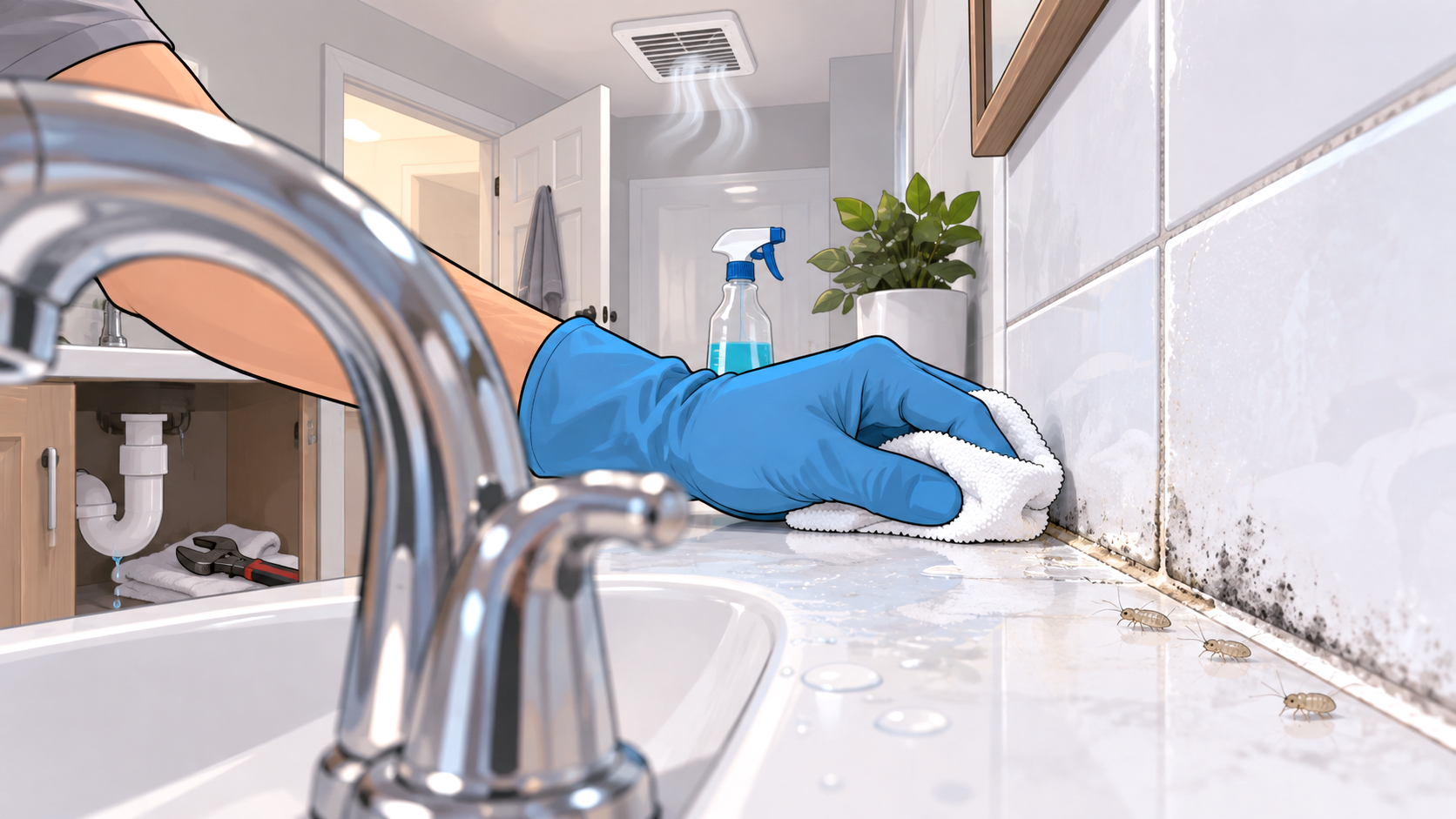
A bathroom gives booklice almost everything they need. Showers and baths repeatedly raise humidity, condensation wets cool surfaces, plumbing provides opportunities for slow leaks, and poorly ventilated corners can stay damp long enough for microscopic fungi to grow. If booklice keep appearing around the sink, tub, window, toilet, or bathroom cabinets, moisture should be the first suspect.
To get rid of booklice in the bathroom, keep relative humidity below about 50%, run the exhaust fan during and after showers, dry wet surfaces, repair plumbing leaks, improve airflow, vacuum visible insects, and investigate persistent dampness around cabinets, walls, and fixtures. Once the bathroom stays dry, booklice usually cannot maintain an indoor population. The insects themselves are rarely the difficult part. The challenge is finding the small area that keeps getting wet.
Why Booklice Like Bathrooms
Booklice prefer warm, damp environments and commonly feed on molds and other fungi. Bathrooms regularly produce both warmth and moisture, particularly when steam from showers remains trapped in the room.
They can occur around leaking or sweating pipes, cracks, voids, cardboard, and other places where moisture supports fungal growth. That makes bathrooms a particularly believable place to encounter them even though the name “booklice” suggests they should be somewhere near books.
A persistent bathroom population is therefore one of the signs of booklice that should prompt a moisture inspection. The insects are not appearing because they eat soap, tile, porcelain, or bathroom fixtures.
First, Make Sure They Are Booklice
Tiny insects in a bathroom are not automatically booklice. Springtails, drain flies, ants, silverfish, mites, and other small arthropods can occur in damp rooms, and some require completely different control methods.
Common indoor booklice are tiny, soft-bodied insects with long, slender antennae and relatively broad heads. Many are only around 1 to 2 millimeters long, so a hand lens or close photograph can make identification much easier.
Movement is another useful clue. Booklice generally crawl. If the tiny insects noticeably spring away when disturbed, compare them with springtails rather than booklice. Correct identification should come before treating drains, walls, or plumbing.
Lower the Bathroom Humidity
Reducing humidity is the most important step.
Booklice do poorly when relative humidity remains sufficiently low. Keeping humidity below approximately 45% to 50% is recommended for household control, and sustained dryness also limits the molds and fungi that provide much of their food.
Use a small digital hygrometer to see what happens before and after a shower. A bathroom may sit at a reasonable humidity level for most of the day but become extremely humid during bathing and remain that way for hours afterward. That repeated cycle can maintain damp microenvironments around trim, cabinets, windows, and other protected locations.
Reducing moisture is considered the most effective way to manage indoor booklice. Their strong dependence on humidity is also why repeatedly killing visible insects without drying the bathroom rarely solves the problem.
Run the Bathroom Exhaust Fan Properly
An exhaust fan can make a major difference because bathing itself produces substantial indoor moisture. The important part is getting that moist air out of the bathroom rather than merely moving it around.
Run the exhaust fan while showering or bathing and continue ventilating afterward until the room has dried. Check that the fan actually moves air effectively and exhausts as intended. A clogged, weak, incorrectly installed, or unused fan can leave steam lingering on walls and ceilings.
Bathrooms with recurring mildew are already showing a symptom of excessive moisture. General home-moisture guidance recommends installing, inspecting, and repairing bathroom exhaust fans when moisture is a problem.
If the bathroom has no effective mechanical ventilation, another appropriate ventilation or dehumidification strategy may be necessary. Opening a window can help when outdoor air is drier, but it can be counterproductive during very humid weather.
Dry the Bathroom After Showers
A bathroom can have acceptable average humidity while particular surfaces remain wet.
Water sitting along the edge of a tub, shower enclosure, windowsill, vanity, or floor can maintain a damp pocket long after the rest of the room begins drying. Wipe persistent condensation and standing water rather than allowing it to evaporate slowly into the room.
Pay particular attention to places that dry poorly, such as the junction between the bathtub and wall, window corners, the floor behind the toilet, shower-door tracks, the underside of bath mats, and areas where toiletries block airflow.
You do not need to keep every bathroom surface completely dry every second. The goal is to prevent prolonged dampness. Booklice thrive where moisture remains available, not simply because a surface gets wet briefly during normal bathroom use.
Check Under the Sink for Leaks
The cabinet beneath a bathroom sink is one of the first places worth inspecting when booklice repeatedly appear around the vanity.
A slow plumbing leak can create a much more favorable environment than the visible bathroom. Remove stored items and inspect the cabinet floor, rear wall, supply lines, drain connections, and areas where pipes enter the wall. Look for swelling, discoloration, peeling material, dampness, or a musty smell.
Booklice are documented around leaking and sweating pipes and other damp locations. A small leak can therefore support insects inside a cabinet even while the exposed countertop remains dry.
Repair the leak rather than treating the cabinet as an insect problem. Then empty, clean, and thoroughly dry the affected space before returning stored belongings.
Look Around the Toilet for Hidden Moisture
Booklice around a toilet do not mean they are coming from human waste or living inside the toilet bowl.
Inspect the floor around the base, the water supply connection, shutoff valve, tank, and nearby wall. Condensation can sometimes form on cool plumbing or the exterior of a toilet tank, while leaks can wet flooring and nearby structural materials.
Repeated moisture deserves attention even when the amount of water seems minor. A slow leak that keeps material damp continuously can create better conditions for booklice than a large splash that dries within an hour.
If flooring remains wet, becomes soft, swells, or develops discoloration, the underlying water problem matters more than the insects. Repairing the plumbing and drying affected materials should take priority.
Check Around the Shower and Bathtub
Booklice found around a shower should lead to an inspection beyond the obvious wet tile.
Check damaged caulk, deteriorated grout, shower-door tracks, wall penetrations, plumbing access points, and adjoining baseboards. Water that escapes the normal wet area can enter wall cavities, flooring, or trim and remain there far longer than exposed shower surfaces.
Do not assume every dark mark is mold or every cracked grout line is responsible for the insects. Instead, look for a consistent relationship between moisture and where booklice are appearing.
If the same section of wall remains damp or booklice repeatedly emerge from one crack, hidden moisture becomes more plausible. The general process for removing booklice from walls applies particularly well when bathroom insects concentrate around trim or wall penetrations rather than open surfaces.
Remove the Booklice You Can See
Once you have started correcting the moisture problem, physically remove visible insects.
Vacuuming works well around baseboards, cabinets, window areas, dry floor edges, and other accessible locations. Integrated pest-management guidance for booklice specifically includes vacuuming alongside humidity reduction.
For hard bathroom surfaces, ordinary cleaning appropriate for that surface can remove insects and accumulated debris. Dry the cleaned area afterward rather than leaving unnecessary moisture behind.
Physical removal reduces the population immediately, but it cannot reach every hidden booklouse or egg. If the bathroom remains damp, survivors can continue developing. Vacuuming should therefore happen alongside drying rather than becoming a daily substitute for it.
Check Bathroom Windows for Condensation
A bathroom window can become a small booklice hotspot even when the rest of the room looks fine.
Warm humid air from a shower can condense against cooler glass and frames. Repeated condensation wets the sill, trim, caulk, and adjacent wall, potentially supporting fungal growth in a narrow area.
Wipe condensation and improve ventilation so the window dries faster. Inspect damaged paint, wood, caulk, and surrounding wall material if the area repeatedly stays wet. Also distinguish condensation from rainwater entering through a defective window, since water intrusion requires repair.
When booklice are concentrated on a wall or windowsill, the pattern of moisture around that particular surface can be more informative than the average humidity elsewhere in the house.
What About Booklice Around Bathroom Mold?
Finding booklice near visible mold is not surprising. Fungi and mold are major food sources for indoor psocids, while the moisture that permits mold growth also creates favorable conditions for the insects themselves.
However, killing the booklice will not eliminate the mold. The moisture source needs to be corrected, and mold should be handled appropriately for its location and extent. If material remains wet, both problems can continue.
Visible mold is not required for booklice to occur. Microscopic fungal growth may provide food without producing a dramatic patch that you can easily see. This is why booklice can be associated with mold even when the bathroom initially looks clean.
Do not use the disappearance of visible mold as the only measure of success. The bathroom also needs to remain sufficiently dry.
Do Booklice Live in Bathroom Drains?
Seeing tiny insects near a sink, tub, or shower drain does not establish that booklice are breeding inside the drain.
Bathrooms naturally concentrate moisture around plumbing fixtures, so insects associated with damp conditions may wander across the same surfaces. Drain flies and other organisms are much more specifically associated with drain environments.
If insects repeatedly emerge directly from a drain, identify them carefully before assuming they are booklice. A close photograph or specimen viewed under magnification can prevent you from spending days dehumidifying a room while overlooking a different pest.
For confirmed booklice, concentrate on humidity, condensation, leaks, damp cracks, and fungal food. Do not pour pesticides or improvised insect-killing mixtures down a drain merely because booklice were seen nearby.
Should You Use a Dehumidifier in the Bathroom?
A dehumidifier can help when ventilation alone cannot keep humidity under control, particularly in a bathroom connected to an already humid basement or living space.
Measure the humidity first. If it remains above roughly 50% for extended periods, dehumidification may be useful. The machine should be appropriately sized for the space and used according to its manufacturer instructions.
Electrical appliances require particular care around tubs, showers, sinks, and wet floors. Do not place or operate a portable dehumidifier where it could contact water or create an electrical hazard.
Where practical, reducing the moisture at its source is better than relying indefinitely on a machine. A leaking pipe needs repair, and inadequate bathroom ventilation may need improvement. A dehumidifier can help control booklice when excessive airborne humidity is genuinely the problem.
Should You Spray Booklice in the Bathroom?
Pesticides are normally unnecessary for household booklice.
A bathroom may seem like an easy place to spray because many surfaces are hard and washable, but insecticide still does not correct the conditions sustaining the population. Booklice hidden around plumbing, cracks, cabinets, or wall voids can persist while moisture remains available.
Current household guidance states that remedying the underlying water problem is more effective than pesticide treatment. Even when a product kills exposed insects, that immediate result should not be confused with eliminating the infestation.
Bathrooms also contain toothbrushes, cosmetics, towels, medications, children’s products, and surfaces people frequently touch. There is little reason to introduce unnecessary pesticide exposure when environmental control is normally sufficient.
If pesticide treatment is ever considered for an unusual persistent infestation, use only a product labeled for the pest and intended application site, and follow the current label exactly.
What About Bleach and Vinegar?
Cleaning a bathroom and treating a booklice infestation are not the same task.
A cleaning product may have an appropriate use on a particular bathroom surface, but there is little value in spraying vinegar, bleach, rubbing alcohol, or another household substance at individual booklice. Contact with a liquid does not address insects and eggs in protected areas or remove the damp conditions supporting them.
Never mix household cleaning chemicals. In particular, bleach can produce dangerous gases when mixed with certain other cleaners, including acids such as vinegar or products containing ammonia.
If mold or ordinary bathroom soil needs cleaning, use a method appropriate for that material and follow the product instructions. For the insects themselves, natural booklice control is primarily about drying, ventilation, physical removal, and correcting moisture rather than finding a homemade spray.
Why Do Booklice Keep Coming Back After Cleaning?
Cleaning removes the insects you can reach, but a bathroom can become humid again with the next shower.
If booklice return repeatedly, measure the humidity instead of cleaning more aggressively. Check whether the exhaust fan is working, whether wet surfaces dry promptly, and whether any plumbing fixture is leaking. Inspect cabinets, baseboards, window frames, bath mats, and other protected areas.
A concealed damp location can also remain favorable after the exposed bathroom dries. Psocids can occur in voids and cracks wherever mold growth is supported, and booklice associated with damp objects can persist until those materials dry.
Their ability to survive temporarily under drier conditions also means you should not expect an instant disappearance. Conservation research notes that indoor Liposcelis can survive dry air for a period but die when dry exposure continues. Consistency matters more than making the bathroom dry for a single day.
When a Bathroom Booklice Problem Needs Further Investigation
A few booklice in a humid bathroom usually do not justify tearing apart walls or calling for emergency pest treatment.
Large numbers that continue emerging from one structural location deserve more attention. A damp vanity, wet baseboard, stained ceiling, soft flooring, recurring mold, or known plumbing leak provides independent evidence that moisture may exist where you cannot see it.
Moisture trapped inside a wall can sometimes require the wall cavity to be opened so it can dry properly. That decision should be based on evidence of a building problem rather than the presence of booklice alone.
Depending on what you find, the appropriate professional may be a plumber, contractor, water-remediation specialist, or pest-management professional. Once the source has been identified, the same principles used to get rid of booklice throughout a home still apply: eliminate excess moisture, remove accessible insects, clean affected areas, and keep conditions unfavorable for another population.
Questions About Booklice in Bathrooms
Can booklice live in a bathroom with no visible mold?
Yes. Visible mold is not required. Booklice can feed on microscopic fungal growth, and a humid bathroom can provide suitable conditions before obvious mold becomes visible. Measure the humidity and check for condensation or hidden moisture even when surfaces look clean.
Why are booklice crawling around my bathroom sink?
The sink area can provide moisture from splashing, condensation, or plumbing leaks. Check underneath the vanity as well as the countertop. A small leak inside the cabinet may be more important than the insects visible around the basin.
Will keeping the bathroom door open get rid of booklice?
It can help if opening the door improves airflow and allows humid bathroom air to mix with substantially drier air elsewhere in the home. It will not correct a plumbing leak or help much if the rest of the home is also humid. A hygrometer will show whether the room is actually drying.
Can booklice survive in a shower?
A wet shower provides moisture, but finding booklice there does not prove they are living on the exposed shower surface. They may be coming from nearby cracks, trim, wall cavities, or other damp areas. Look for where they repeatedly appear after the shower has dried.
How do I know the bathroom booklice are gone?
Repeated sightings should decline as the room remains dry and the moisture source is corrected. Continue monitoring the areas where they were concentrated. If numbers remain high despite sustained humidity below about 50%, reconfirm the identification and investigate for hidden dampness.