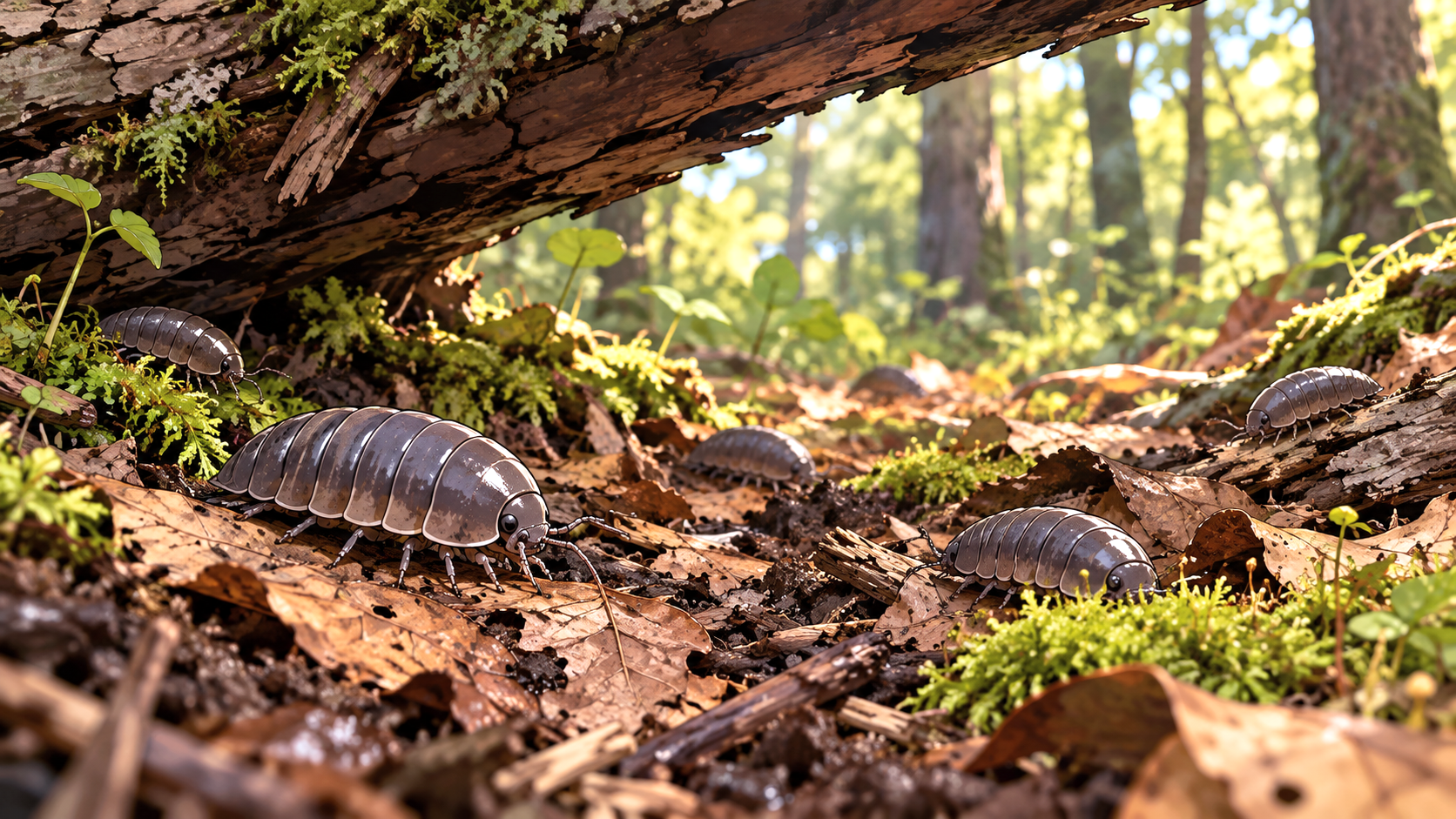
The common roly-poly (Armadillidium vulgare) is not considered endangered or at immediate risk of extinction. It is a widespread terrestrial crustacean found across Europe, North America, and other parts of the world. However, some less familiar species of pill bugs and related woodlice face serious conservation threats, particularly those restricted to individual caves, islands, or small natural habitats.
The common roly-poly has not received a formal global extinction-risk assessment under the International Union for Conservation of Nature (IUCN) Red List. Its status is listed as Not Evaluated, rather than Least Concern. Its extensive distribution provides evidence that the species is widespread, but that alone cannot establish whether its populations are increasing or declining globally.
Why the Common Roly-Poly Is Not Currently Threatened With Extinction
The familiar garden roly-poly occupies a broad range of terrestrial habitats, including woodland floors, gardens, agricultural areas, and disturbed urban environments. Originally native to Europe and surrounding regions, Armadillidium vulgare has become established in numerous other countries through human activity. Its documented global distribution includes records from both native and introduced populations, indicating a species that occupies many geographically separated environments.
Its ability to live alongside human development gives it access to habitats that are unavailable to more specialized woodlice. A garden with leaf litter, sheltered soil, and damp spaces beneath stones can support populations even when the surrounding environment has been extensively modified. The common pill bug also feeds on widely available decomposing organic material rather than depending on a single rare plant or food source.
However, widespread occurrence should not be confused with immunity to environmental change. Local populations can disappear when suitable habitats are destroyed or conditions become too dry. The conservation profile of Armadillidium vulgare identifies the species as neither endangered nor specially protected, while listing its IUCN status as Not Evaluated.
Some Woodlice Are at Genuine Risk of Extinction
The situation changes considerably when examining terrestrial isopods with small geographic ranges. The group containing roly-polies includes thousands of species, some of which inhabit only a particular island, coastal area, forest, or underground cave system. Losing one of these restricted habitats can threaten an entire species rather than merely reducing a local population.
Cave-dwelling woodlice are especially vulnerable because many have evolved under stable environmental conditions. Some occur in only one cave or a small network of underground passages. Construction, groundwater changes, pollution, or quarrying can alter their habitat beyond their ability to survive. The IUCN’s cave invertebrate conservation work identifies restricted distributions and habitat disturbance as major concerns for specialized underground animals.
A conservation study of terrestrial isopods in Portugal examined 15 cave-adapted species and developed extinction-risk profiles using their known distributions, habitat conditions, and threats. These animals occupy geographically restricted underground environments, making their conservation circumstances very different from those of garden pill bugs. The published conservation assessments of Portuguese cave isopods demonstrate why extinction risk must be evaluated at the species level.
Rarity alone is not enough to declare a species endangered. Conservation assessments also consider population trends, geographic distribution, habitat deterioration, and the likelihood of continued decline. Some terrestrial isopods lack sufficient data for a reliable assessment, leaving their actual conservation status unresolved.
What Threatens Roly-Poly Populations?
For terrestrial isopods, habitat alteration is among the most significant conservation concerns. These crustaceans depend on environmental conditions that allow them to avoid excessive water loss, and changes to soil moisture can make previously suitable habitats difficult to occupy. The effects are particularly serious for species confined to naturally humid forests or underground environments.
The IUCN Woodlouse Specialist Group’s conservation assessment identifies several pressures affecting terrestrial isopods, including habitat destruction, agricultural intensification, pesticide exposure, climate change, and the international pet trade.
Forest clearance can eliminate the leaf litter and shaded ground conditions that support moisture-dependent species. Urban development replaces natural soil with buildings and paved surfaces, fragmenting habitats and limiting movement between surviving populations. Prolonged droughts can further reduce the availability of suitable shelter, especially in exposed environments.
Agricultural chemicals present another potential concern. The effect depends on the substance, concentration, exposure, and species involved, so the presence of pesticides in an area does not establish that a population has been eliminated. Terrestrial isopods are nevertheless used in soil ecotoxicology because they can respond to environmental contaminants.
The growing market for ornamental isopods introduces a different kind of pressure. Collectors may seek unusual colors, body patterns, or rare species for terrariums. Captive breeding can supply this interest, but collecting poorly documented species from restricted wild populations can create conservation problems. The IUCN’s guidance on protecting wild woodlice specifically discourages unnecessary collection of rare or threatened species.
Why Losing Roly-Polies Would Affect Soil Ecosystems
Terrestrial isopods help process dead organic matter, supporting the organisms responsible for decomposition and nutrient cycling. Their feeding breaks larger pieces of plant litter into smaller fragments that microorganisms can colonize and decompose further.
Their ecological function overlaps with other soil organisms, but different decomposer groups do not necessarily respond to environmental change in the same way. Springtails contribute to soil health through their interactions with fungi and decomposing material, while pill bugs physically fragment larger pieces of organic debris. Both can occupy the same habitat while contributing differently to its biological processes.
The IUCN Woodlouse Specialist Group’s ecological overview describes how terrestrial isopods contribute to decomposition, nutrient cycling, and soil biodiversity. Their importance extends beyond their role as decomposers because they also provide food for other animals.
In gardens, the relationship between these organisms and plants is not always entirely beneficial. Some pill bugs occasionally consume tender seedlings, while springtails in garden environments are generally associated with decomposing material and microbial feeding. These local feeding interactions do not diminish the broader importance of maintaining healthy soil communities.
The disappearance of a specialized woodlouse species could alter ecological processes within its particular habitat. The effect would depend on which other organisms remain and whether they perform comparable functions.
Does Finding Fewer Roly-Polies Mean They Are Disappearing?
A reduction in the number of roly-polies visible in one garden does not demonstrate a population decline. These animals spend much of their time concealed beneath objects or inside moist organic material, so changes in weather and shelter availability influence how frequently people encounter them.
A dry afternoon may produce very few sightings, while lifting a damp piece of bark after rainfall can reveal numerous individuals. Changes in landscaping can also affect where roly-polies gather without necessarily indicating that they have died.
Other small soil animals show similar changes in visibility. Springtails living in potted plants often become noticeable when soil conditions favor their activity, although they are taxonomically distinct from pill bugs. A sudden increase or decrease in visible arthropods should therefore be interpreted alongside recent changes in moisture, temperature, and habitat.
Establishing a genuine local population decline requires repeated observations under comparable conditions. A single observation beneath an overturned stone provides no reliable measure of the total number living in the surrounding soil.
How to Help Protect Roly-Polies and Other Woodlice
Conserving ordinary garden roly-polies requires relatively little intervention. Leaving some leaf litter in suitable locations, retaining sheltered areas beneath natural debris, and avoiding unnecessary pesticide applications can help maintain habitat for decomposing organisms. These measures are particularly useful in gardens where most exposed soil has otherwise been cleared or disturbed.
Garden maintenance still needs to account for buildings and vulnerable plants. Excessively damp debris immediately against a foundation can encourage nuisance arthropods to enter a home, while some earwigs contribute to garden ecosystems despite occasionally damaging ornamental plants. Maintaining habitat away from structures allows wildlife to benefit without creating avoidable household pest problems.
Protecting rare terrestrial isopods requires a different approach. Their conservation depends on identifying the species, documenting its distribution, preserving the habitat where it occurs, and preventing destructive collection. The IUCN Woodlouse Specialist Group’s species conservation priorities emphasize habitat protection and population monitoring for species with restricted ranges.
For an ordinary backyard, preserving a small area of undisturbed, naturally moist ground is a practical contribution. For rare cave or island woodlice, protecting the habitat itself may determine whether the species survives.