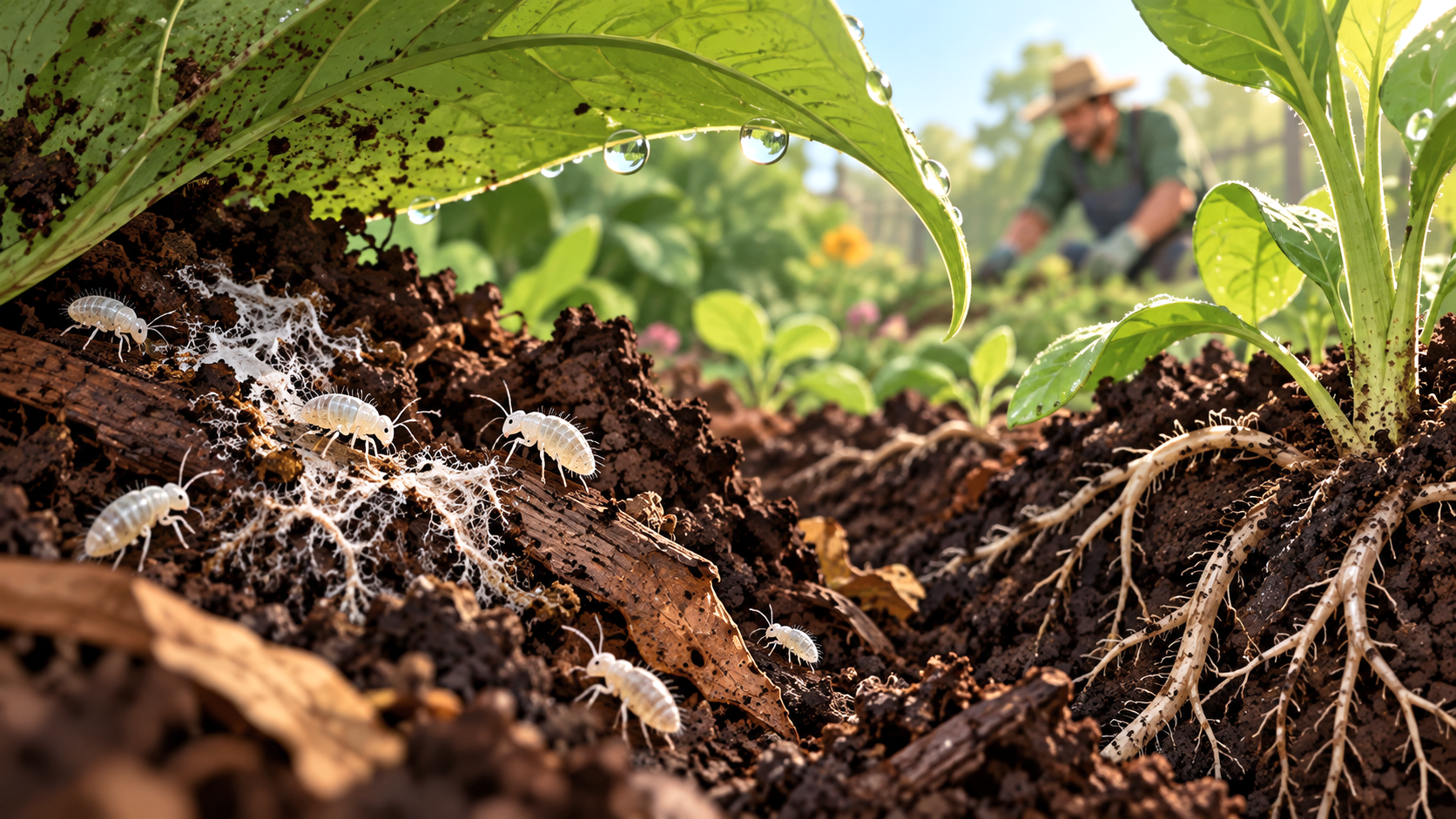
Springtails are generally good for your garden. Most live in soil, leaf litter, mulch and compost, where they feed on fungi, bacteria, algae and decaying organic material. Their activity contributes to decomposition and nutrient cycling in the soil. A few species can feed on young plants, but significant garden damage from springtails is uncommon. Seeing hundreds of tiny springtails beneath wet leaves or in rich garden soil can make them look like an infestation that needs to be removed. In most cases, the opposite interpretation is more useful. Springtails belong to the community of small organisms continually processing dead material beneath your plants.
What Springtails Do in Garden Soil
Springtails spend much of their lives where gardeners rarely look. They can occur in tremendous numbers in moist soil with plenty of organic matter, yet their tiny size keeps most of that activity hidden. The great majority of springtails develop in soil, where common food sources include fungi, algae, bacteria and decaying plant material.
That diet explains why they are frequently abundant in leaf litter, compost and mulch. These places provide both the moisture springtails need and plenty of material being broken down by fungi and other microorganisms. If you want a closer look at when their presence is useful rather than problematic, our guide to whether springtails in soil are good or bad covers that distinction.
Springtails are not doing this work alone. Garden soil contains an entire community of decomposers and other organisms interacting with organic material. Springtails are simply one particularly numerous part of that system.
Springtails Help With Decomposition
Dead leaves, old roots and other plant debris do not disappear by themselves. A network of fungi, bacteria and soil animals gradually processes that organic material.
Springtails participate in this process both through what they eat and through their interactions with soil microorganisms. Soil arthropods including springtails can shred organic matter and stimulate microbial activity. That helps decomposition continue within the wider soil ecosystem.
This is the benefit we think matters most when deciding whether garden springtails deserve to be treated as pests. Their value is not that each individual springtail directly fertilizes a plant. Instead, they participate in the biological processes that continually break down organic residues and move materials through the soil food web.
Springtails are among the small arthropods that play an active role in decomposition. They also become food for other arthropods, connecting decomposers with predators higher in the soil food web.
Springtails Contribute to Nutrient Cycling
Decomposition and nutrient cycling are closely connected. Nutrients locked inside dead biological material eventually become part of the soil system again as decomposers process that material.
Springtails are recognized as decomposers involved in nutrient cycling, alongside organisms such as certain beetles, termites and fly larvae. Their contribution is one small part of a much larger biological process that keeps organic material moving through an ecosystem.
This does not mean adding springtails to ordinary garden beds will suddenly make vegetables grow faster. Garden soil already contains complex populations of microorganisms and animals, and plant growth depends on far more than the abundance of one group of soil arthropods. It is more accurate to see springtails as participants in healthy soil processes, not as a garden amendment.
A Garden Full of Springtails Does Not Automatically Need Treatment
Springtails can reach astonishing densities. Moist soils rich in organic material may contain thousands of springtails per square foot. That can look alarming when rain, watering or disturbance suddenly makes them visible.
Numbers alone are a poor reason to treat them. Springtails naturally thrive where moisture and decomposing material provide suitable habitat. A population beneath mulch or leaf litter is therefore very different from a destructive pest population chewing through a crop.
This distinction is especially useful after heavy watering or rain. Springtails need moisture, so wet conditions can make them easier to notice. Their abundance can tell you that the immediate habitat is moist and biologically active, but it does not by itself tell you whether the soil is healthy for a particular plant.
The same principle explains what attracts springtails around yards and homes. Moisture and organic material can support large populations without those populations becoming a garden problem.
The Exception Is Plant-Feeding Springtails
Springtails are not universally beneficial. Some species feed on living plant material, particularly tender young growth. In gardens, their feeding can produce small holes in leaves, although springtail leaf damage is typically minimal.
Certain agricultural situations can produce more meaningful damage. Springtails can feed on germinating seeds and roots of small plants in moist growing environments with high organic matter, resulting in reduced stands and loss of vigor. Spinach and beets are among the crops associated with this type of injury.
That exception should not turn every garden springtail into a suspect. The sensible dividing line is actual plant damage. Springtails crawling through compost, mulch or soil are doing what most springtails normally do. Springtails associated with fresh injury to vulnerable seedlings deserve a closer look.
Our separate guide to whether springtails are harmful to plants focuses specifically on that damage question.
Should You Leave Springtails in Your Garden?
For ordinary garden populations that are not damaging plants, there is little reason to remove springtails. Their normal activities fit into the decomposition and soil-food-web processes already happening beneath the surface.
Trying to create an unusually large springtail population is unnecessary as well. A garden is not healthier simply because it contains more springtails. Their populations respond to habitat conditions, particularly moisture and available organic material.
We would therefore treat their presence as one piece of the garden ecosystem rather than something that needs to be maximized or eliminated. Leave harmless populations alone. If seedlings show real feeding injury, identify the cause before deciding that the springtails are responsible.
That approach also prevents an easy gardening mistake: treating a visible organism while ignoring what it is actually doing. Knowing what springtails look like helps confirm the identification before you make that judgment.
Other Questions About Springtails in the Garden
Do springtails eat garden fungi?
Yes. Fungi are an important part of the diet of many springtails. However, a garden contains many different fungi, and springtail feeding should not be treated as a substitute for managing a specific plant disease.
Do springtails have natural predators in the garden?
Yes. Springtails form part of the garden food web and are eaten by other small animals. Predatory mites and rove beetles are among their documented natural enemies, so springtails also transfer energy from decomposer communities to predators.
Why are there so many springtails in my mulch?
Mulch can provide the combination springtails favor: moisture, shelter and decomposing organic material. Large populations in mulch are therefore unsurprising and do not, by themselves, indicate that nearby plants are being damaged.
Can springtails live in a compost pile?
Yes. Compost provides moist organic material and microorganisms that suit the feeding habits of many springtails. Their presence fits naturally with the decomposer community working through the material.
Should I remove springtails before planting a garden bed?
Not simply because they are present. Normal soil populations do not need to be eliminated before planting. However, springtails have caused damage to germinating seeds and young plants in some moist, high-organic-matter growing situations, so fresh seedling injury should be investigated rather than dismissed.