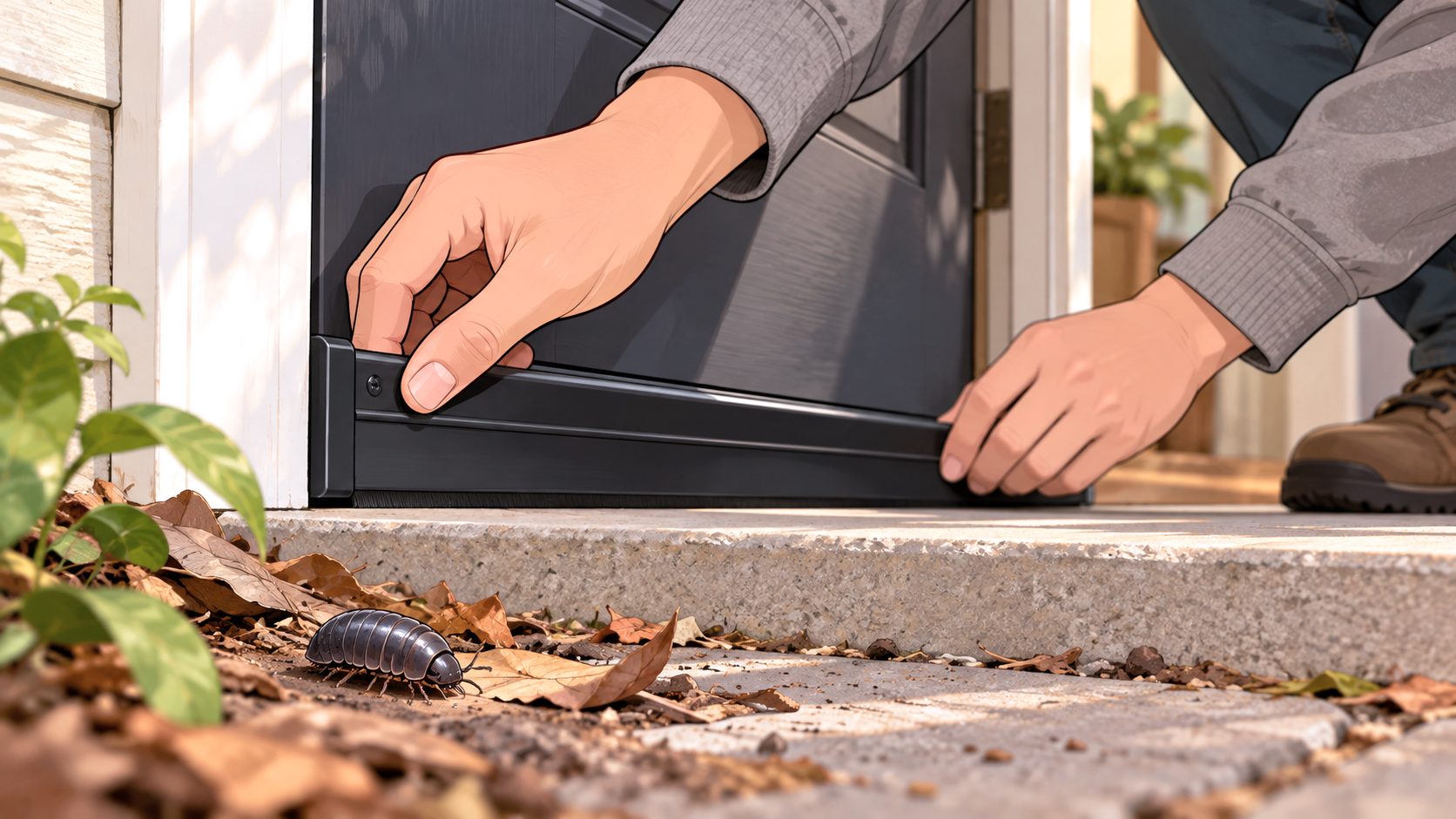
To keep roly-polies out of your house, install tight-fitting door sweeps, seal gaps around the foundation, redirect water away from exterior walls, and remove damp debris near entrances. The most effective prevention combines physical exclusion with moisture control. Roly-polies, also called pill bugs, normally live outdoors and enter buildings through openings near ground level. Blocking those openings prevents entry, while making the surrounding area less hospitable reduces the number gathering outside.
The common roly-poly (Armadillidium vulgare) cannot establish a thriving population in an ordinary dry living space. A house with repeated sightings near basement doors or ground-floor windows usually has an outdoor entry problem, although consistently damp indoor areas can also provide temporary shelter.
Seal the Gaps Roly-Polies Use to Enter
The space beneath an exterior door is one of the first places to inspect. A poorly fitted sweep may leave enough clearance for small pill bugs to crawl beneath it, particularly where the threshold is uneven. Close the door and examine the bottom edge for visible daylight. Replace damaged sweeps with a properly fitted barrier that contacts the threshold without preventing the door from opening and closing.
Doorframes deserve attention beyond the bottom edge. Gaps between the frame and surrounding wall, deteriorated weatherstripping, and openings near the corners can provide additional routes. The University of California’s pill bug prevention guidance identifies door sweeps, weatherstripping, and sealing exterior openings as effective exclusion measures.
Inspect basement windows, foundation cracks, and locations where pipes or cables pass through exterior walls. Use suitable exterior sealant for small stationary gaps and appropriate weatherproof materials around service penetrations. Larger openings may require a fitted repair rather than a bead of caulk. Avoid sealing drainage openings or blocking ventilation features that the building requires.
Prioritize the entrances closest to repeated sightings. If most roly-polies appear beside one basement door, repairing that threshold is more useful than sealing unrelated gaps throughout the upper floors. The Environmental Protection Agency’s building pest prevention guidance recommends physical barriers, sound weatherstripping, and attention to openings around walls and floors as part of keeping crawling pests outdoors.
Keep the Foundation Perimeter Less Attractive
A foundation bordered by wet mulch, fallen leaves, or decaying wood provides pill bugs with shelter immediately beside potential entry points. Removing unnecessary material from this narrow perimeter reduces the number living close to the building. Concentrate especially on doorsteps, basement windows, and places where landscaping touches siding.
The University of Maryland’s pill bug management recommendations identify stones, boards, leaves, and mulch close to the foundation as common hiding places. Move stored firewood, discarded boards, and unused flowerpots away from entrances. Thin dense vegetation where it prevents the ground from drying, and avoid piling mulch directly against exterior walls.
There is no need to clear an entire garden. Leaf litter and decomposing vegetation provide habitat for useful soil organisms, so the goal is to separate that habitat from the building. A flowerbed several feet away from an entrance can retain its organic mulch while the immediate doorway receives a cleaner, better-drained border.
Pay particular attention to containers placed directly beside the house. A large planter sitting on a shaded concrete patio can retain moisture underneath, even when the surrounding pavement appears dry. Raise or reposition containers where practical and remove accumulated leaves from beneath them.
Stop Irrigation and Drainage From Keeping the Soil Wet
Exterior moisture can undermine otherwise good exclusion work. A sprinkler repeatedly soaking the foundation creates favorable conditions for pill bugs along the same walls where cracks and thresholds provide entry. Redirect spray heads away from the building and repair leaking irrigation fittings. Where plant requirements permit, allow the soil surface to dry between watering sessions.
The Utah State University guidance on isopod prevention places particular emphasis on reducing moisture and hiding places around foundations. Downspouts discharging beside the house, persistently wet soil near steps, and water collecting beneath outdoor storage items all deserve inspection.
Drainage problems require different repairs depending on their source. A leaking hose connection needs repair, while surface water moving toward the house may require changes to grading or drainage. Avoid simply covering wet soil with more mulch or landscape fabric. Those materials do not correct the water source and can preserve damp conditions underneath.
Moisture-related pest problems often overlap. Springtails entering a house may also be associated with damp conditions, although their much smaller bodies and jumping behavior distinguish them from pill bugs. Repeated appearances of several moisture-dependent arthropods make a closer inspection of nearby water sources worthwhile.
Prevent Roly-Polies From Surviving in Basements and Crawlspaces
Exclusion keeps new animals from entering, but an existing damp basement can continue sheltering those already inside. Inspect for condensation, plumbing leaks, wet stored materials, and moisture entering through foundation walls. The University of Minnesota’s recommendations for sowbugs and related household invaders identify repeated sightings of living individuals indoors as a reason to investigate excess moisture.
Repair water leaks and improve ventilation where it is appropriate for the space. A dehumidifier can help control indoor humidity, but it will not repair a leaking pipe or stop groundwater entering through a damaged foundation. Its usefulness is similar to dehumidification for springtail problems, where lowering moisture reduces favorable indoor conditions without physically closing entry points.
Remove wet cardboard, decaying plant material, and other damp organic debris from storage areas. Roly-polies do not need household food scraps to survive, so kitchen sanitation alone will not solve a basement entry problem. Their continued presence is more closely connected to moisture and shelter.
Live individuals can be collected with a cup and relocated outdoors. A vacuum or dustpan can remove those already dead. Routine indoor insecticide applications provide little lasting benefit against animals that naturally die in dry indoor conditions, particularly when new individuals can continue entering through unrepaired openings.
Check Whether Your Prevention Measures Worked
Use the location of new sightings to evaluate the repairs. After fitting a door sweep and clearing the surrounding debris, inspect the threshold following rainfall and during ordinary dry weather. If roly-polies continue appearing along the same interior wall, examine nearby window frames, utility penetrations, and foundation joints that were not addressed initially.
The Environmental Protection Agency’s integrated pest management principles emphasize monitoring after preventive measures rather than assuming a treatment has succeeded. Keep a simple record of where living individuals appear so the remaining entry routes can be narrowed down.
Persistent activity in a crawlspace with wet soil or recurring water intrusion deserves investigation by an appropriate building professional. Where the surrounding environment has been corrected and the entry points are properly sealed, additional pesticide treatment is generally unnecessary. Maintaining those repairs and keeping organic debris away from entrances provides lasting protection without eliminating harmless pill bugs from the rest of the property.