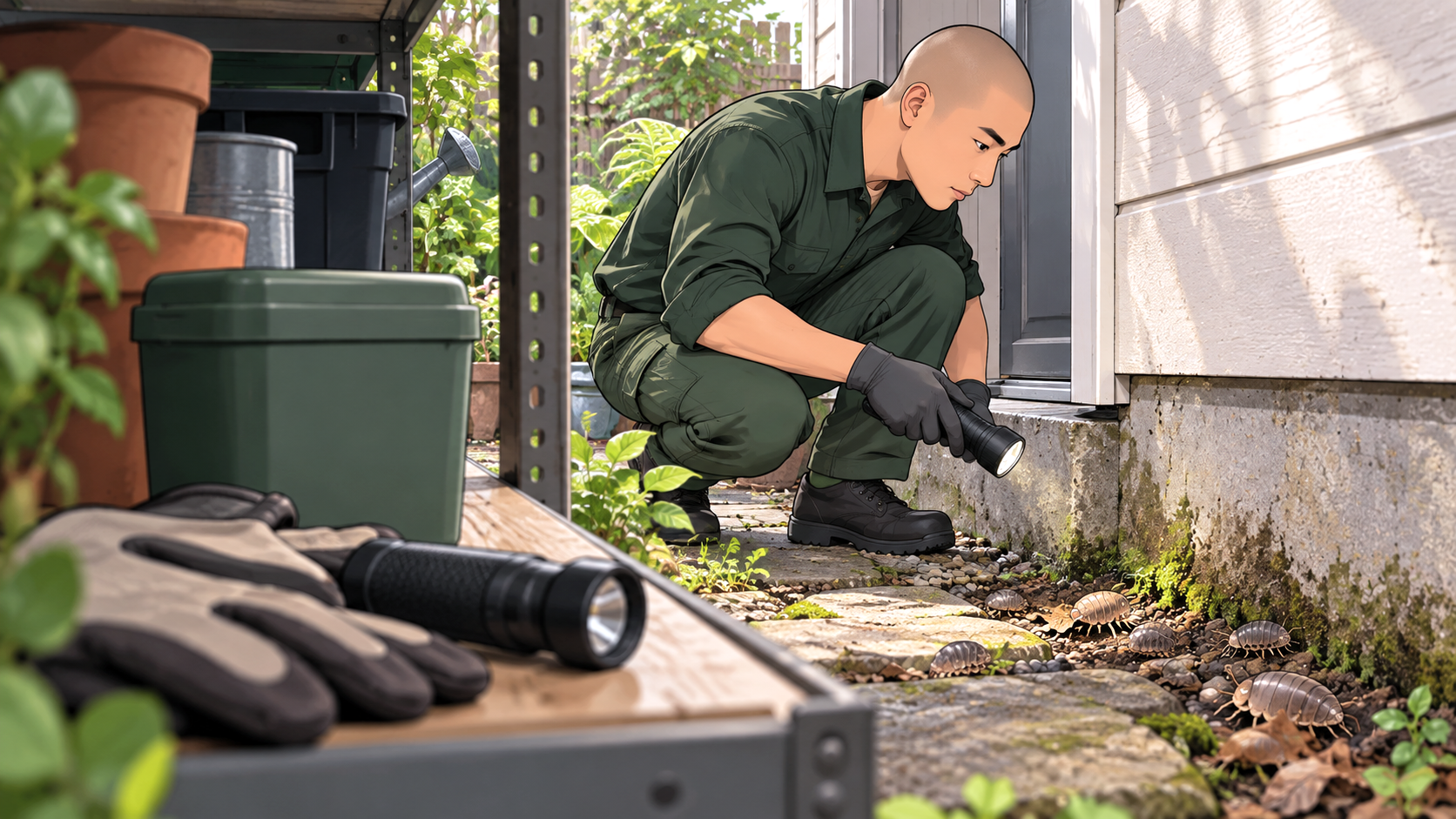
The best roly-poly killers are pesticides specifically suited to pillbugs or sowbugs and authorized for the location being treated. Among products marketed in the United States, Spectracide Bug Stop Home Barrier is a practical ready-to-use option for exposed pillbugs, Ortho Home Defense Insect Killer for Indoor & Perimeter2 offers another household treatment choice, and Suspend SC is a concentrated alternative for larger or more demanding applications.
These products differ in their active ingredients, preparation requirements, permitted uses, and environmental precautions. None guarantees instant death or permanent control of every roly-poly around a property.
For a few pillbugs wandering indoors, buying an insecticide is usually unnecessary. Roly-polies depend on damp environments, and moisture correction, exclusion, and physical removal can prevent repeated problems without exposing other organisms to pesticides.
The products compared below are US-market examples. Their availability, registration, permitted treatment sites, and user qualifications must be checked independently in other countries, including Canada.
Which Roly-Poly Killer Is Best?
| Product | Formulation | Main advantage | Important limitation |
|---|---|---|---|
| Spectracide Bug Stop Home Barrier | Ready-to-use gamma-cyhalothrin spray | Convenient treatment of exposed pillbugs where permitted | Does not eliminate concealed outdoor populations |
| Ortho Home Defense Insect Killer for Indoor & Perimeter2 | Ready-to-use pyrethroid spray | Suitable format for qualifying household and perimeter applications | Residual claims for other pests do not establish equivalent pillbug protection |
| Suspend SC | Deltamethrin suspension concentrate | Flexible format for larger authorized treatment areas | Requires mixing, appropriate equipment, and careful label compliance |
These selections reflect differences in formulation and practical use rather than results from a controlled experiment directly comparing their effectiveness against roly-polies.
The exact package label should always be checked because similarly named products can have different ingredients, directions, or approved uses.
Spectracide Bug Stop Home Barrier: Best Ready-to-Use Contact Option
Spectracide Bug Stop Home Barrier is a ready-to-use insecticide formulated for certain household and exterior pest-control applications. The AccuShot version contains 0.025% gamma-cyhalothrin, a synthetic pyrethroid that interferes with normal nerve signaling in susceptible arthropods.
Its main advantage is that the manufacturer specifically includes pillbugs and sowbugs among the organisms covered by the product’s directions.
That provides a stronger basis for considering it than choosing a general insect spray simply because it kills other crawling pests.
Where Spectracide Makes Sense
Spectracide is most relevant when pillbugs are already visible in a location covered by the current product label and direct treatment is justified.
A homeowner dealing with recurring roly-poly activity near an authorized treatment area may find a premixed product more practical than buying a pesticide concentrate and separate application equipment.
However, visible pillbugs are often only part of the population. Many remain beneath mulch, stones, wood, planters, and other moisture-retaining materials. Treating exposed individuals does not eliminate animals sheltered elsewhere.
The product’s current directions and approved treatment areas should determine whether it is appropriate for the situation.
What to Watch For
Gamma-cyhalothrin is a pyrethroid insecticide, so environmental exposure deserves particular attention.
Outdoor applications can present risks where spray reaches drains, runoff pathways, or aquatic habitats. Indoor applications require compliance with the product’s precautions concerning people, pets, food-contact areas, and treated surfaces.
Spectracide should not be sprayed indiscriminately across vegetable beds, compost areas, or outdoor habitats merely because pillbugs are present.
Our assessment: A convenient ready-to-use option where the exact US product label authorizes the intended treatment. Its strongest advantage is ease of use, not proven superiority over every other pillbug insecticide.
Ortho Home Defense: Best for Recurring Household Entry Problems
Ortho Home Defense Insect Killer for Indoor & Perimeter2 is intended for certain household and structural perimeter pest-control applications.
The US product information specifically identifies pillbugs, rollie pollies, and sowbugs among its controlled organisms.
That makes it relevant to homeowners dealing with repeated nuisance activity around ground-level entrances, garages, and other permitted treatment sites.
Why Ortho Is Worth Comparing
The convenience of Ortho Home Defense lies in its ready-to-use format and its coverage of numerous household pests.
For someone dealing with several appropriately identified nuisance arthropods around a building, it may be more practical than purchasing a separate insecticide for every species.
The currently listed US formulation contains bifenthrin and zeta-cypermethrin, although formulations and ingredients must be checked against the actual container.
The manufacturer’s Ortho Home Defense product information lists pillbugs and identifies the relevant treatment settings.
However, the manufacturer’s extended residual protection claims for certain other household insects should not be assumed to establish the same duration of control against roly-polies.
Why Moisture Correction Still Matters
Suppose roly-polies repeatedly appear beside a basement door.
An authorized perimeter treatment may affect exposed individuals, but it cannot repair a damaged door sweep, redirect water away from the foundation, or remove wet debris supporting the outdoor population.
Those physical conditions can continue admitting pillbugs after a treated area loses effectiveness.
Where several moisture-associated organisms are appearing near the same entrance, springtail activity around houses can also indicate conditions worth investigating.
Our assessment: A practical household-and-perimeter option for qualifying applications, particularly where the homeowner is already managing several listed pests. Exclusion and moisture correction should come before repeated spraying.
Suspend SC: Best Concentrate to Consider for Larger Problems
Suspend SC is a deltamethrin-based suspension concentrate intended for various structural pest-management applications.
Unlike ready-to-use products, a concentrate requires preparation and application equipment suitable for the permitted treatment.
Its US labeling includes pillbugs and sowbugs among the pests covered by certain applications. The Suspend SC product label provides the applicable directions and restrictions.
What Makes Suspend SC Different?
The main distinction is its concentrated formulation.
For an appropriately qualified user managing an extensive pest problem at authorized treatment sites, a concentrate may provide a more suitable application format than multiple small trigger bottles.
However, that flexibility also increases the importance of correct product identification, measuring, equipment selection, exposure prevention, and adherence to the permitted application directions.
There is no responsible universal Suspend SC mixing ratio for every pillbug problem. The product’s instructions depend on the particular use and formulation, and a stronger mixture should not be assumed more effective or acceptable.
When It Is Unnecessary
Suspend SC is difficult to justify for occasional pillbugs wandering across an indoor floor.
Even a large number of animals gathering outdoors may not represent damage requiring pesticide treatment. Roly-polies are common decomposers, and substantial populations can occur in damp organic material without creating a meaningful pest problem.
Where recurring activity is severe, a qualified pest-control professional may be better placed to evaluate whether concentrated pesticide treatment is warranted.
Our assessment: A potential option for larger, authorized pest-management applications. It is not the preferred choice for a minor household nuisance or an ordinary garden population.
Why We Did Not Automatically Recommend Garden Insecticides
Roly-polies usually feed on decaying plant material and contribute to decomposition. They can occasionally damage seedlings, tender roots, and fruits or vegetables touching damp soil, but their presence in a garden does not establish that they caused plant injury.
This distinction matters when selecting an insecticide.
A product approved for structural perimeter treatment is not automatically suitable for strawberries, leafy vegetables, fruit trees, or other edible crops.
Likewise, a broad-spectrum garden insecticide is not necessarily appropriate for pillbugs merely because it controls caterpillars, beetles, or other familiar plant pests.
Where plant injury is occurring, first determine whether roly-polies are actually responsible. Earwigs can also damage certain garden plants, while slugs and other ground-dwelling organisms may produce overlapping symptoms.
For confirmed pillbug injury, reducing wet organic debris immediately around affected plants, protecting seedlings, and separating vulnerable fruit from the soil may reduce damage without pesticides.
The University of California’s pillbug and sowbug management guidance emphasizes moisture reduction, habitat management, and preventing access to vulnerable plants.
Garden insecticides should be considered only where there is a meaningful problem and the exact product is authorized for the intended crop, site, and application.
Are Diatomaceous Earth and Natural Roly-Poly Killers Effective?
Natural or household substances are frequently recommended as alternatives to conventional insecticides. Their effectiveness and safety, however, are not interchangeable.
Diatomaceous earth has a physical desiccating action that can contribute to water loss in susceptible arthropods. Its performance depends on suitable exposure and dry conditions.
Because roly-polies gather in wet mulch, damp soil, and other humid habitats, those conditions often work against the material’s usefulness. Evidence specifically measuring its effectiveness against roly-polies is also more limited than research involving certain insects.
The National Pesticide Information Center’s diatomaceous earth fact sheet describes its mode of action and possible respiratory, eye, and skin irritation.
Household vinegar, rubbing alcohol, essential oils, and ordinary dish soap present different concerns. Reliable pillbug-specific control evidence is limited, while homemade mixtures can introduce unnecessary exposure, plant injury, or flammability hazards.
These household substances should not be treated as substitutes for properly labeled pesticide products.
For a small group of roly-polies, physical collection or simple shelter traps may be more practical than chemical treatment.
Pesticide Registration Matters More Than Brand Recognition
A pesticide’s availability online does not establish that it can legally be purchased or used in every jurisdiction.
The products compared here are US-market examples. Their EPA registration, permitted use sites, and directions do not automatically authorize identical applications in Canada or elsewhere.
Canadian readers should verify the exact product through Health Canada’s pesticide label search.
Canadian pest-control products must comply with federal registration and labeling requirements, along with applicable provincial or local restrictions. Some formulations may also be restricted to particular categories of applicators.
In the United States, the EPA’s pesticide-labeling guidance explains the relationship between registered labels and the limited exceptions allowed under Section 2(ee) of FIFRA.
Those exceptions do not authorize otherwise prohibited application sites or remove applicable restrictions.
For a consumer-oriented buying guide, selecting a product that specifically identifies pillbugs or sowbugs and permits the intended treatment site remains a sensible approach.
Product names, concentrations, and label directions should always be checked against the exact formulation rather than older packaging or general brand descriptions.
Safety Risks Before Using a Roly-Poly Insecticide
All three named products contain synthetic pyrethroid active ingredients in the formulations discussed here.
Pyrethroids can affect organisms beyond the intended pest. Environmental concerns are particularly important around aquatic habitats because several compounds in this class are highly toxic to fish and aquatic invertebrates.
Outdoor pesticide applications should not be extended into drains, stormwater routes, ponds, or other prohibited locations.
Application restrictions involving paved surfaces, runoff, weather, and spray drift must be determined from the particular product label.
Pets also require consideration. Animals may encounter pesticides through treated surfaces, contaminated objects, ingestion, or other exposure routes.
The National Pesticide Information Center’s guidance on pesticide use around pets emphasizes following product-specific precautions, removing pets and their belongings from treatment areas when required, and respecting the conditions for safe reentry.
No general statement that all pesticides become safe immediately after drying should replace those directions.
Treatment decisions should also account for non-target arthropods. Pillbugs are commonly harmless decomposers, and unnecessary spraying may affect other organisms sharing their habitat.
Why Even the Best Roly-Poly Killer May Not Solve the Problem
Killing exposed pillbugs and preventing an ongoing infestation are different outcomes.
Roly-polies spend much of their time hidden beneath stones, mulch, flowerpots, damp wood, and other material close to the ground.
A pesticide may kill individuals that receive sufficient exposure while leaving many others sheltered nearby.
Additional pillbugs can also move into a treated area from surrounding habitat.
Repeatedly spraying the same doorway or patio may therefore produce temporary reductions without changing the underlying conditions supporting their activity.
For household invasions, worn weatherstripping, foundation openings, wet landscaping, and poorly directed irrigation can all contribute to recurring sightings.
For garden problems, excessive surface moisture, dense organic shelter, and vulnerable plants resting against the ground can sustain continued feeding opportunities.
The EPA’s integrated pest management principles emphasize identifying the pest, evaluating whether intervention is necessary, and selecting methods that minimize unnecessary risks.
In many cases, correcting the habitat provides more lasting benefits than choosing a stronger insecticide.
Which Roly-Poly Killer Should You Buy?
For a small, localized problem where a pesticide is justified and authorized, Spectracide Bug Stop Home Barrier offers a convenient ready-to-use formulation with specific pillbug labeling.
Ortho Home Defense Insect Killer for Indoor & Perimeter2 is another option where the problem involves permitted household or structural perimeter applications. Its broader pest coverage may be useful when other listed household pests are also present.
Suspend SC is more relevant when the treatment involves a larger authorized area and concentrated pesticide handling is appropriate.
These recommendations concern product suitability rather than a verified head-to-head ranking of pillbug mortality or residual effectiveness.
None should be used indiscriminately across an entire lawn or garden. Treatment should follow the exact registered label, with particular attention to environmental restrictions and whether the problem warrants chemical intervention.
For most homeowners finding a few roly-polies near a door, the best first purchase is more likely to be a replacement door sweep than an insecticide. Preventing entry and reducing nearby moisture can address the problem without repeated chemical applications.