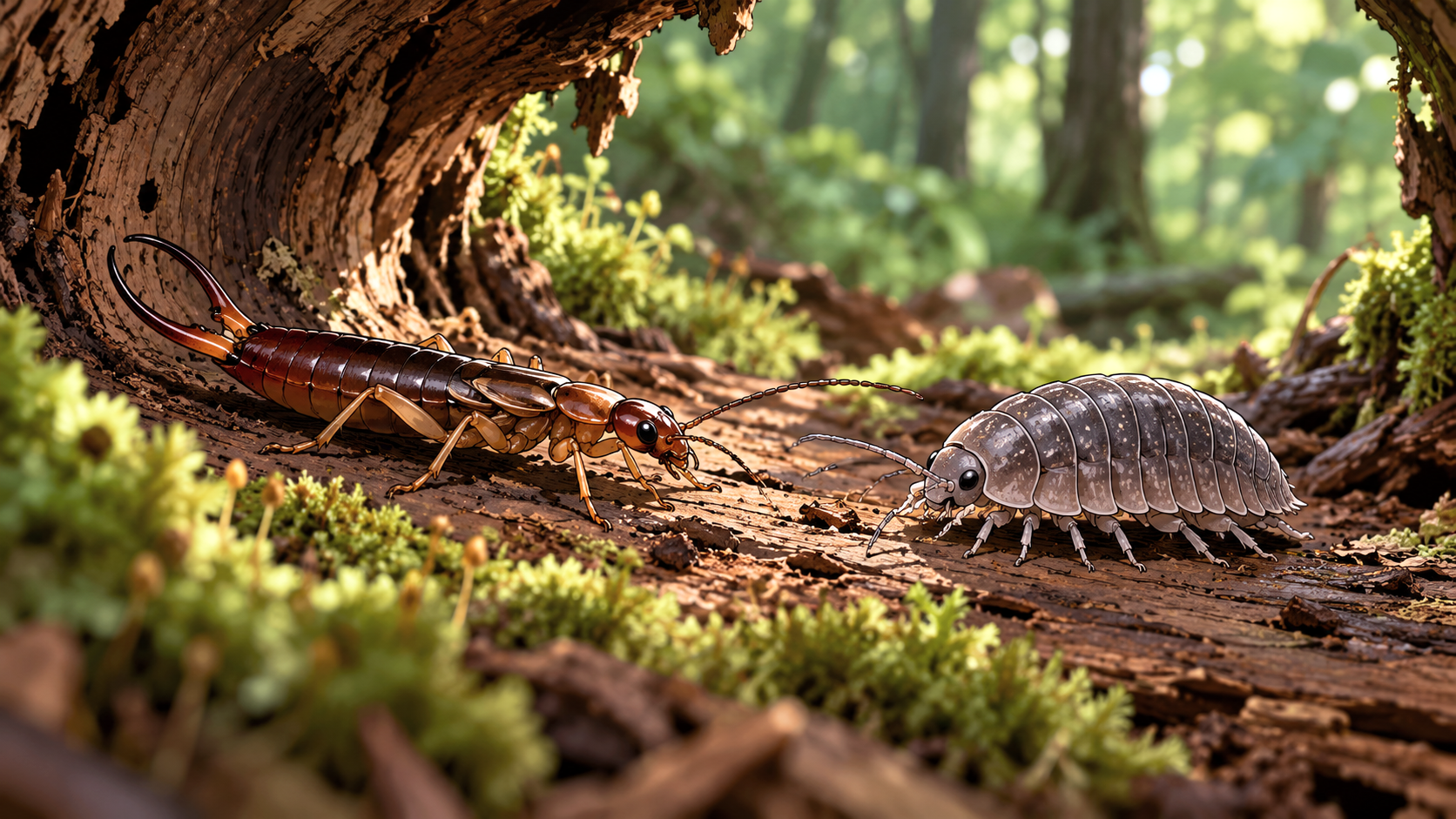
An earwig and a woodlouse may hide beneath the same garden stone, but they are easy to distinguish once you examine their bodies. Earwigs are six-legged insects with prominent pincers at the rear of the abdomen. Woodlice are terrestrial crustaceans with 14 walking legs, broad segmented body plates, and no earwig-like pincers. Woodlice are also commonly called sowbugs, pillbugs, roly-polies, or slaters, depending on the species and region.
Their shared preference for sheltered, damp places explains why they are frequently discovered together. Yet their differences in anatomy, movement, feeding, and moisture requirements are considerable.
Earwig vs Woodlouse: Physical Differences
| Feature | Earwig | Woodlouse |
|---|---|---|
| Animal group | Insect | Terrestrial crustacean |
| Classification | Order Dermaptera | Order Isopoda, suborder Oniscidea |
| Walking legs | 6 | 14 in typical adults |
| Body shape | Long, narrow, relatively flattened | Broadly oval, flattened or domed |
| Body covering | Exoskeleton with a flexible, exposed abdomen | Distinctive overlapping-looking dorsal plates |
| Rear appendages | Hardened forceps or pincers | Small uropods in many species; no true pincers |
| Antennae | Long and threadlike | Usually shorter and jointed |
| Defensive behavior | Runs, twists its abdomen, may pinch | Withdraws, clings to surfaces, or rolls into a ball in some species |
| Wings | Present in some species | Absent |
| Diet | Omnivorous; may hunt insects or eat living plants | Primarily decaying plant material and associated organic matter |
The Australian Museum’s earwig identification guide describes their six legs and modified abdominal pincers. By contrast, the Natural History Museum’s classification of terrestrial isopods places woodlice among crustaceans rather than insects.
The difference is apparent from above: an earwig has a narrow abdomen extending behind its three pairs of legs, whereas a woodlouse looks more like a small armored oval.
Earwigs Have Pincers; Woodlice Have Body Plates
The rear end provides the quickest identification clue.
An earwig possesses two hardened appendages called cerci, modified into forceps. In the common European earwig (Forficula auricularia), males usually have noticeably curved pincers, while females have straighter ones. The forceps are used in defense and interactions with other insects, and they can help an earwig hold prey.
Woodlice lack these structures. Their most conspicuous feature is a series of dorsal plates extending across the body, giving them a segmented, armored appearance. These plates form part of their external skeleton and protect the softer tissues underneath.
Some woodlice have small projections extending from the rear of the body. These are called uropods, and they are not equivalent to an earwig’s forceps. The anatomical description of terrestrial isopods in the journal ZooKeys identifies the paired uropods and the seven leg-bearing thoracic segments used in scientific identification.
A sowbug’s uropods may resemble two tiny tails, particularly when viewed from behind. They do not form the large, curved gripping structures characteristic of an earwig.
The defensive pinching behavior of earwigs comes from their modified cerci. Woodlice cannot deliver the same kind of pinch because they do not possess comparable appendages.
Why Woodlice Have 14 Legs Instead of Six
Despite their insectlike appearance, woodlice are more closely related to aquatic isopods than to earwigs.
A typical adult woodlouse has seven pairs of walking legs attached to seven thoracic segments. The legs are tucked beneath the body, which can make them difficult to count when the animal is viewed from directly above.
An earwig’s three pairs of legs are attached to its thorax, immediately behind the head. Its abdomen extends backward without additional walking legs.
The Massey University guide to woodlouse anatomy identifies seven pairs of legs as a defining characteristic of terrestrial isopods. Although most crustaceans live in water, woodlice belong to a lineage adapted to terrestrial environments.
Their classification explains several features that distinguish them from insects, including the arrangement of their respiratory structures and the development of their young.
A newly released juvenile woodlouse may initially have only six pairs of walking legs, with the seventh developing after an early molt. This means a leg count alone can be misleading when examining very young individuals. The broad body plates and lack of forceps remain useful.
Can Woodlice Roll Into a Ball Like Pillbugs?
Some woodlice can curl into a tightly enclosed ball, but others cannot.
The common pillbug (Armadillidium vulgare) is capable of conglobation, the defensive behavior responsible for the name roly-poly. Its body segments fit together to protect the softer underside when the animal curls up.
Many sowbugs, including species of Porcellio, have a flatter body and more projecting uropods. They may bend or partially curl when disturbed but cannot form the same tightly closed ball.
The University of Florida’s pillbug identification account explains how this behavior separates pillbugs from the more flattened sowbugs.
Earwigs do not roll into armored balls. When threatened, they generally run toward cover or arch their flexible abdomens to present their pincers.
A small gray animal curling into a neat ball is therefore a pillbug rather than an earwig. A flattened woodlouse that remains extended may still be a sowbug, particularly if its body is divided into broad plates and numerous legs are visible beneath it.
Why You Often Find Earwigs and Woodlice Together
Both animals favor protected spaces near the ground, especially where conditions remain humid. Lifting a flowerpot, log, garden board, or damp piece of cardboard can reveal earwigs alongside several woodlice.
Their requirements overlap, but woodlice have a particularly strong dependence on environmental moisture.
Terrestrial isopods possess respiratory structures on modified abdominal appendages. Depending on the species, these structures include gill-like surfaces or specialized air-conducting organs that require protection against excessive drying. The University of Puget Sound’s account of the common woodlouse explains how these adaptations allow crustaceans to breathe on land.
Earwigs are also vulnerable to drying conditions, but they breathe through the insect tracheal system. They occupy sheltered microhabitats without relying on the same respiratory anatomy as woodlice.
The places where earwigs live and hide consequently overlap with woodlouse habitats, especially beneath objects that reduce exposure to sunlight and dry air.
Finding both animals together does not mean they share a nest or cooperate. They are independently taking advantage of suitable conditions within the same small space.
Earwigs and Woodlice Eat Different Things
Woodlice primarily consume decaying leaves, rotting plant tissues, fungi-associated material, and other organic debris. Their feeding contributes to the breakdown of dead vegetation and the recycling of nutrients.
Earwigs have a more flexible diet. European earwigs consume organic debris but also feed on living plants, aphids, insect eggs, and other small arthropods. Some earwig species are useful predators in gardens.
The University of California’s earwig management guidance describes this combination of predatory and plant-feeding behavior, while Clemson University’s woodlouse guidance emphasizes the role of sowbugs and pillbugs as decomposers.
There is some dietary overlap. Both may feed on softened or decomposing plant material, and woodlice occasionally damage tender seedlings or low-growing fruit when other conditions are favorable. Nevertheless, their presence beside a damaged plant does not prove either animal caused the injury.
An earwig discovered inside a flower may be hunting smaller insects, while a woodlouse beneath the same plant may be consuming decomposing material at the soil surface.
When earwig feeding damage appears on garden plants, identification should be supported by observations of the insects actually feeding. The same principle applies to woodlice suspected of damaging seedlings.
Which One Moves Faster?
Earwigs generally run more quickly and with a more flexible, elongated movement. Their long antennae may sweep from side to side as they navigate surrounding objects.
Woodlice usually move with a steadier crawling motion. Their multiple pairs of relatively short legs create continuous movement beneath the body, while the dorsal plates remain conspicuous from above.
A disturbed earwig may abruptly accelerate and disappear into a narrow gap. A woodlouse may instead move toward shelter, cling to the underside of an object, or curl defensively if it belongs to a species capable of rolling.
These behavioral differences can help during a brief encounter, but movement should not replace anatomical identification. Both animals may remain motionless when undisturbed, and some woodlice are capable of moving surprisingly quickly.
Which One Is More Likely to Live Inside Your House?
Earwigs and woodlice are both primarily associated with outdoor environments, but either may enter a building.
Earwigs frequently appear as occasional wanderers. They can move through exterior openings and temporarily hide in indoor crevices, especially near the places where they entered.
Woodlice may enter through similar openings, but repeated sightings can be particularly suggestive of persistently damp conditions. Their respiratory requirements make prolonged survival in dry household environments more difficult.
The museum conservation guidance on woodlice identifies indoor woodlouse activity as a possible indicator of excess moisture or nearby damp refuges.
A woodlouse on a bathroom floor should not automatically be interpreted as proof of a plumbing leak. It may have entered from outdoors. However, numerous woodlice repeatedly discovered in the same basement or storage area justify examining the environmental conditions there.
The presence of earwigs in basements can also coincide with dampness, although their appearance alone does not establish that they are reproducing indoors.
Are Earwigs or Woodlice More Likely to Damage a House?
Neither animal is a structural wood-destroying pest.
Earwigs may hide in cracks within wooden materials but do not bore galleries through sound timber. Their appearance around furniture, siding, or floorboards is not equivalent to finding termites or wood-boring beetles.
Woodlice are associated with decomposing organic matter, including rotten wood. They generally exploit material already softened by decay rather than damaging sound structural wood.
The relationship between earwigs and household wood damage is therefore fundamentally different from the damage caused by organisms that actively consume structural timber.
Woodlice can occasionally become a nuisance in damp storage spaces, but their presence is more useful as an environmental clue than as evidence of an insect attack on the building.
How to Identify an Earwig or Woodlouse From a Photograph
A photograph taken directly above the animal can reveal its body outline, but a slightly angled view is often better for showing the legs and terminal appendages.
An earwig should display six relatively long legs and a narrow abdomen ending in a pair of forceps. A woodlouse should have a wider, armored appearance, with multiple short legs beneath seven main thoracic plates.
The most useful identification clues can be checked in this order:
- Look for prominent rear pincers. Their presence strongly favors an earwig.
- Examine the body outline. A broad oval covered with transverse plates suggests a woodlouse.
- Count visible legs when possible. Six indicates an insect; 14 indicates a typical adult woodlouse.
- Observe defensive behavior. Rolling into a tight ball identifies a pillbug-type woodlouse rather than an earwig.
Do not rely solely on color. European earwigs are commonly reddish brown, while woodlice may be gray, brown, nearly black, or mottled. Both can change in appearance depending on lighting, age, and recent molting.
Likewise, different earwig species can vary in size and color, and woodlice include numerous species with different body proportions.
For an ordinary household encounter, the combination of body plates, leg count, and rear appendages is usually sufficient. An earwig is a pincer-bearing insect; a woodlouse is a many-legged terrestrial crustacean. Their shared hiding places should not obscure those fundamental anatomical differences.