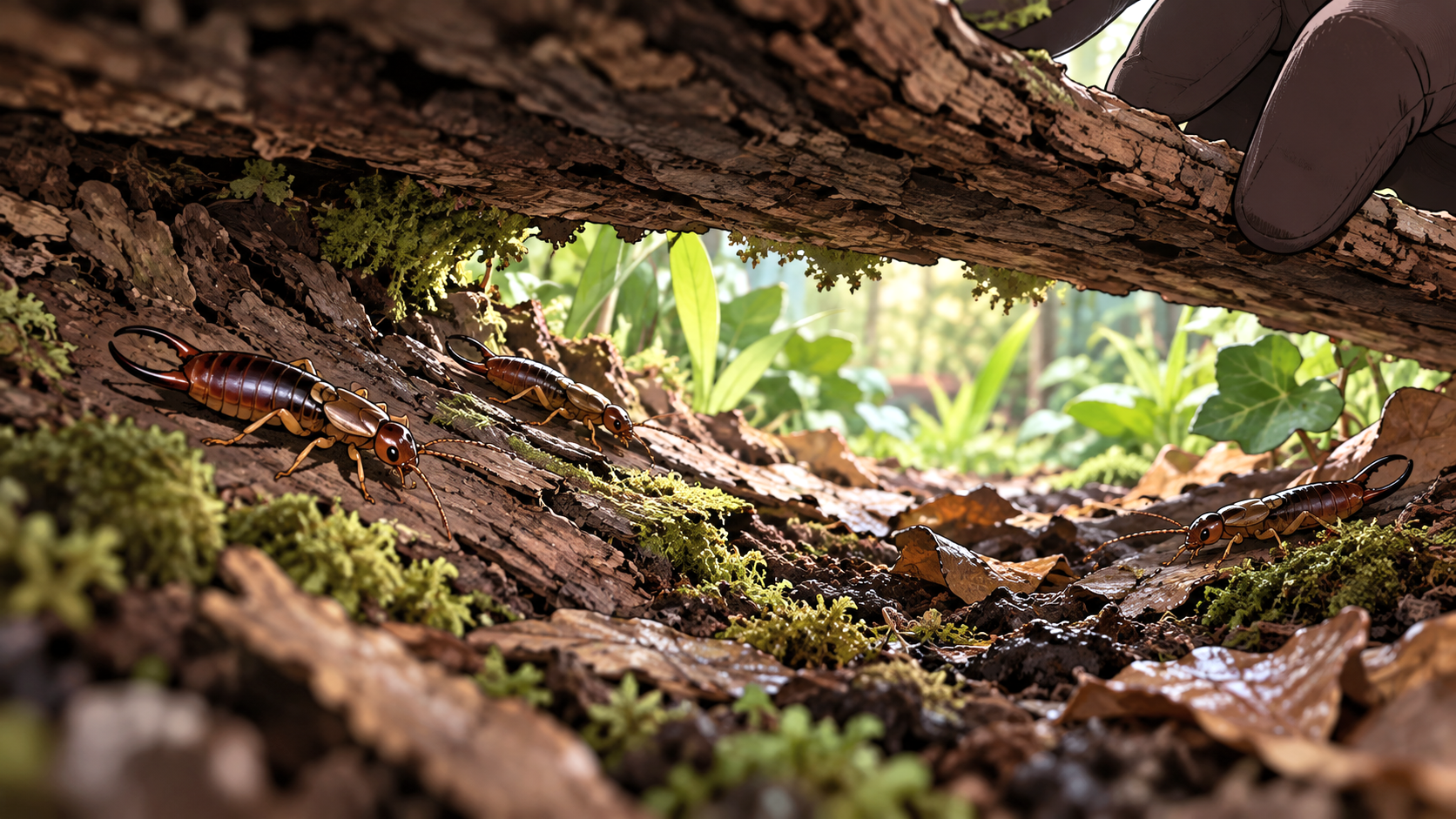
Earwigs live primarily outdoors, sheltering beneath rocks, logs, mulch, leaf litter, flowerpots, loose bark, and other objects that provide darkness and protection from drying out. They also hide in garden plants, narrow structural gaps, and occasionally inside houses. Most earwig hiding places are temporary daytime shelters, not nests. A true earwig nest is usually a small underground chamber where a female guards her eggs and newly hatched young.
European earwigs (Forficula auricularia) are especially common around gardens and buildings in temperate regions. They frequently gather in groups, so lifting one board or flowerpot can reveal dozens of insects together. Such gatherings do not necessarily indicate reproduction.
Where Earwigs Usually Live Outdoors
Earwigs are primarily ground-associated insects, but their sheltering habits are not restricted to soil. They occupy protected spaces at ground level and can climb vegetation, fences, and other structures to find suitable refuges.
Their preferred hiding places typically provide three conditions: limited light, close contact with surrounding surfaces, and protection against excessive moisture loss. The European earwig’s documented habitat preferences include leaf debris, cracks, and other dark locations.
Common outdoor refuges include:
- Under rocks and landscape stones: Narrow spaces between stones and soil provide shade and protection from disturbance.
- Beneath logs, boards, and stacked firewood: Wood resting against the ground creates sheltered cavities, particularly where the lower surfaces remain damp.
- Inside leaf litter and garden debris: Layers of fallen material provide numerous small spaces where earwigs can remain concealed.
- Under flowerpots and plant containers: Contact between a pot and the surface beneath it forms an enclosed daytime refuge.
- Within mulch: Loose organic material provides cover, especially where it retains moisture near the soil surface.
- Beneath loose tree bark: Bark crevices create protected spaces that earwigs can occupy above ground.
The University of Minnesota’s observations of earwig hiding behavior also identify welcome mats, gaps between paving materials, and objects resting on soil as frequent shelters.
These locations do not necessarily support permanent colonies. An earwig may remain beneath an object during daylight, leave after sunset, and occupy a different refuge the following morning.
The concentration of suitable hiding places helps explain why earwigs are often found around particular parts of a property rather than being distributed evenly throughout the landscape.
Why Earwigs Gather in Large Groups
Finding 20 or 30 earwigs beneath a single object can resemble discovering a nest, especially when insects of different sizes are present. European earwigs, however, exhibit a behavior known as aggregation, in which individuals gather in shared shelters outside the reproductive period.
Their attraction to previously occupied shelters is partly chemical. Research published in the Journal of Chemical Ecology identified chemical signals associated with European earwig aggregation. These signals can influence where individuals settle, making an already occupied refuge more attractive to other earwigs.
A later study in Crop Protection investigated earwigs returning to previously occupied cardboard shelters. In laboratory experiments, shelters conditioned by earwigs attracted additional individuals, with the effect persisting for several weeks under the tested conditions.
This behavior explains why an apparently ordinary piece of cardboard, wooden board, or folded material can repeatedly contain large numbers of earwigs. The insects are responding to favorable shelter characteristics and, potentially, chemical cues left by previous occupants.
An aggregation may contain adult males, adult females, and immature earwigs. Unlike a reproductive nest, it does not require a guarding mother or a clutch of eggs.
The tendency to share refuges is also why earwigs are commonly active at night but may appear unusually concentrated when their daytime hiding places are disturbed.
Where Earwigs Hide in Garden Plants
Earwigs do not remain exclusively on the ground. They climb stems and trunks, moving into foliage where overlapping plant structures provide protected spaces.
Particularly favorable hiding places include tightly folded leaves, dense flower heads, plant crowns, and damaged fruit. Earwigs can also shelter between vegetables or ornamental plants that press closely together.
The University of California’s European earwig management guidance for citrus identifies bark crevices, trunk wraps, curled leaves, and closely packed plant parts as common refuges.
This can produce surprising discoveries. An earwig may emerge from a flower that appeared empty from the outside, or several may be concealed where leaves wrap tightly around a developing stem.
In strawberries, earwigs sometimes occupy split or damaged fruit. The UC Statewide IPM guidance for strawberry earwigs describes individuals sheltering inside damaged fruit and near plant crowns.
These observations should not automatically be interpreted as evidence that earwigs created the original damage. Some insects enter cavities produced by ripening, weather, disease, or feeding by other organisms.
Likewise, earwigs found in an orchard canopy may be hunting aphids or other small insects. Earwig damage to garden plants requires evidence of feeding rather than simply finding insects among the foliage.
Can Earwigs Hide High Above the Ground?
Yes. European earwigs can occupy elevated shelters in trees and shrubs even though their reproductive chambers are generally associated with soil.
The University of California’s avocado pest guidance documents earwigs hiding beneath trunk wraps and within protected plant structures. Orchard researchers have also collected substantial numbers in cardboard shelters attached to trees.
An earwig discovered several feet above the ground has therefore not necessarily arrived by flight. European earwigs are capable of climbing and commonly move vertically while searching for shelter or food.
Their presence in trees also shows why a hiding place should not automatically be described as a nesting site. An elevated crevice may serve as a daytime refuge without containing eggs or supporting reproduction.
Where Earwigs Nest and Lay Their Eggs
True European earwig nests are generally underground. During the colder part of the year, females occupy small chambers or tunnels in the soil, where they subsequently deposit and protect their eggs.
The European earwig nesting behavior documented by Penn State Extension describes females gathering their eggs together within shallow underground chambers. The mother remains beside the clutch and protects it from disturbance.
The soil chamber differs considerably from the loose groupings of adults found beneath surface objects. It is a reproductive shelter occupied by a female and her offspring, rather than a communal structure used by an entire earwig population.
The UC Statewide IPM life-cycle description confirms that females dig soil cells for egg laying, with newly hatched nymphs remaining under maternal protection during their early development.
A reproductive nest may be difficult to recognize without disturbing the soil. Its entrance is not necessarily a conspicuous hole, and a female can occupy a chamber beneath an object that provides additional surface protection.
Earwigs do not construct elaborate communal nests resembling ant colonies or termite mounds. They also do not normally create permanent galleries throughout wood or building materials.
The reproductive behavior and egg production of European earwigs account for the presence of an attending mother and developing young within these chambers.
Where Earwigs Hide Around House Foundations
Exterior building features can reproduce many of the conditions earwigs encounter beneath natural objects.
Earwigs may occupy narrow spaces where foundations meet adjacent materials, particularly where vegetation, decorative stones, stored objects, or damp debris provide cover. They can also hide beneath exterior mats, loose siding edges, and objects stored close to walls.
The Colorado State University account of European earwigs identifies debris and stacked materials as important shelters around homes. Cracks around doors and windows can also permit insects to move into buildings.
A foundation may therefore serve two separate roles: its exterior surroundings can provide daytime shelter, while structural openings offer occasional access indoors.
Neither situation establishes that earwigs are living inside the foundation itself. A gap beneath exterior trim may be occupied temporarily without containing a reproductive chamber.
Similarly, earwigs found beneath outdoor carpeting or mats may be exploiting the enclosed space beneath the material rather than feeding on or reproducing within the fabric.
Where Do Earwigs Hide Inside Houses?
Indoor earwigs usually occupy concealed spaces where they can avoid disturbance. Their hiding locations often depend on where they entered and which protected surfaces are available nearby.
Possible indoor refuges include gaps beneath baseboards, spaces behind stored objects, cracks around door frames, and sheltered areas beneath household appliances or furniture.
Penn State Extension documents earwigs hiding in indoor cracks, furniture, clothing, and other belongings. Such observations reflect the insects’ ability to enter and shelter within buildings, not evidence that they normally establish permanent indoor colonies.
A household earwig may hide beneath an object during daylight and become visible when the object is moved. It may also wander across an exposed floor after dark before locating another concealed space.
Indoor appearances are particularly confusing because a single insect can move between several hiding places. An earwig discovered beneath a cabinet does not necessarily originate from the cabinet’s interior, and one found on a bed does not indicate that bedding is its preferred habitat.
Do Earwigs Live Inside Walls?
Earwigs can occupy accessible wall gaps, particularly around utility penetrations, damaged trim, and openings connected to outdoor spaces. However, they are not wood-boring insects and do not normally excavate structural tunnels to create their own shelter.
Finding an earwig emerging from a baseboard gap indicates that the insect used the opening. It does not prove that a large population is nesting behind the wall.
A damp structural cavity could provide temporary refuge, but evidence of actual indoor reproduction would require more than repeated sightings of adult insects.
Do Earwigs Hide in Bathrooms and Basements?
Bathrooms and basements can offer suitable hiding conditions because these rooms frequently contain plumbing openings, floor-level gaps, storage areas, and relatively protected surfaces.
An earwig found near a bathtub may have entered through an opening around a pipe rather than originating inside the drain. Earwigs appearing in bathrooms are not proof that the insects inhabit the plumbing system.
Basements can provide more extensive shelter where stored boxes, floor cracks, and poorly ventilated areas are present. Basement earwig activity may therefore involve both insects arriving from outdoors and individuals remaining concealed indoors for some time.
Neither room should automatically be considered a breeding site without evidence of eggs, a guarding female, or developing young.
Do Earwigs Make Nests in Wood, Furniture, or Mattresses?
Earwigs can hide within existing gaps in wooden objects, furniture joints, or occasionally bedding, but they do not normally excavate these materials or build reproductive nests inside them.
Their association with wood is primarily related to shelter. Loose bark, deteriorating logs, wooden boards, and furniture crevices can provide enclosed spaces without being consumed or structurally altered by the insects.
Consequently, earwigs do not damage house timbers in the manner of wood-destroying pests. Their presence in a wooden object should not be confused with termite galleries or wood-boring beetle tunnels.
Mattresses present a similar distinction. An earwig can occasionally enter a fold, seam, or nearby gap, but bedding is not a characteristic reproductive habitat.
The occasional occurrence of earwigs in beds reflects their ability to wander into household spaces rather than a particular attraction to sleeping people.
Do Earwigs Return to the Same Hiding Place?
Earwigs may reuse suitable shelters, especially when the location remains protected and has previously contained other individuals.
Experiments involving conditioned cardboard shelters demonstrate that European earwigs respond to cues associated with earlier occupants. However, this does not mean every earwig returns to the same individual hiding place each morning.
Shelter availability changes with weather, disturbance, vegetation growth, and movement of surrounding objects. Earwigs can abandon one refuge and occupy another nearby.
This also explains why repeatedly finding groups beneath a particular board does not prove that all the same individuals are returning. The location may simply remain attractive to new arrivals.
The behavior has practical importance for interpreting observations. A regularly occupied shelter identifies a place where earwigs gather, but it does not establish a permanent nest or breeding population.
How to Tell an Earwig Nest From an Ordinary Hiding Place
The clearest evidence of a true reproductive nest is an attending female accompanied by eggs or very young nymphs within a protected chamber.
By comparison, finding several adult earwigs beneath a rock or flowerpot usually indicates shared sheltering behavior. Their tendency to aggregate makes large daytime groups relatively common even when no eggs are present.
The distinction can be summarized as follows:
| Observation | Most likely explanation |
|---|---|
| Several adults beneath a board | Daytime aggregation |
| Earwigs inside curled leaves or damaged fruit | Temporary shelter |
| A female beside a cluster of eggs in soil | Reproductive nest |
| A female attending newly hatched nymphs | Active maternal shelter |
| Repeated adults emerging from an indoor gap | Hiding or entry route; reproduction not established |
| Multiple earwigs beneath loose bark | Shared refuge rather than necessarily a nest |
A large group of earwigs is not enough to diagnose an infestation or identify a nesting site. The insects’ normal behavior produces concentrations that can appear alarming without indicating unusual reproduction.
Their ecological role also varies by location. Earwigs concealed in orchard bark may feed on plant pests, while individuals sheltering in damaged fruit can become a nuisance. The same physical hiding behavior can therefore be beneficial in one setting and undesirable in another.
For habitat identification, the most informative signs are the type of shelter, whether eggs or young are present, and whether the location is used temporarily or for reproduction. A true earwig nest is associated with maternal care, while most earwig hiding places simply provide protection during periods of inactivity.