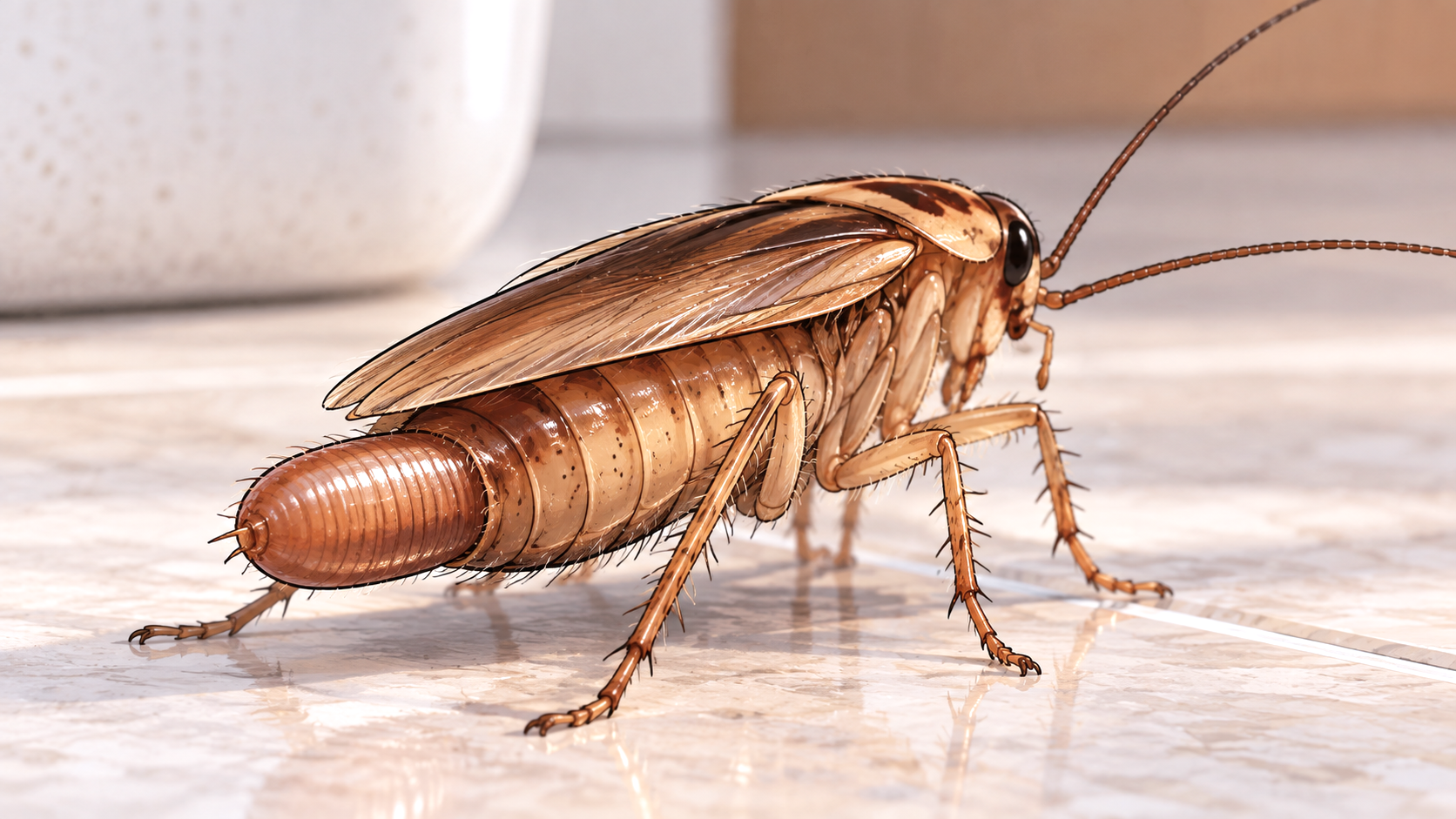
The clearest sign that a cockroach is carrying developing eggs is a small, elongated egg case protruding from the rear of its abdomen. This is particularly noticeable in female German cockroaches, which retain their egg cases until shortly before the young hatch. However, many other cockroach species deposit their egg cases much earlier, making their reproductive status difficult to determine from appearance alone.
A swollen abdomen does not necessarily indicate that a cockroach is carrying eggs, and the absence of a visible egg case does not establish that a female is not reproducing. The reliability of the signs depends heavily on the species involved.
What Does a Pregnant Cockroach Look Like?
A German cockroach carrying an egg case has a distinctive appearance. The insect’s ordinary abdomen ends in a brown or yellowish-brown capsule that projects backward from the body. The capsule is usually approximately 8 millimeters long, making it conspicuous compared with the adult’s relatively small size.
The University of Florida’s German cockroach identification guidance includes photographs of females carrying these capsules. The egg case, called an ootheca, remains attached near the genital chamber at the end of the abdomen.
An observer can often recognize the arrangement without magnification because the capsule looks like an additional structure extending beyond the insect’s normal body outline. It has a defined shape rather than the flexible appearance of abdominal tissue.
The visible signs differ among species:
| Cockroach | Visible reproductive sign | Can appearance confirm egg carrying? |
|---|---|---|
| German cockroach | Egg case protruding from the abdomen | Yes, while the capsule is attached |
| American cockroach | Egg case may protrude briefly | Yes, during the short carrying period |
| Oriental cockroach | Egg case may be visible before deposition | Yes, if the case is exposed |
| Brown-banded cockroach | Enlarged abdomen or briefly attached egg case | Attached case confirms egg production; swelling alone does not |
| Smokybrown cockroach | Temporarily visible egg case | Only during the carrying period |
A cockroach photographed from above may conceal part of the capsule beneath its wings or abdomen. A side or rear view is sometimes necessary to determine whether the projecting object is an egg case.
German Cockroaches Are the Easiest to Recognize While Carrying Eggs
Female German cockroaches (Blattella germanica) retain their oothecae for most of embryonic development. They generally release the capsules shortly before hatching, although nymphs sometimes emerge while the cases remain attached.
This extended carrying behavior makes the species unusually easy to recognize during that reproductive stage.
According to Rutgers University’s German cockroach profile, the ootheca is visible at the posterior end of the female. The capsule is approximately 8 millimeters long, 3 millimeters high, and 2 millimeters wide.
The protruding capsule may be mistaken for part of the abdomen when the cockroach is observed briefly. However, its distinct outline and attachment point can usually be recognized in a sharp photograph.
A German cockroach without a visible capsule may still be reproductively active. She could be between egg cases, developing another capsule internally, or have recently released one.
Because German cockroach eggs develop over several weeks, an attached case may remain visible through a substantial part of the female’s reproductive cycle. Its presence confirms egg carrying but does not reveal the exact stage of embryonic development.
Why American Cockroaches Rarely Have Visible Egg Cases
American cockroach females (Periplaneta americana) also form oothecae, but they retain them for a much shorter period.
Virginia Tech’s American cockroach description reports that females carry their egg cases for approximately two days before placing them in protected locations.
A female may therefore be observed with an egg case protruding from her abdomen, but that appearance is relatively temporary.
Once the capsule has been deposited, the female’s body no longer displays an obvious external sign of that particular egg case. She may subsequently produce additional capsules, but ordinary visual inspection cannot establish where she is within the next reproductive cycle.
The University of Florida’s account of American cockroach reproduction confirms that females deposit formed oothecae rather than carrying them throughout incubation.
Consequently, an American cockroach without an attached capsule cannot be classified as nonreproductive from appearance alone.
The same general limitation applies to Oriental cockroaches and several other species that release their egg cases relatively early.
Does a Swollen Cockroach Abdomen Mean It Is Pregnant?
An enlarged abdomen can accompany egg production, but swelling alone is unreliable.
The most striking example occurs in brown-banded cockroaches (Supella longipalpa). Oklahoma State University reports that reproductive females can develop markedly enlarged abdomens. Females of this species carry the egg capsule for approximately 24–36 hours before attaching it to a surface.
The Oklahoma State University brown-banded cockroach account describes this conspicuous abdominal enlargement.
However, abdomen width can vary for reasons unrelated to the presence of developing eggs. Individual body proportions, feeding condition, hydration, and developmental abnormalities may affect appearance.
A recently fed cockroach can also appear more distended than one that has gone without food.
The abdomen may become visibly altered during reproductive development, but identifying its internal contents requires more than a photograph of its exterior.
A swollen cockroach should therefore be described as possibly gravid rather than definitely carrying eggs unless an attached ootheca or another reliable sign is present.
Can a Cockroach Be Carrying Eggs Without Showing an Egg Case?
Yes. An egg case is not continuously visible throughout the reproductive process.
Before an ootheca is formed and extruded, developing eggs remain within the female’s reproductive system. Once a capsule has been deposited, the female may have no external indication that she recently produced it.
Even in German cockroaches, whose capsules remain attached for much longer, a female may be observed during the interval between successive cases.
The University of California, Riverside’s examination of cockroach reproduction documents substantial differences between species in how long females retain their egg cases.
The absence of a visible capsule is therefore evidence only that one is not externally apparent at the moment of observation.
The number of possible reproductive cycles also differs by species. Cockroach egg production over a female’s lifetime can involve several separate oothecae rather than one continuous episode of egg carrying.
Is the Word Pregnant Correct for Cockroaches?
For familiar household cockroaches, gravid is generally the more precise term for a female carrying developing eggs. A female visibly carrying an ootheca can be described as an ootheca-bearing female.
Most common pest cockroaches are oviparous, meaning they reproduce through eggs enclosed within capsules. Their reproductive biology differs from mammalian pregnancy, so using pregnant without qualification can create confusion.
There is an important exception among cockroaches.
The Pacific beetle-mimic cockroach (Diploptera punctata) gives birth to live young. Its embryos develop within a maternal brood sac and receive nutrition from the mother through specialized secretions.
A study published in Frontiers in Physiology describes the molecular mechanisms of pregnancy and live birth in Diploptera punctata. In this species, pregnancy is an appropriate biological description because the young are retained and nourished internally throughout development.
A female D. punctata does not display the same protruding external ootheca characteristic of a gravid German cockroach. Her reproductive condition cannot be diagnosed reliably by looking for a capsule at the abdominal tip.
For ordinary household identification, calling a female gravid avoids confusing external egg-case carrying with true live-bearing reproduction.
Can You Tell if a Cockroach Is About to Lay an Egg Case?
There is no dependable external countdown for predicting exactly when a female will produce or deposit an ootheca.
In German cockroaches, a visible capsule establishes that the egg case has already formed. It does not establish whether hatching is imminent without additional information about its developmental age.
In brown-banded and American cockroaches, an attached capsule may indicate that the female is approaching the time when she normally deposits it. However, the length of the carrying period varies among species, and an isolated sighting cannot establish when the capsule first appeared.
A female with an enlarged abdomen but no external capsule is even more difficult to assess. Her appearance cannot reliably reveal whether an egg case will be produced within hours, days, or at all.
The species-dependent behavior involved in cockroach egg-case deposition influences what can be inferred from observing a female, but external appearance is not a precise measure of reproductive timing.
Does an Attached Egg Case Mean the Cockroach Has Fertilized Eggs?
Not necessarily.
An ootheca is evidence of egg-case production, but it does not independently establish that every egg inside is fertilized or viable.
The University of California, Riverside’s account of German cockroach reproduction reports that unmated females can form egg cases, although those cases ordinarily do not produce viable offspring.
A visible ootheca should therefore not be treated as absolute proof that living nymphs will emerge.
The distinction becomes relevant when examining a single captured cockroach. Its attached capsule establishes the female’s reproductive condition, but not the outcome of the eggs.
Determining egg viability generally requires evidence beyond the female’s appearance, such as observations of successful development or hatching under appropriate conditions.
How to Check a Cockroach’s Reproductive Status From a Photograph
The best photograph shows the entire insect from above with a clear view of the rear abdomen. A second image taken from the side can reveal a capsule obscured by the body.
Look for a rigid, elongated structure projecting from the abdominal tip rather than relying on the apparent width of the insect. The capsule should have a defined boundary separating it from the surrounding abdominal tissue.
If the object is a German cockroach, an external ootheca is strong evidence that the female is carrying eggs. For species that deposit their capsules soon after formation, the same photographic evidence may be unavailable during most of adulthood.
A capsule found separately from the insect is not proof that a particular nearby female produced it. Cockroach egg cases can be deposited or attached in different locations, and an empty capsule may remain after the producing female has disappeared.
When the abdomen looks swollen but no ootheca is visible, the photograph cannot establish whether the cockroach is gravid. A confident assessment should be limited to what is actually observable, rather than interpreting body thickness as confirmation of pregnancy.